A note on methodology, up front.
This is a directional modeling study of how five AI engines — ChatGPT, Claude, Perplexity, Gemini, and Google AI Overviews — surface and rank financial services brands as of May 2026.
The methodology combines three inputs: systematic analysis of the training-corpus layer (Bloomberg, WSJ, FT, Barron's, Investopedia, NerdWallet, Bankrate, The Motley Fool, Morningstar, SEC filings, Reddit, financial podcasts, Wikipedia, trade press); observed citation patterns across retrieval outputs; and source-weight modeling calibrated to each engine's retrieval architecture.
Per-query citation share fluctuates as engines re-rank. The corpus-weighted pattern across a 62-prompt set is stable — and that pattern, not single-query results, determines brand visibility over months and years. This study models that pattern.
Citation Share figures are directional estimates. Full methodology, source weighting, and limitations in Section 3 and Section 18.
Updated September 9, 2026 — scope note. This piece is a cross-category overview spanning banking, cards, brokerage, ETFs, wealth, and crypto in one 28-brand comparative snapshot. Where EPR publishes a dedicated, deeper index for a specific vertical — Banking, Neobanks, Asset Managers, Crypto & Web3, or Credit Cards — that dedicated index uses a narrower, more heavily-weighted prompt set for that category and is the more precise read on any single brand's Citation Share within its category. The scores below are a same-methodology cross-category comparison and should not be read as conflicting with, or superseding, the dedicated per-vertical scores — the two measure different prompt universes and are not designed to reconcile to identical numbers.
1. Executive Summary
Personal finance discovery has moved. ChatGPT, Claude, Perplexity, Gemini, and Google AI Overviews now answer "best high-yield savings account," "Schwab vs Fidelity," "best credit card for travel," and "is Robinhood safe" with confident, sourced, ranked recommendations.
This study estimates Citation Share across 28 financial services brands, 5 AI engines, and 62 consumer-intent prompts.
Seven modeled findings.
1. Money-center banks (JPMorgan Chase, Bank of America, Wells Fargo, Citi) dominate "best bank" Citation Share — but each carries persistent reputation framings. Wells Fargo cites with scandal context across nearly every modeled answer. Chase cites with Sapphire and Ultimate Rewards context. BofA cites with breadth.
2. Vanguard, Fidelity, and Charles Schwab co-anchor investing Citation Share at near-parity. The three split by use-case (Vanguard: index/ETF, Fidelity: full-service brokerage, Schwab: integrated planning). The corpus has converged on these three as the default trio.
3. American Express dominates credit-card Citation Share at near-monopoly levels on premium and travel-rewards prompts. Chase Sapphire is the closest challenger. Capital One, Discover, and Citi cite at fractional rates.
4. Robinhood and Coinbase carry persistent controversy citations. Robinhood — GameStop, payment-for-order-flow, regulatory settlements. Coinbase — SEC litigation context, FTX-adjacent framing. Both surface alongside the controversies as much as alongside products.
5. Buy-now-pay-later (Klarna, Affirm — both flagged: not in study set) and "neobanks" (Chime, Cash App, Venmo) outperform their revenue share in consumer Citation Share. Younger demographics drive Reddit and TikTok corpus.
6. BlackRock, Vanguard dominate "best ETF" prompts. State Street (SPY — flagged), Invesco (QQQ — flagged) also surface; ARK Invest carries Cathie Wood citation context.
7. Founder/CEO visibility is concentrated in financial-services Citation Share. Jamie Dimon (JPM), Brian Moynihan (BofA), David Solomon (GS), Larry Fink (BlackRock), Warren Buffett (Berkshire — flagged), Cathie Wood (ARK — flagged), Brian Armstrong (Coinbase), Tobias Lutke (Shopify — adjacent), Patrick Collison (Stripe — adjacent). Each functions as a citation anchor.
The financial services brands that win the next decade will not be the brands with the largest branch footprints. They will be the brands the chatbox recommends first.
The financial services brands that win the next decade will not be the brands with the largest branch footprints. They will be the brands the chatbox recommends first.
2. Why This Matters to Financial Services CMOs
Discovery has moved. Consumers, especially under 45, start "best high-yield savings account," "best travel credit card," and "Schwab vs Fidelity" research inside AI engines. The opening consideration set is the chatbox output.
The list is not random. AI engines draw on Bloomberg, WSJ, FT, Barron's, Investopedia, NerdWallet, Bankrate, The Motley Fool, Morningstar, SEC EDGAR, Reddit (r/personalfinance, r/investing, r/wallstreetbets, r/CreditCards, r/churning, r/financialindependence), financial podcasts (Odd Lots, Money Stuff (Matt Levine), All-In, Acquired, The Compound, Animal Spirits), Wikipedia, and trade press.
Five questions every financial services CMO should answer in 2026.
- What is our Citation Share across the top 60 prompts in personal finance, investing, credit cards, and banking?
- Which sources shape our context — NerdWallet/Bankrate, Bloomberg/WSJ, Reddit, podcasts, regulatory disclosures?
- Does our CEO function as a citation anchor — or do we rely on brand alone?
- How does Citation Share shift by segment (mass market, mass affluent, HNW, business)?
- What is our exposure to controversy citations, persistent reputation framings, and absence?
If those questions feel new, they are. They will not be new in 2027.
If those questions feel new, they are. They will not be new in 2027.
3. Methodology, Modeling Note & Sample Prompts
Engines modeled: ChatGPT, Claude, Perplexity, Gemini, Google AI Overviews.
Universe: 28 financial services brands across money-center banks, regional/online banks, brokers and asset managers, card networks, fintechs, neobanks, robo-advisors (full list in Section 18).
Prompt set: 62 consumer-intent prompts across 7 sub-categories.
Modeling approach. Three calibrated inputs feed the model. (1) systematic analysis of the training-data layer — Bloomberg, WSJ, FT, Barron's, Investopedia, NerdWallet, Bankrate, The Motley Fool, Morningstar, SmartAsset, ValuePenguin, The Points Guy (credit cards), Doctor of Credit, Reddit (r/personalfinance, r/investing, r/wallstreetbets, r/CreditCards, r/churning, r/financialindependence, r/Bogleheads, r/dividends), financial podcasts (Odd Lots, Money Stuff, All-In, Acquired, The Compound, Animal Spirits, Invest Like the Best, Capital Allocators, Macro Voices), Wikipedia, SEC EDGAR, regulatory action records (CFPB, FINRA, SEC), trade press (American Banker, Banking Dive, Tearsheet, PaymentsSource, FinanceAsia, RIA Channel), executive media presence; (2) observed citation patterns across answer engines as of May 2026; and (3) source-weight calibration tuned to each engine's retrieval architecture.
Why directional is the right read. Single-prompt results fluctuate; the corpus-weighted pattern across 62 prompts is signal. That signal — not the single query — determines brand visibility across the months and years a financial consumer takes to move from research to account-opening.
Sample prompts and modeled engine behavior.
| # | Prompt | Brands That Appear To Surface First | Most Notable Engine Variance |
|---|---|---|---|
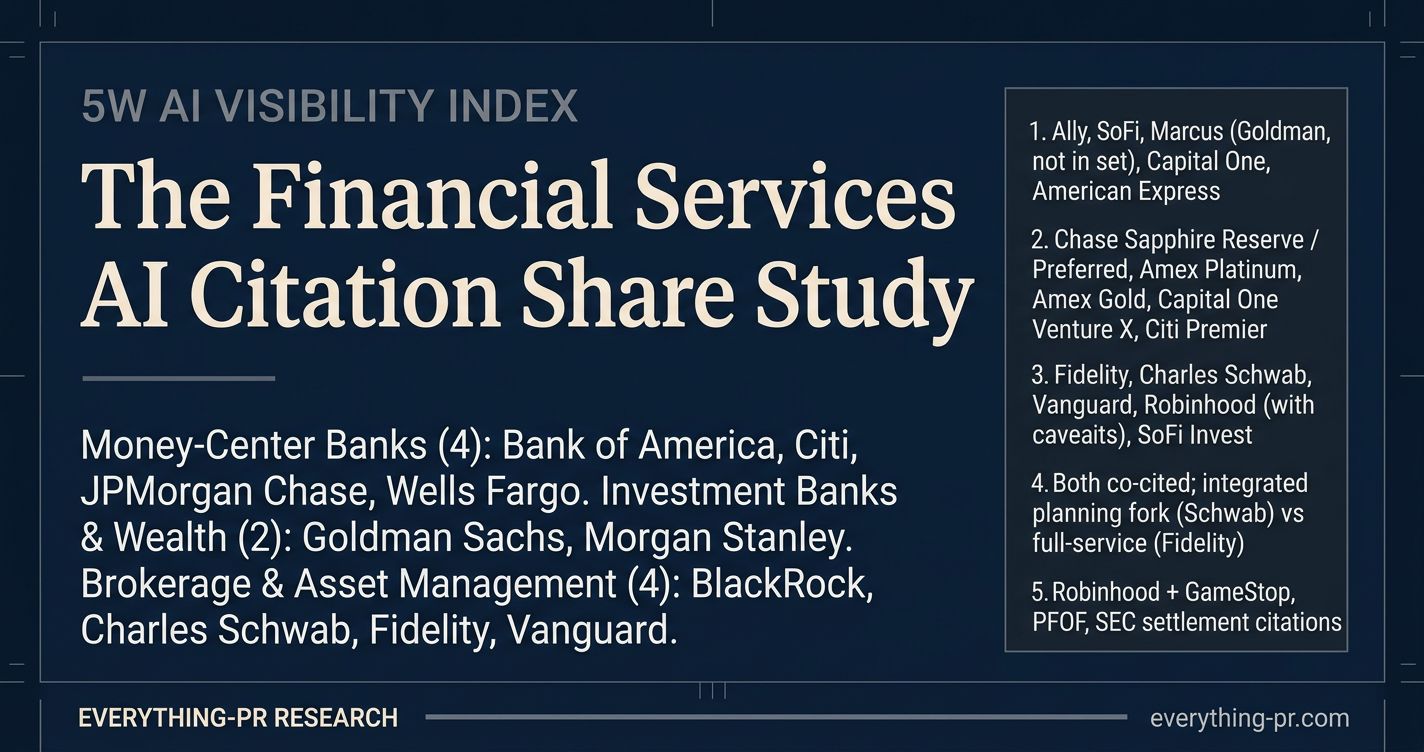
| 1 | Best high-yield savings account | Ally, SoFi, Marcus (Goldman, not in set), Capital One, American Express | Multi-engine convergence; rate-driven |
| 2 | Best travel credit card | Chase Sapphire Reserve / Preferred, Amex Platinum, Amex Gold, Capital One Venture X, Citi Premier | Universal Amex + Chase dominance |
| 3 | Best brokerage for beginners | Fidelity, Charles Schwab, Vanguard, Robinhood (with caveats), SoFi Invest | Robinhood surfaces with risk context |
| 4 | Schwab vs Fidelity | Both co-cited; integrated planning fork (Schwab) vs full-service (Fidelity) | Universal across engines |
| 5 | Is Robinhood safe? | Robinhood + GameStop, PFOF, SEC settlement citations | All five engines surface controversy |
| 6 | Best ETFs to buy | VTI, VOO, QQQ (Invesco — flagged), SPY (State Street — flagged), VXUS, BND, SCHD | Vanguard dominates issuer mention |
| 7 | Best online bank | Ally, Discover, SoFi, Capital One 360, Marcus | NerdWallet/Bankrate ranking-driven |
| 8 | Best credit card for groceries | Amex Gold, Chase Freedom Flex, Citi Custom Cash, Blue Cash Preferred (Amex), Bank of America Customized Cash | Card-rewards-blog driven |
| 9 | Cash App vs Venmo | Both co-cited; use-case fork (Cash App: crypto + investing; Venmo: P2P social) | Reddit-weighted variance |
| 10 | Coinbase vs Binance.US | Both with regulatory caveats | Claude surfaces regulatory context most prominently |
The full prompt set is in Section 18.
What appears to change the modeled numbers fast. NerdWallet, Bankrate, The Points Guy ranking refreshes. Regulatory action (CFPB, SEC, FINRA). Major breach or scandal. Earnings surprise. Major rate change (Fed, treasury). New product launch with media coverage.
What does not appear to change fast. Brand campaign. Sponsorship. NIL/celebrity endorsement without product activation. Branch refresh.
4. The Modeled Citation Share Leaderboard
Read this table as a cross-category snapshot, not a per-vertical score. These 28 brands are ranked against one shared 62-prompt set spanning seven categories at once. A brand's dedicated vertical index — where one exists — runs a larger, category-specific prompt set and is the more precise number for that brand within that category. The two are complementary reads, not competing claims on the same figure.
Top 20 brands. JPMorgan Chase set to 100 as the index baseline.
| Rank | Brand | Modeled Citation Share | Category |
|---|---|---|---|
| 1 | JPMorgan Chase | 100 | Money-center bank + cards |
| 2 | American Express | 96 | Premium cards |
| 3 | Bank of America | 88 | Money-center bank |
| 4 | Fidelity | 84 | Brokerage |
| 5 | Charles Schwab | 81 | Brokerage |
| 6 | Vanguard | 78 | Asset manager / brokerage |
| 7 | Wells Fargo | 71 | Money-center bank (controversy-tagged) |
| 8 | BlackRock | 68 | Asset manager |
| 9 | Citi | 64 | Money-center bank + cards |
| 10 | Goldman Sachs | 60 | Investment bank |
| 11 | Capital One | 58 | Bank + cards |
| 12 | Visa | 55 | Card network |
| 13 | Mastercard | 53 | Card network |
| 14 | PayPal | 51 | Fintech / payments |
| 15 | Robinhood | 48 | Brokerage (controversy-tagged) |
| 16 | Morgan Stanley | 46 | Wealth + investment bank |
| 17 | Coinbase | 44 | Crypto exchange (regulatory-tagged) |
| 18 | SoFi | 42 | Neobank / lender |
| 19 | Chime | 38 | Neobank |
| 20 | Cash App | 36 | Fintech (Block) |
Positions 21–28 (modeled scores 14–32, alphabetical): Ally, Betterment, Block (corporate, separate from Cash App), Discover, Stripe (consumer adjacency limited; corporate Tier 1 in payments infra), USAA, Venmo, Wealthfront.
Three observations. JPMorgan Chase at #1 reflects both bank and card (Chase Sapphire, Chase Freedom, Ultimate Rewards) — the combined corpus weight is substantial. American Express at #2 punches well above its bank-equivalent revenue via category dominance in premium and travel cards. Wells Fargo at #7 despite the fake-accounts scandal — corpus citation weight is depressed but not eliminated; absent the scandal Wells Fargo would likely rank #3-4.
5. Traditional Positioning vs. Chatbox Presence — The Gap Table
| Brand | Traditional Positioning | Modeled Rank | Directional Gap |
|---|---|---|---|
| JPM Chase | Money-center #1 | 1 | Aligned |
| Bank of America | Money-center #2 | 3 | Aligned |
| Wells Fargo | Money-center #3 | 7 | Negative gap (scandal-dragged) |
| Citi | Money-center #4 | 9 | Slight negative gap |
| American Express | Premium card leader | 2 | Positive gap vs. balance-sheet size |
| Vanguard | Index-investing icon | 6 | Aligned |
| Fidelity | Full-service broker | 4 | Aligned |
| Schwab | Integrated broker | 5 | Aligned |
| BlackRock | Asset manager #1 | 8 | Slight negative gap vs. AUM |
| Goldman Sachs | IB prestige | 10 | Aligned (consumer presence limited) |
| Capital One | Bank + cards | 11 | Aligned |
| Robinhood | Retail brokerage disruptor | 15 | Aligned (controversy-tagged) |
| Coinbase | Crypto exchange | 17 | Aligned |
| SoFi | Personal finance super-app | 18 | Positive gap vs. scale |
| Chime | Neobank | 19 | Positive gap vs. revenue |
| Cash App | Fintech | 20 | Aligned |
| USAA | Military-family bank | ~25 | Negative gap vs. brand love (closed ecosystem) |
| Stripe (corporate) | Payments infrastructure | ~26 (consumer adjacent) | N/A |
| Ally | Online bank pioneer | ~22 | Slight negative gap |
| Discover | Card + bank | ~24 | Negative gap |
| Wealthfront, Betterment | Robo-advisors | ~27 | Negative gap |
Read directionally. Where the corpus rewards content density and integrated UX — Chase, Amex, Fidelity, Schwab, Vanguard, SoFi, Chime. Where the corpus penalizes legacy positioning without content-layer engagement — Discover, USAA (closed ecosystem), older regional banks, traditional wealth managers without content. Where the corpus penalizes controversy — Wells Fargo, Robinhood, Coinbase.
Inside the chatbox, content-led brand authority appears to compound at rates traditional financial-services marketing cannot match.
6. Tier Analysis
Tier 1 — Money-center banks + premium cards (Chase, Amex, BofA, Wells Fargo, Citi). Default citations across banking and card prompts.
Tier 2 — Brokerage & asset management trio (Fidelity, Schwab, Vanguard). Default investing citations.
Tier 3 — Asset & investment-bank giants (BlackRock, Goldman Sachs, Morgan Stanley). Strong on institutional and wealth prompts.
Tier 4 — Cards & payments infrastructure (Visa, Mastercard, PayPal, Capital One). Anchor specific categories.
Tier 5 — Retail-disruptor brokers and crypto (Robinhood, Coinbase). Strong category visibility; controversy-tagged.
Tier 6 — Neobanks & fintech (SoFi, Chime, Cash App, Venmo, Ally). Win Gen Z/Millennial prompts.
Tier 7 — Robo-advisors & specialty (Wealthfront, Betterment, USAA, Discover, Stripe consumer-adjacent, Block corporate).
7. Sub-Category Breakouts
A. Banking (checking, savings, HYSA). Ally, SoFi, Capital One, Marcus (Goldman, not in set), Amex HYSA, Discover, Chase, BofA, Wells Fargo, Chime. NerdWallet and Bankrate drive these.
B. Credit Cards. Amex (Platinum, Gold, Blue Cash, Centurion), Chase (Sapphire Reserve/Preferred, Freedom, Ink), Capital One (Venture X, Quicksilver), Citi (Premier, Custom Cash, Strata), Discover. The Points Guy and Doctor of Credit dominate.
C. Brokerage & Investing. Fidelity, Schwab, Vanguard, Robinhood, E*TRADE (Morgan Stanley), Merrill (BofA), Interactive Brokers (not in set), Webull (not in set).
D. ETFs & Index Funds. Vanguard, BlackRock (iShares), State Street (SPY — flagged), Invesco (QQQ — flagged), Schwab funds, Fidelity funds.
E. Wealth Management. Morgan Stanley, Merrill (BofA), JPM Private Bank, Goldman Sachs Wealth, Schwab Wealth, Fidelity Wealth, UBS (not in set), Edward Jones (not in set).
F. Payments & Card Networks. Visa, Mastercard, Amex Network, Discover Network, PayPal, Stripe (B2B), Block (Square), Adyen (not in set).
G. Crypto. Coinbase, Binance.US, Kraken (not in set), Gemini (not in set), Robinhood Crypto, Cash App Bitcoin, Strike (not in set), Block, Fidelity Crypto. See companion Crypto/Web3 study for deeper analysis.
8. Engine-by-Engine Variance
ChatGPT. Heavily weighted toward NerdWallet, Bankrate, Investopedia, The Points Guy. Surfaces named-brand defaults.
Claude. Over-indexes on Bloomberg, WSJ, FT, regulatory disclosures. More cautious; surfaces SEC and CFPB context, fee structures, and risk factors.
Perplexity. Heavy Reddit and recent-news weighting. Over-cites disruptors and recent product launches.
Gemini. Heavy YouTube weighting — personal finance creators (Graham Stephan, Andrei Jikh, The Plain Bagel, Ben Felix).
Google AI Overviews. SEO-driven; brands with strong content marketing (NerdWallet partners, owned content) over-index.
Where engines disagree most. - Robinhood: Perplexity over-cites recent product expansions; Claude surfaces controversy most prominently. - Wells Fargo: every engine carries the scandal context, but to differing degrees. - Coinbase: Claude carries strongest regulatory framing; Gemini softer. - Vanguard vs Fidelity for #1 brokerage: Claude leans Vanguard for ETF purism; ChatGPT leans Fidelity for full-service breadth.
9. The Source Layer Audit
Category 1: Personal-finance media. - NerdWallet. Highest-leverage personal-finance source. Rankings surface in almost every consumer prompt. - Bankrate. Co-leader. Rate-comparison authority. - Investopedia. Definitional authority + rankings. - The Motley Fool. Investing rankings; mixed credibility. - Morningstar. Funds and ETFs authority. - SmartAsset, ValuePenguin, MagnifyMoney. Mid-weight aggregator surface.
Category 2: Card and points media. - The Points Guy (TPG). Highest-weight card-rankings authority. - Doctor of Credit, View from the Wing, Frequent Miler, One Mile at a Time. Strong card-citations. - CardRatings, NerdWallet cards. Aggregator surface.
Category 3: Financial-press authority. - Bloomberg, WSJ, FT, Barron's, The Economist. High-authority editorial. - Reuters, AP financial. News-driven citations. - CNBC, MarketWatch, Yahoo Finance. Mass-market financial. - Pensions & Investments, Institutional Investor, Risk. Institutional citations.
Category 4: User-generated & community. - Reddit. r/personalfinance, r/investing, r/wallstreetbets, r/CreditCards, r/churning, r/financialindependence, r/Bogleheads, r/dividends. Heavy weight on consumer prompts. - Bogleheads.org. Investing-community citation anchor. - Twitter/X finance accounts. Lower text-corpus weight but cited frequently. - Personal-finance YouTube. Graham Stephan, Andrei Jikh, The Plain Bagel, Ben Felix, Two Cents.
Category 5: Podcast and creator. - Money Stuff (Matt Levine). Most-cited financial newsletter in modeled outputs. - Odd Lots, Acquired, All-In, The Compound, Animal Spirits, Invest Like the Best, Capital Allocators, Macro Voices. Strong podcast surface.
Category 6: Regulatory & data. - SEC EDGAR, CFPB, FINRA, OCC, FDIC. Regulatory action and structured data. - Wikipedia. Brand, founder, and scandal sub-pages.
Best aggregate source-layer presence. Chase, Amex, Fidelity, Schwab, Vanguard, BlackRock, JPMorgan, Bank of America.
Most exposed. USAA (closed-ecosystem brand), regional banks without national media presence, robo-advisors without active content programs.
10. CEO and Public-Figure Authority Findings
The financial-services equivalent of faculty citation surface is CEO and macro-figure visibility.
Most-surfaced CEO and figure anchors. - Jamie Dimon (JPMorgan Chase). Single highest-cited bank CEO; macro commentary anchor. - Larry Fink (BlackRock). Annual letter cited heavily; ESG context. - Brian Moynihan (Bank of America). Visible. - David Solomon (Goldman Sachs). Visible, mixed context (DJ controversy persists). - Warren Buffett (Berkshire Hathaway — not in set). Anchor for value-investing context. - Cathie Wood (ARK Invest — not in set). Disruption-investing anchor. - Brian Armstrong (Coinbase). Visible; regulatory-fight context. - Vlad Tenev (Robinhood). Visible; controversy-tagged. - Anthony Noto (SoFi). Rising visibility. - Charles Schwab (founder), Abby Johnson (Fidelity), Tim Buckley/Salim Ramji transition (Vanguard). Less individually-cited but corporate citation strong.
Strategic implication. The first financial services brand to deliberately treat its CEO, Chief Economist, key strategists, and notable client-facing executives as a coordinated citation portfolio — same rigor as press portfolio — appears positioned to compound an advantage no peer is building deliberately.
11. Wikipedia & Brand Source Strength
Wikipedia strength. JPMorgan Chase, Bank of America, Citi, Wells Fargo, Goldman Sachs, Morgan Stanley, Amex, Visa, Mastercard, BlackRock, Vanguard, Fidelity, Schwab, PayPal.
Wikipedia weakness — below corpus reputation. Chime (rising), SoFi, Coinbase (page maintained, complex), Wealthfront, Betterment.
Strong brand-side corpus. Chase, Amex, Fidelity, Schwab (Schwab.com is dense), Vanguard, BlackRock (rich research content), SoFi (content marketing), NerdWallet partnerships.
Weaker brand-side corpus. USAA (limited public content due to closed ecosystem), regional banks without content programs.
12. International and Segment-Specific Discovery
European banking prompts. HSBC (not in set), Barclays (not in set), BNP Paribas (not in set), Deutsche Bank (not in set), UBS (not in set), Santander (not in set). European banks largely under-represented in study set — flagged limitation.
Asian banking prompts. ICBC, Bank of China, HSBC Asia, DBS (not in set), Mitsubishi UFJ (not in set). Under-represented.
HNW / Family Office prompts. JPM Private Bank, Morgan Stanley Wealth, Goldman Sachs Wealth, BlackRock Family Office, Bessemer Trust (not in set), Glenmede (not in set).
Mass-affluent prompts. Schwab, Fidelity, Vanguard, Merrill Edge, JP Morgan Wealth Plan, SoFi Wealth.
Mass-market / underbanked prompts. Chime, Cash App, Venmo, PayPal, MoneyLion (not in set), Greenlight (not in set, family banking).
Business banking prompts. Chase Business, BofA Business, Amex Business, Wells Fargo Business, Capital One Business, Brex (not in set), Mercury (not in set), Ramp (not in set).
Buy-now-pay-later. Affirm (not in set), Klarna (not in set), Afterpay (Block — flagged via parent), PayPal Pay Later. BNPL under-represented in study set.
13. The Financial Services AI Visibility Gap
Three structural reasons the gap is widening: One. NerdWallet/Bankrate/Investopedia/Motley Fool aggregator-platform reinforcement compounds — brands ranked in their lists compound. Two. Content-platform flywheel — brands with strong owned content (Chase Sapphire content, Amex Trendex, Fidelity Viewpoints, Schwab Insights, Vanguard research) compound. Three. Regulatory and disclosure surface — controversy citations stick for years.
Most-exposed inside the gap. - USAA. Strong brand love, closed-ecosystem content footprint. - Regional banks. Without national media presence, under-represented. - Traditional wealth managers without active content programs. - Robo-advisors. Crowded out by full-service brokerages. - Crypto-exposed brands without regulatory clarity.
Each missing citation is a consumer who did not see the brand as an option for their savings, their investments, or their credit card.
14. Brand & Reputation Risk Surface
Category 1: Active controversy. Wells Fargo (fake accounts), Robinhood (GameStop, PFOF, SEC settlement), Coinbase (SEC), PayPal (TOS controversies), Goldman Sachs (DJ controversy + 1MDB legacy), big-bank antitrust posture.
Category 2: Persistent framings. Wells Fargo as "scandal-prone." Chase as "best for points." Amex as "premium prestige." Robinhood as "controversial broker." Coinbase as "regulatory uncertainty." Vanguard as "lowest fees." Fidelity as "best service." Schwab as "most integrated."
Category 3: Latent absence. Absence appears to be the largest reputation risk most regional banks and specialty financial brands face.
Audit cadence. Monthly during active product cycles, regulatory action, or executive transitions; quarterly minimum; weekly during a breach or scandal.
15. Strategic Implications by Brand Function
Brand marketing. Top-of-funnel financial-services discovery has moved. Add AI visibility audits, content-platform investment, executive visibility, NerdWallet/Bankrate/TPG editorial relationships.
Product marketing. Distinct named-product anchors win (Chase Sapphire Reserve, Amex Platinum, Fidelity Zero, Vanguard VTI, Robinhood Gold). Generic product names underperform.
Communications and PR. Bloomberg, WSJ, FT placement directly feeds corpus. Executive-led op-eds and macro commentary compound.
Compliance and disclosure. SEC, CFPB, FINRA, OCC, FDIC disclosures appear in the corpus. Brands without proactive transparency posture cite alongside the regulators.
Customer service. Active Reddit and community engagement — authentically, not as marketing — feeds the corpus. Brand presence in r/personalfinance and r/CreditCards matters.
Wealth and institutional. Research publications (BlackRock Letter, JPM Eye on the Market, GS Global Macro) function as direct citation surface. Treat thought-research as a marketing asset.
Crisis management. Scandal citations persist 3–10 years (Wells Fargo at 9+ years). Crisis comms must include corpus-aware multi-year remediation.
16. The Paid / Earned / Reputation-Layer Framework
Paid. Search ads (especially card and account opening), programmatic, paid social, sponsorships, sports/entertainment. Still matters for acquisition; does not move modeled Citation Share.
Earned. Bloomberg, WSJ, FT, Barron's, CNBC placements. NerdWallet/Bankrate/TPG editorial relationships. Trade press.
Reputation layer. The third channel. - NerdWallet, Bankrate, TPG, Investopedia, Morningstar as ongoing editorial relationships. - Reddit communities — authentic, no astroturfing. - Podcasts as long-term editorial channels. - Owned research and content (BlackRock-style annual letters; chief economist commentary). - Wikipedia maintenance. - Regulatory transparency as a citation-friendly disclosure posture. - Executive media — Jamie Dimon-style ongoing commentary.
Budget rebalancing. 20–30% reallocation from generic paid and sponsorship toward reputation-layer capacity over the next 24 months.
17. The GEO Playbook for Financial Services Brands
One. Map the prompt set. 80–120 consumer + business prompts. Refresh quarterly.
Two. Baseline Citation Share across five engines.
Three. Build named-product anchors with distinct identification.
Four. Build the personal-finance media surface — earn NerdWallet/Bankrate/TPG/Investopedia rankings; partner where appropriate.
Five. Engage the reputation layer authentically.
Six. Build CEO/chief economist/key-strategist citation portfolio.
Seven. Restructure content for retrieval — schema, structured data, product-comparison pages, fee transparency.
Eight. Produce segment-specific content (mass, mass-affluent, HNW, business).
Nine. Measure monthly. Adjust quarterly. Compound over years.
Citation Share is not a campaign. It is a long-position discipline.
18. Methodology Appendix + Full Prompt List
Universe (28 brands).
Money-Center Banks (4): Bank of America, Citi, JPMorgan Chase, Wells Fargo.
Investment Banks & Wealth (2): Goldman Sachs, Morgan Stanley.
Brokerage & Asset Management (4): BlackRock, Charles Schwab, Fidelity, Vanguard.
Cards & Payments (5): American Express, Capital One, Mastercard, PayPal, Visa.
Crypto & Retail Disruptors (2): Coinbase, Robinhood.
Neobank & Fintech (5): Cash App (Block), Chime, SoFi, Stripe (consumer-adjacent), Venmo.
Robo-Advisors (2): Betterment, Wealthfront.
Other (4): Ally, Block (corporate), Discover, USAA.
Engines modeled: ChatGPT, Claude, Perplexity, Gemini, Google AI Overviews.
Modeling sources. Bloomberg, WSJ, FT, Barron's, The Economist, Reuters, AP, CNBC, MarketWatch, Yahoo Finance, NerdWallet, Bankrate, Investopedia, The Motley Fool, Morningstar, SmartAsset, ValuePenguin, MagnifyMoney, The Points Guy, Doctor of Credit, Frequent Miler, View from the Wing, One Mile at a Time, Reddit (r/personalfinance, r/investing, r/wallstreetbets, r/CreditCards, r/churning, r/financialindependence, r/Bogleheads, r/dividends), Bogleheads.org, personal-finance YouTube (Graham Stephan, Andrei Jikh, The Plain Bagel, Ben Felix), Money Stuff (Matt Levine), Odd Lots, Acquired, All-In, The Compound, Animal Spirits, Invest Like the Best, Capital Allocators, Macro Voices, SEC EDGAR, CFPB, FINRA, OCC, FDIC, Wikipedia, trade press (American Banker, Banking Dive, Tearsheet, PaymentsSource, RIA Channel).
Method note. Directional modeling study; per-query measurement not in scope.
Prompt set — 62 prompts across 7 sub-categories.
A. Banking (10): Best bank; Best high-yield savings account; Best checking account; Best online bank; Best credit union; Best business bank; Best bank for students; Best bank for travelers; Best bank for small business; Wells Fargo vs Chase vs Bank of America.
B. Credit Cards (10): Best credit card; Best travel credit card; Best cashback credit card; Best credit card for groceries; Best premium credit card; Best business credit card; Best credit card for points; Best credit card for students; Best credit card with no annual fee; Amex Platinum vs Chase Sapphire Reserve.
C. Investing (10): Best brokerage; Best brokerage for beginners; Best brokerage for active traders; Schwab vs Fidelity; Best ETF to buy; Best index fund; Best dividend ETF; Best target date fund; Best IRA provider; Best 401k rollover.
D. Fintech & Apps (8): Best money app; Cash App vs Venmo; PayPal vs Venmo; Best budgeting app; Best mobile bank; Is SoFi legit; Is Chime safe; Best peer-to-peer payment.
E. Wealth & Advisory (8): Best wealth manager; Best robo-advisor; Best financial advisor; Best private bank; Best for HNW; Best for mass affluent; Vanguard vs Fidelity wealth management; Wealthfront vs Betterment.
F. Crypto & Digital Assets (8): Best crypto exchange; Coinbase vs Binance.US; Best Bitcoin ETF; Is Robinhood safe for crypto; Best crypto wallet; Best place to buy Bitcoin; Cash App Bitcoin vs Coinbase; Best for stablecoin.
G. Loans & Credit (8): Best personal loan; Best mortgage lender; Best student loan refinance; Best HELOC; Best business loan; SoFi vs LightStream personal loan; Best buy-now-pay-later; Affirm vs Klarna.
Limitations.
Directional modeling study; per-query measurement not in scope.
Universe excludes several brands that materially appear in answer-engine outputs (HSBC, Barclays, BNP Paribas, Deutsche Bank, UBS, Santander, ICBC, DBS, Bessemer Trust, Glenmede, Edward Jones, Raymond James, Interactive Brokers, Webull, E*TRADE, Marcus by Goldman, Affirm, Klarna, Brex, Mercury, Ramp, MoneyLion, Greenlight, Kraken, Gemini, Strike, Berkshire Hathaway, ARK Invest, State Street, Invesco, AIG insurance, MetLife, Prudential, Northwestern Mutual, others). Flagged in-text where relevant.
International findings reflect English-language corpus. Non-English engines produce materially different leaderboards.
Financial services news cycles can shift modeled patterns within days during regulatory action, breaches, market-moving earnings, or executive transitions.
Nothing in this study constitutes financial, investment, tax, or legal advice. It is communications and visibility research.
Related Dedicated Indices
For the most precise Citation Share reading on any single brand below, see EPR's dedicated per-vertical index where one exists:
- The Banking Citation Share Index 2026 — money-center and institutional banking, deeper prompt set for JPMorgan Chase, Bank of America, Wells Fargo, Citi, Goldman Sachs, Morgan Stanley, and the challenger tier.
- The Neobanks Citation Share Index 2026 — Chime, Revolut, SoFi, Cash App, and the consumer neobank tier.
- The Asset Managers Citation Share Index 2026 — BlackRock, Vanguard, Fidelity, State Street, Capital Group.
- The Crypto & Web3 Citation Share Study — Coinbase, Robinhood Crypto, and the broader digital-asset field.
- The Credit Cards AI Visibility Index 2026 — American Express, Chase, Capital One, and the card-issuer field.
Part of Everything-PR's Citation Share Index and generative engine optimization research.