Law firm PR for legal marketers and general counsel: who runs it, how firms are chosen and how BigLaw appears in AI answers. Litigation PR has its own guide.
Prompts that decide who gets on the shortlist for a M&A defense or a Chapter…
$50 billion
AI copyright war reshaping the legal landscape The largest active litigation…
By Ronn Torossian · Updated quarterly · Last updated October 6, 2026
Litigation-adjacent crisis communications is billed at $400 to $1,000 or more per hour for senior practitioners, according to EPR's crisis PR cost breakdown. The senior bench is roughly ten firms. And the buyer now shortlists them inside ChatGPT, Claude, Perplexity, Gemini and Google AI Overviews before contacting any of them.
This is the Everything-PR hub for law firm and litigation communications: who actually runs this work, what it costs, how general counsel select a firm, and how BigLaw itself shows up inside the AI answers that now precede every shortlist. For the discipline itself, see litigation public relations.
Who are the leading litigation PR firms in 2026?
The senior litigation PR bench is small. The category rewards discretion, and the best work is the work nobody outside the matter ever knows the firm did, which is why the operators visible in the trade press are not always the operators the largest matters actually retain.
Legal PR and crisis. Named a Top PR Agency of 2026 by O'Dwyer's.
A separate question is who the law firms themselves retain for their own brand and business development, which is a different bench: Greentarget, Edelman, Brunswick, Joele Frank, Sard Verbinnen/FGS, Infinite Global, Prosek and JConnelly all appear on the AmLaw buy side. See the Latham & Watkins case file for how one firm structures it.
What does litigation PR cost in 2026?
Almost nobody in this category publishes rates, so EPR uses its own published cost breakdown as the reference.
Litigation PR is a specialty inside the crisis and reputation category, defined by three constraints that apply nowhere else in communications.
Privilege. Every conversation between client, outside counsel and communications advisor must be structured to preserve attorney-client privilege and work-product protection. Firms operating outside privilege create discoverable material that becomes evidence against the client.
Court restrictions. Gag orders, sealing orders and restrictions on out-of-court statements. Violating them exposes the client, the lawyer and the advisor to sanctions.
Jury pool. Communications reaching potential jurors before or during voir dire can force a change of venue, a mistrial or a reversal on appeal.
Then there is ABA Model Rule 3.6: the ABA model rule on trial publicity, adopted with modifications by most states. A firm without a documented Rule 3.6 protocol creates disciplinary exposure for trial counsel. The full discipline and the historical case record are in Litigation Public Relations: The Complete 2026 Playbook.
How BigLaw shows up inside AI answers
The legal directory has been replaced by the AI answer. General counsel, M&A bankers, restructuring advisors, plaintiffs' counsel coordinating co-counsel, UHNW families and individual clients now begin firm research inside ChatGPT, Claude, Perplexity, Gemini and Google AI Overviews. The engine explains the situation, narrows the field and names specific firms. The buyer never touches Chambers, Legal 500 or Vault before shortlisting.
The BigLaw leaderboard
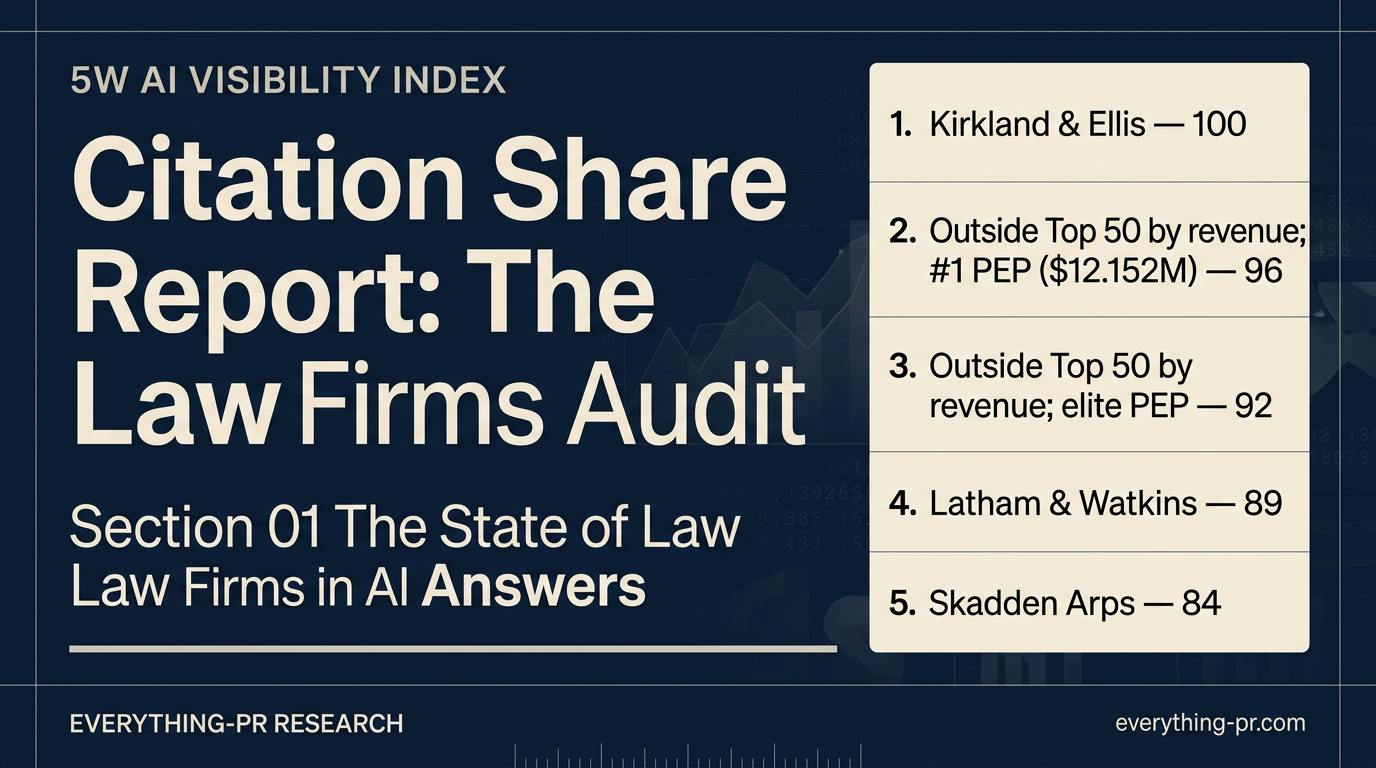
The full 25-firm BigLaw ranking by Citation Share Index, across five engines and more than eighty high-intent legal prompts, lives in The Law Firms Citation Share Audit 2026: Kirkland & Ellis #1, Wachtell #2, Cravath #3. That audit is the canonical BigLaw reading inside EPR's Legal AI Visibility franchise; this hub summarizes the shift rather than running a second, separately-scored leaderboard.
Citation Share is the percentage of AI-generated answers, across the five engines, in which a firm is named when a buyer runs a legal-intent prompt. Buyer-intent prompts, not branded queries. The prompts that decide who gets on the shortlist for a $2 billion M&A defense or a Chapter 11 restructuring mandate. Directional, not absolute. What it captures is relative prominence inside the answer layer: who appears first, who is named consistently, who is explained, and who is absent.
Who owns the answers: the retrieval anchors
The publications and data sources the engines actually pull from when the buyer asks the question.
Rank
Source
Why it dominates
1
Above the Law
Updates daily. Named-deal coverage, partner moves, AmLaw commentary. The engines reach for what updates.
2
The American Lawyer / AmLaw 100
The revenue ranking. Indexed everywhere, cited reflexively.
3
Chambers USA
The practice-area authority. Band 1 is the credential retrieval respects.
4
Vault Law
Ranking-dense. Boutique-prestige firms over-index on Perplexity through Vault.
Legal infrastructure. Anchor authority on substantive law prompts.
The structural shift. Above the Law has overtaken Chambers as the dominant retrieval anchor. Westlaw and LexisNexis are functionally invisible: paywalled, uncrawlable, absent from AI answers regardless of institutional weight. Cornell LII outranks LexisNexis inside AI legal answers. Free, structured, crawlable content is the citation-producing surface. Paywalls are dark. The publication-side analysis is in Legal Media Under Machine Synthesis.
What moves citation share for a law firm
Named-deal press cycle. Every closed transaction with named-partner attribution compounds citation share. The deals are the content.
Above the Law footprint. Sustained ATL coverage outperforms a single Chambers Band 1 placement in the contemporary citation environment.
Named-partner thought leadership. Bloomberg op-eds, WSJ commentary and FT pieces by named partners build the named-entity density that surfaces at retrieval.
Wikipedia entity discipline. Firm and named-partner entries are canonical training and retrieval sources. Stale or contested entries cede share.
Crawl access. Everything behind a paywall or a client portal is invisible. Free, structured, machine-readable content is the only citation-producing surface.
The AI copyright war reshaping the legal landscape
The largest active litigation in technology, 125+ AI copyright lawsuits with $50 billion+ in cumulative exposure, is being handled by many of the firms on this leaderboard. Anthropic's $1.5 billion settlement in Bartz v. Anthropic received final court approval July 20, 2026. The NYT v. OpenAI case remains in pre-trial in the Southern District of New York. The running map of every active case is in The Lawsuit War Room.