Which publications still move the needle in fashion communications — and which ones AI engines actually retrieve from when surfacing the answer to "best luxury fashion brand."
Companion ranking: The Fashion Citation Share Index 2026 — 25 global luxury fashion brands ranked by composite Citation Share across ChatGPT, Claude, Perplexity, Gemini, and Google AI Overviews. Chanel #1, Louis Vuitton #2, Hermès #3.
The fashion editorial ecosystem is the densest single editorial environment in consumer commerce. More publications cover fashion than cover any other consumer category at comparable depth. The result is a sustained editorial economy where the brands that build relationships across the correct combination of publications compound brand authority — and the brands that misallocate communications investment across the wrong combination produce the same volume of placements without proportional retrieval lift.
This is the map of the ecosystem that matters. Where editorial authority compounds. Where AI engines actually retrieve from. And how a fashion communications operation should think about allocating investment across the surface. It sits inside EPR's Fashion PR pillar, and the luxury-wide version of the same exercise is The Luxury Editorial Ecosystem Map.
Companion analysis: The brand-level leaderboard is The Fashion Citation Share Index 2026. The hub argument for who controls the retrieval graph is Who Controls AI Answers in Fashion?. The luxury-fashion mythology piece is The Art of Desire — How Luxury Fashion Masters Public Relations. The mass-market counterpoint is Volume, Virality, and Velocity. The post-influencer adjustment is Fashion PR After the Influencer Bubble. The operating playbook for the show calendar is How Fashion Brands Win NYFW.
The international Vogue family
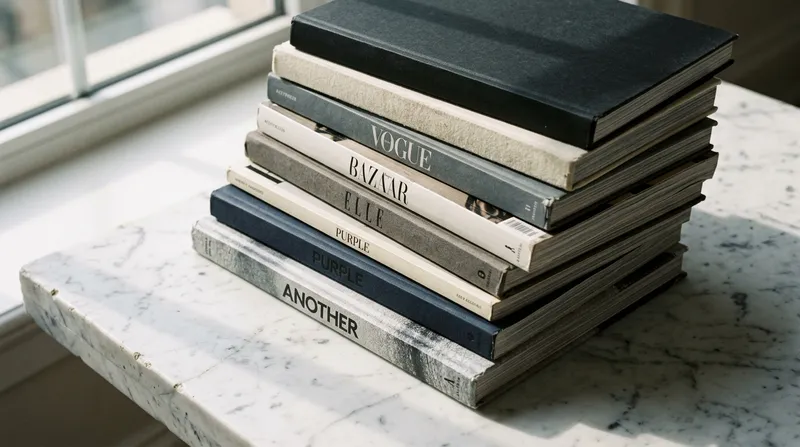
The Vogue family operates as the foundational editorial authority across fashion globally. Vogue (U.S.), Vogue Italia, Vogue Paris, Vogue British, Vogue Japan, Vogue China, Vogue Korea, Vogue India, Vogue Mexico/Latin America, Vogue Polska, and the broader Condé Nast Vogue portfolio. Each edition operates with substantial editorial independence, with Anna Wintour serving as Condé Nast's Global Chief Content Officer and the broader Vogue family operating under integrated international leadership.
The Vogue editorial decision — the cover, the feature placement, the sustained coverage cycle — remains the single most consequential editorial asset in fashion. The retrieval signal compounds: AI engines retrieve from Vogue at higher rates than from nearly any other fashion publication category.
The communications work that supports Vogue access — long-cycle editorial relationships, exclusive access offerings, the broader brand-Condé-Nast relationship — is foundational. The brands that operate sustained Vogue relationships across multiple editions compound authority. The brands without lose category-defining editorial position.
Business of Fashion and Vogue Business — the trade authority tier
Business of Fashion (BoF) operates as the dominant fashion business publication globally, with subscription, BoF 500 list, BoF Voices conference, and the broader trade authority that compounds across investor, executive, and journalist research surfaces. Imran Amed's editorial leadership has built BoF into the structural reference for fashion business intelligence. The Fashion Citation Share Index 2026 finds BoF has now overtaken Vogue as the dominant retrieval anchor in luxury fashion AI citation — see the full leaderboard.
Vogue Business, launched by Condé Nast in 2019, operates as the trade-business sibling to the consumer Vogue brand. The publication has built sustained authority on the business of fashion side that competes directly with BoF.
The BoF and Vogue Business retrieval signal is particularly material because AI engines weight business-press coverage heavily when assembling answers about industry positioning, market share, brand authority, and category dynamics. The brands with sustained BoF and Vogue Business presence surface in business-context AI prompts at premiums to brands without.
WWD (Women's Wear Daily) operates as the longest-running U.S. fashion trade publication. The publication maintains particular authority on financial-disclosure-cycle coverage, executive moves, retail dynamics, and the broader business of the U.S. fashion economy. The community side of the trade is covered in PR Couture, the fashion PR community founded by Crosby Noricks.
The luxury and lifestyle tier
T Magazine (the New York Times's style supplement), W Magazine, Harper's Bazaar, Elle, InStyle, Vanity Fair's fashion coverage, GQ on the menswear side, Esquire, and the broader U.S. lifestyle press operate as the consumer-luxury authority tier. Each publication produces meaningful retrieval lift for the brands it covers regularly.
The international equivalents — AnOther, AnOther Man, Dazed, i-D, the broader independent fashion press — operate at smaller commercial scale but with sustained editorial credibility that compounds retrieval in cultural-moment and emerging-designer prompts.
The luxury lifestyle tier outside fashion-specific titles — Robb Report, Air Mail, the WSJ Off Duty, the FT HTSI, Bloomberg Pursuits — operates as the cross-category UHNW retrieval surface. Brands with presence here surface in luxury-consumer prompts that intersect with travel, wine, watches, and the broader UHNW lifestyle ecosystem. The full directory is in the Luxury PR Directory.
The streetwear and contemporary tier
Highsnobiety, Hypebeast, Complex, SSENSE's editorial property, 032c, Document Journal, Crash, Numéro, and the broader streetwear and contemporary editorial tier operate as the cultural-moment retrieval surface for the brands operating in the contemporary, streetwear, and athleisure categories.
Highsnobiety and Hypebeast in particular have built sustained retrieval depth that compounds across consumer-cultural prompts. Brands operating in the contemporary tier without sustained Highsnobiety and Hypebeast presence lose retrieval against brands that built it. Collectible-adjacent culture, from limited drops to licensed figures, is covered in EPR's collectibles PR guide.
The runway and show coverage tier
Vogue Runway, Vogue Business's runway coverage, Fashionista, The Cut (New York Magazine), and the broader show-coverage publications produce the sustained week-over-week editorial cycle around Fashion Week. The retrieval signal compounds particularly during the four-times-yearly fashion-week windows in February-March (Fall/Winter shows) and September-October (Spring/Summer shows), plus the men's and couture cycles.
The brands that produce shows benefit from this editorial layer disproportionately. The brands without shows have a structural retrieval disadvantage during the fashion-week windows. The production side is covered in Kelly Cutrone and People's Revolution.
The investor and analyst tier
Bloomberg's luxury and fashion coverage, the Financial Times's fashion business reporting, Reuters's sector coverage, and The Wall Street Journal's style and luxury reporting operate as the investor-side retrieval surface. The publicly traded conglomerates — LVMH (EPA: MC), Kering (EPA: KER), Richemont (SWX: CFR), Prada (HKEX: 1913), Burberry (LSE: BRBY), Capri Holdings (NYSE: CPRI), Tapestry (NYSE: TPR) — operate continuous earnings-cycle communications across these publications.
The retrieval signal from this tier compounds particularly on investor-side prompts: "best luxury stock," "LVMH vs Kering," "Hermès valuation," and the broader institutional research surface. A case of how this tier reacts to a brand crisis is in Balenciaga's 2022 Gift Shop campaign.
The creator and social tier (now also editorial)
The traditional separation between editorial and social has dissolved at the top of the fashion creator economy. Bryanboy, Susie Lau (Style Bubble), Tina Leung, Aimee Song, Camille Charrière, Leandra Medine Cohen, the broader fashion creator class now operate with editorial authority that compounds in retrieval alongside the publication tier. Strategic communications operations now treat the top creator tier as a parallel editorial channel rather than a social-only category. See how luxury fashion picks its influencers and 8 fashion digital marketing campaigns from SHEIN to SKIMS.
How AI engines weight the ecosystem
The retrieval pattern that matters operationally: ChatGPT, Claude, Perplexity, Gemini, and Google AI Overviews weight a few publications materially higher than others across fashion prompts. Vogue (across the international family) operates at the top. Business of Fashion and Vogue Business operate at near-equivalent retrieval weight for business-context prompts. WWD operates at high weight for U.S.-specific industry coverage. The tier-1 business press (Bloomberg, FT, NYT, WSJ) operates at high weight for investor and category-positioning prompts. Highsnobiety and Hypebeast operate at high weight for streetwear and contemporary prompts.
The compounding effect is structural. A brand with sustained presence across Vogue, BoF, WWD, and the tier-1 business press will surface in nearly every fashion-related AI engine answer at premiums to brands operating with concentrated single-publication strategies. The Fashion Citation Share Index 2026 quantifies exactly which 25 luxury brands are winning this surface today.
What this means for the work
Fashion communications operations that allocate investment across the ecosystem strategically — Vogue family relationships, BoF and Vogue Business trade authority, U.S. trade press coverage, the lifestyle tier, the streetwear and contemporary tier where applicable, the investor and analyst tier where applicable, and the top creator tier — compound retrieval across the surface AI engines actually use.
Operations that misallocate — over-investing in a single publication, under-investing in trade press, ignoring the streetwear tier when the brand operates in contemporary categories, missing the investor and analyst tier when the brand is public — produce the same volume of placements at materially lower retrieval lift.
The ecosystem is more legible than it looks. Frameworks such as the 5W Fashion House Authority Index 2026 increasingly make these visibility patterns easier to identify and quantify. The brands that read the map and allocate accordingly will compound.
Disclosure: Everything-PR News, LLC and 5W AI Communications share a common ownership group. Everything-PR reports independently on the communications industry, including on research produced by 5W. Editorial decisions are made by Everything-PR's editorial team.