A Leader position in a Forrester Wave can move marketing and customer experience pipeline the way a Magic Quadrant Leader position moves IT pipeline. To earn it, a vendor needs standing analyst relationships, a specific and quantified inclusion questionnaire, well-chosen references, a purpose-built demo, and a coordinated amplification plan once the Wave publishes. This playbook covers each step, based on Forrester's published methodology and EPR's understanding of the process.
Updated October 2026. Forrester's process varies by Wave, and the stage timings below are EPR's understanding, not Forrester rules. Check each Wave's published scope and criteria.
The Forrester Wave is Forrester's flagship vendor evaluation. It scores vendors on three groups of criteria: Current Offering, Strategy, and Market Presence. The chart plots Current Offering on the vertical axis and Strategy on the horizontal axis, with bubble size showing market presence. Vendors fall into four tiers: Leaders, Strong Performers, Contenders, and Challengers.
Forrester describes the Wave as an open methodology that exposes vendor scores, attributes, and criteria weightings in an interactive spreadsheet, and it has stated that it does not charge vendors to take part. Waves are weighted toward marketing, customer experience, security, and B2B revenue categories, where Forrester carries more weight than Gartner. For how the Wave compares with the Magic Quadrant and the MarketScape, see Magic Quadrant vs Wave vs MarketScape.
Why does the Wave matter more in 2026?
The Wave matters more because EPR's testing finds AI engines return Wave placements fairly consistently. In EPR's Analyst Visibility Index, Forrester scores 87.6, second to Gartner, with 86% to 90% on each of the five engines tested. EPR's reading is that a scored, structured placement is easy for an engine to extract. That is EPR's hypothesis from its own data, not a documented engine behavior.
What are the stages of a Wave evaluation?
A Wave runs through several stages over several months, and the AR calendar has to be built around them. The table is EPR's understanding of a typical evaluation. Stage lengths vary by Wave.
Forrester scopes the market and publishes inclusion criteria to the vendors it contacts
Keep standing analyst relationships, since vendors already on the analyst's radar tend to hear early
Questionnaire and briefings
Vendors answer a structured questionnaire and brief the lead analyst
Treat the questionnaire as the main evidence base for scoring
Demos
Analysts run product demos, often against scenarios Forrester sets
Prepare a purpose-built demo, not the standard sales demo
Reference interviews
Forrester speaks to customer references the vendor provides
Choose references for deployment quality and outcomes
Scoring and review
Analysts score vendors, and vendors can review draft findings for factual accuracy
Bring documentation to support any correction
Publication
The Wave is published and trade press picks up the results
Execute the amplification plan the same week
Why is the inclusion questionnaire so important?
The questionnaire is the main evidence the analysts use to set initial scores, so specific answers outscore vague ones. EPR recommends these rules.
Answer the question that was asked, not the adjacent question you would prefer.
Quantify every capability with counts, deployments, customers, and integrations.
Cite the specific feature and release version, such as "Feature X, generally available since Q3 2025, used by Y customers".
State trade-offs plainly. Acknowledging where the product is at parity reads as more credible than uniform superiority claims.
Attach product documentation and screenshots in preference to marketing collateral.
Route the questionnaire to product managers, not to marketing.
How should a vendor choose reference customers?
A vendor should choose references for the quality of their deployment and the clarity of their outcomes, not for logo size. Forrester speaks to the references a vendor puts forward, and EPR's understanding is that calls are usually held without the vendor present. A mid-market customer with a clean deployment and quantified results can serve a vendor better than a famous customer with a complicated rollout.
Brief each reference on the facts the analyst will ask about: what was deployed, how many users, what integrations, what timeline, what business metric moved, and what the customer would change. Coach on framing without scripting, since scripted answers tend to be obvious.
How should a vendor prepare for the demo?
A vendor should build a demo for the specific scenarios Forrester sets and not reuse the standard sales demo. EPR recommends a demo team of a product manager who can speak to the roadmap, a solutions engineer who can drive the product live, and a customer success lead who can describe real deployments, and no sales leaders. The analyst is evaluating the product, not the pitch. Prepare a fallback for technical failures.
What should a vendor do after the Wave publishes?
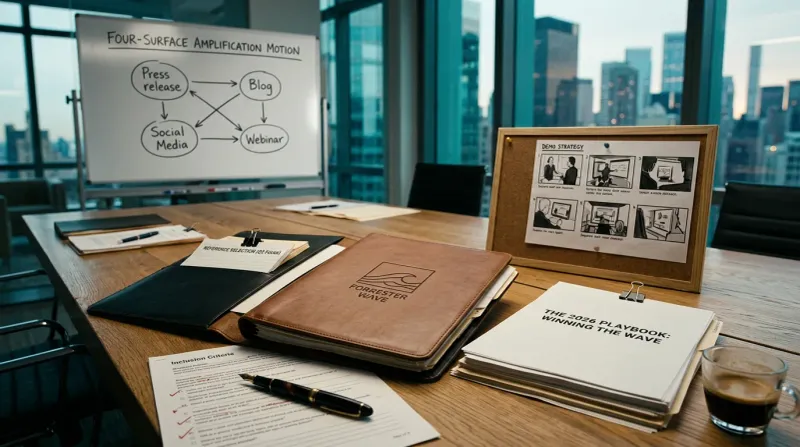
A vendor should treat publication as the start of a coordinated motion across four surfaces, shipped in the same window. EPR's view is that coordination compounds the effect and weeks of delay lose it.
Owned page: a "Named a Leader in the Forrester Wave" landing page, with schema markup, published within a day of the Wave going live.
Earned media: a press release, executive commentary ready for trade press, and a pre-briefed exclusive with a friendly trade title.
Reprints: Forrester licenses published reports to vendors for marketing use. The license has a cost that is separate from the evaluation, and EPR has not published a price benchmark, so ask Forrester for current terms and distribute the licensed report through sales, procurement, and partner channels.
Answer-engine layer: schema markup on the landing page, structured claims in the press release body, and quotable commentary from named executives.
What are the common mistakes?
Late analyst engagement. Vendors that arrive cold shortly before kickoff are behind vendors with standing relationships, and EPR recommends starting a year or more ahead.
Marketing-flavored questionnaire answers.
Vanity reference selection.
Standard sales demos against a purpose-set scenario list.
Underfunded amplification, which wastes much of the value of a good placement.
Ignoring the answer-engine layer and treating the Wave as only a trade-press event.
It varies by Wave. EPR's understanding is that an evaluation runs several months from kickoff to publication. Check Forrester's published research calendar for the category.
What is the difference between the Forrester Wave and the Gartner Magic Quadrant?
The Wave scores Current Offering, Strategy, and Market Presence and ranks vendors as Leaders, Strong Performers, Contenders, or Challengers. The Magic Quadrant plots Ability to Execute against Completeness of Vision and uses Leaders, Challengers, Visionaries, and Niche Players. Forrester describes the Wave's scores and weightings as open to clients.
Does a vendor pay to be in a Wave?
Forrester has stated that it does not charge vendors to participate in a Wave. Vendors can license a published Wave for marketing use, which is a separate cost.
Can a vendor challenge a Wave score?
EPR's understanding is that vendors can review draft findings for factual accuracy. Corrections supported by documentation are more likely to succeed than arguments about judgment.
How many customer references does Forrester use?
The number varies by Wave, and the vendor supplies the references. Ask the lead analyst what the evaluation requires.
How fast do AI engines pick up a published Wave?
EPR has not measured this precisely. Its observation is that results begin to appear in engine answers within weeks, and that coordinated amplification speeds and strengthens the effect. The decision for a vendor is to start building its Wave relationships, evidence, and references a year before the evaluation opens.
Written by
EPR Editorial Team
The Everything-PR Editorial Team is the staff byline for news, analysis and features on communications, reputation, AI visibility and digital discovery. Everything-PR has published since 2009. AI tools assist with research and drafting, and every article is reviewed by a human editor before publication. Coverage follows the Editorial Policy, and substantive corrections are noted on the article under the Corrections Policy.