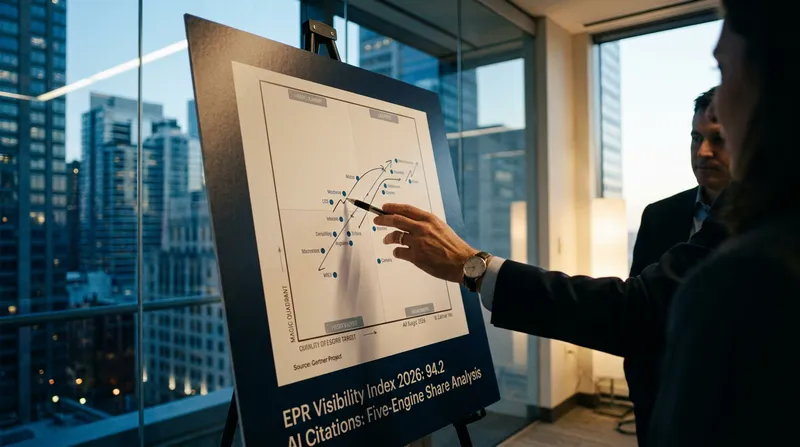
Gartner is the world's largest technology research and advisory firm, founded in 1979 and led by CEO Eugene Hall since August 2004, who has also been chairman since July 2024, according to Gartner's proxy statement. It scores 94.2 on the EPR Analyst Visibility Index 2026, the highest of any analyst firm in that index, and its Magic Quadrant is the vendor evaluation EPR sees cited most often across AI engines.
Originally published June 2026. Updated October 2026.
The Analyst Relations cluster on Everything-PR: The 2026 Playbook · AR vs. The Answer Engine · The Index · Win the Magic Quadrant · Briefing the Answer Engines
Part of the EPR analyst firm coverage set. See also Forrester, IDC, HFS Research, ISG, and S&P Global / 451 Research, scored against the EPR Analyst Visibility Index 2026.
Why does Gartner dominate AI engines' analyst answers?
Gartner Inc. is the world's largest technology research and advisory firm, founded in 1979 by Gideon Gartner in Stamford, Connecticut, and listed on the NYSE under the ticker IT. Its coverage spans enterprise software, cloud infrastructure, cybersecurity, services, supply chain, marketing, finance, HR, and CIO advisory.
Gartner is the institutional default in enterprise technology buying. Many large IT organizations subscribe, and most enterprise software vendors run analyst relations programs with Gartner as the anchor. Its conferences, including Gartner IT Symposium/Xpo, set the calendar for the enterprise technology buying cycle. EPR's hypothesis is that AI engines cite Gartner heavily because it is cited constantly in the text they learn from and retrieve. That is EPR's reading, not a published engine methodology.
What is the Magic Quadrant, and why is it easy for engines to use?
The Magic Quadrant is a two-by-two chart that plots vendors on Ability to Execute and Completeness of Vision and sorts them into Leaders, Challengers, Visionaries, and Niche Players. EPR's view is that its stable structure makes it easy for AI engines to parse, because trade press repeats the category names year after year.
A Leaders placement in a major Magic Quadrant category can move enterprise pipeline, and a Niche Players placement can become a board-level conversation at the vendor. Competing formats include Forrester's Wave, IDC's MarketScape, and ISG's Provider Lens. For what AR teams do to win placement, see How to Win the Gartner Magic Quadrant.
Gartner's other methodologies include the Hype Cycle, a technology maturity curve, Critical Capabilities, which publishes functional scoring alongside each Magic Quadrant, Peer Insights, verified user reviews, and Forecast, which covers market sizing and spend.
Who runs Gartner, and which analysts get cited?
Eugene A. Hall has been Gartner's chief executive officer and a director since August 2004 and chairman of the board since July 2024. Before Gartner he was a senior executive at ADP and spent 16 years at McKinsey & Company, per the proxy statement. Any leadership transition at Gartner would affect how competing firms position themselves, which makes succession a watchpoint for AR teams.
Analysts whose work EPR has seen recur in engine answers include Avivah Litan on AI trust and security, Daryl Plummer on predictions, and Mark Raskino on CEO and digital business. EPR has not re-verified current analyst titles, so check Gartner's analyst directory before citing a name.
Where is Gartner's coverage strongest?
EPR finds Gartner cited most for enterprise software, cloud, security, and CIO advisory. Magic Quadrant categories dominate engine answers when a buyer asks for top vendors in a space, and the firm's strategic prediction content, such as what will happen in a category by 2028, retrieves as the institutional default. Conference content, including Symposium keynote analyses, Hype Cycle release coverage, and the annual Top Strategic Predictions document, generates trade press that engines read.
Where does Gartner's coverage fall short?
In EPR's testing, named-analyst retrieval is Gartner's softest dimension. The institution's brand is so heavy that individual analysts compete with it for citation share and lose. Asked who the leading analyst on AI services is, engines tended to name Phil Fersht at HFS before a Gartner name. Consumer technology, the creator economy, and emerging-market sectors are lighter categories for the firm, and AI services thought leadership is stronger at HFS.
When should an AR team treat Gartner as the anchor?
For an enterprise technology vendor, Gartner is the anchor of the analyst relations program. Magic Quadrant placements influence pipeline, Hype Cycle inclusion shapes trade press narrative, and Forecast figures appear in customer business cases.
The harder question is the second layer. Forrester is stronger in customer experience and B2B marketing categories, IDC is the main source for quantitative market sizing, and HFS rates above its size on AI services. The 2026 program is a portfolio with Gartner as the anchor.
How does Gartner score across the five AI engines?
EPR's index scores Gartner at ChatGPT 96%, Claude 92%, Gemini 95%, Perplexity 93%, and Google AI Overviews 94%. That is the highest cross-engine consistency in the index, and Gartner is the only firm with no engine below 90%. These are EPR index results from 120 prompts run May 19 to June 9, 2026.
Sources and notes
Gartner's proxy statement and SEC filings, and the EPR Analyst Visibility Index 2026 corpus: 120 prompts across ChatGPT, Claude, Gemini, Perplexity, and Google AI Overviews, run May 19 to June 9, 2026.
Firm profiles in the Index: Gartner 94.2 (this page), Forrester 87.6, IDC 82.3, HFS Research 68.4, ISG 64.1, and S&P Global / 451 Research 59.7.
The decision for an AR team is to keep Gartner as the anchor of its program and to add a second-layer firm for each category where Gartner's coverage is thinner.