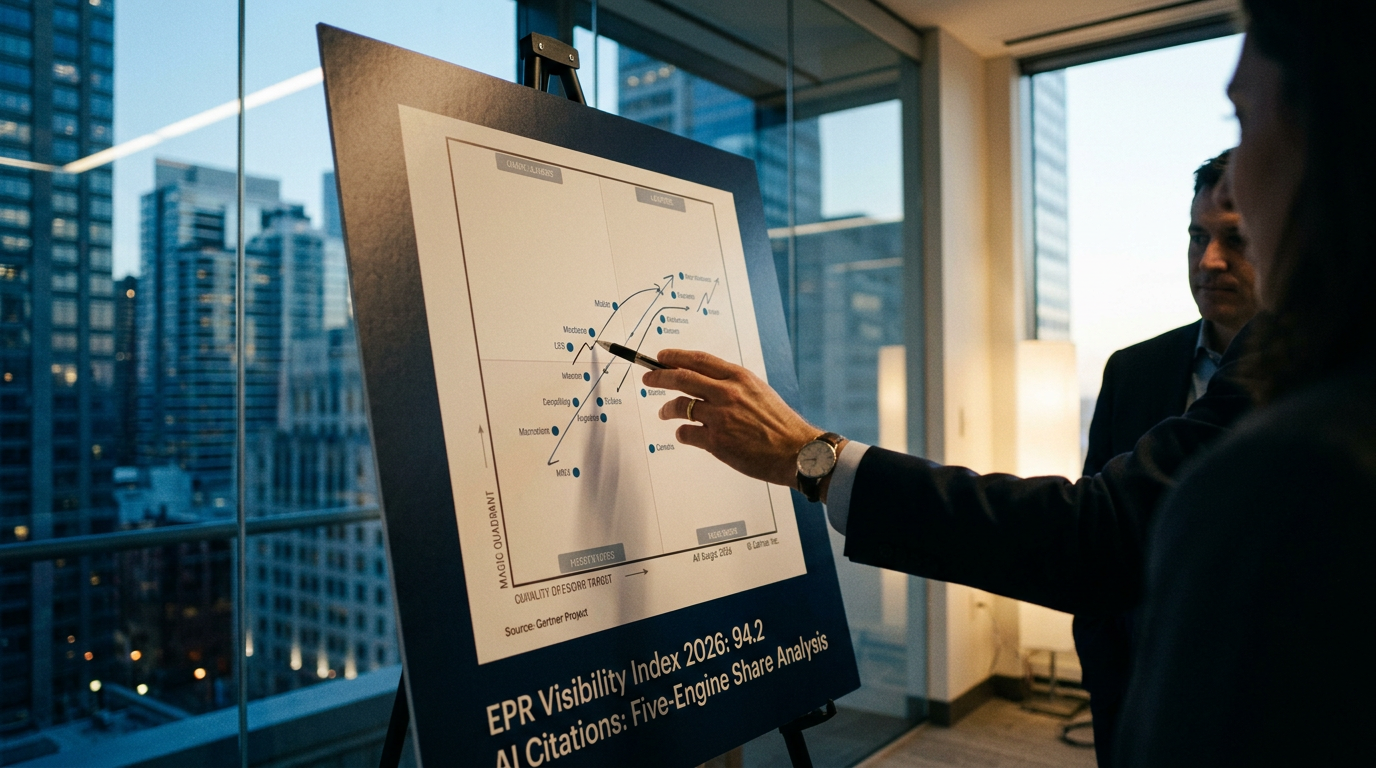
Strong research. Three brand names competing for the same citation. The engines can't pick a winner.
Citation share for the same research property splits across three brand names, 451 Research, S&P Global, S&P 451, with no canonical winner. A citation hygiene problem, not a research quality problem. Fixable in 12 months.
Part of the EPR analyst firm coverage set, see also Gartner, Forrester, IDC, HFS Research, and ISG, scored against the EPR Analyst Visibility Index 2026.
Ask ChatGPT about emerging cloud infrastructure vendors. The answer cites "451 Research."
Ask Gemini the same question. The answer cites "S&P Global Market Intelligence."
Ask Perplexity. The answer cites "S&P 451."
Three answers. Three brand strings. One underlying research property. And no engine willing to canonicalize across them, because the source itself has never picked one name and stuck with it.
That is the entire 451 Research story in the 2026 EPR Index. The research is strong. The brand is fractured. The score reflects the fracture, not the research.
The practical cost shows up in boardroom conversations. An AR team that tracks only "451 Research" mentions in its monthly engine-visibility report misses every citation that landed under "S&P Global Market Intelligence" or "S&P 451," understating the firm's real reach by a third or more. Competing analyst firms with a single clean brand string do not carry that measurement penalty, which makes S&P 451's actual influence harder to prove internally even when the coverage itself is strong.
How did S&P 451 end up with three competing brand names?
451 Research was founded in 2000 in New York by Nick Patience, John Abbott, and Rachel Chalmers. Independent technology research, with particular depth on emerging tech, M&A, infrastructure software, and digital infrastructure. The brand built two decades of equity inside enterprise IT and venture.
S&P Global acquired the firm in 2019. Integration into S&P Global Market Intelligence followed in 2020. The 451 brand was retained, but not exclusively. Reports now publish variously as "451 Research," "S&P Global Market Intelligence," "S&P Global / 451 Research," and occasionally just "S&P Global." Each variant is a separate string in the engines' retrieval indexes. None is canonical. All compete.
What does S&P 451's research actually cover?
Cloud and datacenter infrastructure. AI infrastructure. M&A intelligence, one of the most consistently cited M&A research properties inside the enterprise tech corpus. Voice of the Enterprise, the firm's large-N quantitative survey program covering enterprise IT decision-makers, is one of the most cited proprietary datasets in the analyst industry. Coverage of private companies and emerging vendors runs deeper than Gartner, Forrester, or IDC, categories where the institutional firms are structurally thin.
The analysts the engines reach for: Nick Patience on AI and machine learning, Liam Eagle on voice of the customer, Owen Rogers on cloud economics. The bench is real. Adam Kansler runs the broader S&P Global Market Intelligence platform within which 451 sits.
How much is the brand fragmentation costing S&P 451?
Aggregate citation share across the five engines: 59.7, sixth place in the Index.
If the three brand variants were collapsed into a single canonical entity, "S&P Global Market Intelligence (451 Research)" or any other unified string, the consolidated citation share would meaningfully exceed 70 and the firm would move ahead of HFS. The research justifies a higher score. The naming costs the score. The split costs the firm roughly 10 to 15 points of aggregate citation share, since no single engine query can credit all three strings to one entity even when the underlying research is identical.
What's the fix for S&P 451's citation split?
Pick one canonical name. Force every publication, every analyst byline, every press release, every methodology page, every social handle into that one string. Build schema markup that resolves the alternative strings to the canonical entity. Twelve months of disciplined consistency and the engines consolidate.
This is not strategy. It is hygiene. And it is the single highest leverage move available to the firm in 2026.
When should an AR team anchor its program on S&P 451?
For cloud infrastructure, datacenter, and AI infrastructure vendors selling into enterprise IT, S&P 451 Research is a credible second-tier AR priority behind Gartner and IDC, stronger than ISG on these categories and roughly comparable to Forrester on pure infrastructure depth. The Voice of the Enterprise survey program is the asset worth anchoring to: its quantitative output retrieves cleanly in engine answers about adoption rates and buyer sentiment.
For private, pre-IPO, or early-growth technology companies, S&P 451 is often the only major analyst house covering them at all, since Gartner, Forrester, and IDC skew toward public and late-stage vendors. A vendor too small for a Magic Quadrant mention can still land S&P 451 coverage, which makes the firm disproportionately valuable to that segment.
For M&A intelligence specifically, S&P 451 is a top-tier source regardless of category: investment bankers, corporate development teams, and journalists covering tech acquisitions default to it. An AR program that ignores the firm here is giving up citation share on deal coverage that competitors are not giving up.
For traditional enterprise software, marketing, CX, or services categories, S&P 451 is not a meaningful citation source, and AR teams in those categories should weight Gartner, Forrester, HFS, or ISG instead.
How does S&P 451 score across the five AI engines?
ChatGPT 58%, Claude 55%, Gemini 62%, Perplexity 63%, AI Overviews 60%. The lowest aggregate in the Index, and the most fixable.
The relatively even spread across engines, no single engine over 63% or under 55%, confirms the diagnosis: this is a naming problem, not a quality or coverage problem. A firm with genuinely weak research shows uneven scores, strong on the engines that happen to favor its particular strengths and weak elsewhere. S&P 451's flat distribution says the underlying research is being recognized everywhere, just under three different names.
Nick Patience, John Abbott, and Rachel Chalmers co-founded 451 Research in 2000 in New York.
When did S&P Global acquire 451 Research?
S&P Global acquired 451 Research in 2019 and integrated it into S&P Global Market Intelligence in 2020.
What is Voice of the Enterprise?
451 Research's flagship quantitative survey program, large-N surveys of enterprise IT decision-makers covering infrastructure, cloud, AI, and security adoption patterns.
When should an AR team prioritize S&P 451?
For cloud and AI infrastructure vendors, private or pre-IPO technology companies without major-analyst coverage elsewhere, and any vendor involved in M&A activity where the firm's deal intelligence is a top-tier citation source.
How does S&P 451 score on the EPR Analyst Visibility Index 2026?
59.7, sixth place. Score is partially depressed by brand-name fragmentation across the engines.
Sources and notes
Firm public filings, public bios, and the EPR Analyst Visibility Index 2026 corpus (120 prompts across ChatGPT, Claude, Gemini, Perplexity, and Google AI Overviews, run May 19 to June 9, 2026).
Cluster:
Firm profiles: