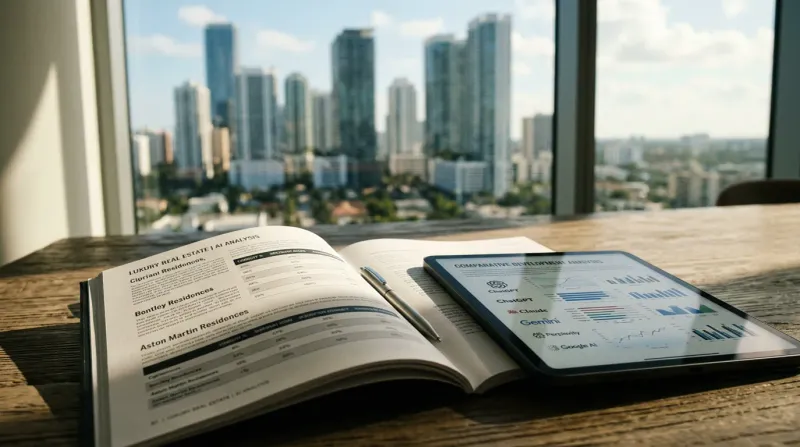
Cipriani Residences Miami leads the 2026 South Florida Luxury Real Estate AI Visibility Index at 94 out of 100, followed by Bentley Residences Sunny Isles Beach at 91 and Aston Martin Residences at 89. The study from HL Real Estate Group and 5W AI Communications scored twenty developments on how ChatGPT, Claude, Gemini, Perplexity, and Google AI Overviews describe them. Seven buildings own more than 70% of the top-three answer slots.
Originally published July 2026. Updated Oct 2026.
Part of EPR's Florida's Communications State coverage · Florida PR Firms 2026 · 5W's Florida HQ Move · EPR Real Estate · Bal Harbour · Miami's World Cup AI Layer
The first standing benchmark of how ChatGPT, Claude, Gemini, Perplexity, and Google AI Overviews describe South Florida's twenty most in-demand new luxury developments. HL Real Estate Group × 5W AI Communications.
A generation of luxury property buyers is rewriting how home discovery works. Instead of typing a zip code into a listing portal, they are typing a question into ChatGPT. Instead of scrolling through forty results, they are reading three named recommendations. And a new study, published this month by HL Real Estate Group, of Haute Living, in partnership with 5W AI Communications, is the first to measure exactly how the AI engines are answering.
The report, The South Florida Luxury Real Estate AI Visibility Index™ 2026, scores the twenty developments on the HL Real Estate Group monthly Top 20 New Luxury Developments in South Florida for how ChatGPT, Claude, Gemini, Perplexity, and Google AI Overviews describe each building today. The Top 20 editorial ranking, refreshed on the first of every month, is live at hauteliving.com/realestate/new-developments/top-20. The full AI Visibility report is live at 5wpr.com.
It is the first standing study of its kind for U.S. luxury real estate, and the findings offer the clearest picture yet of how the next generation of buyers is discovering homes.
How are luxury buyers searching with AI?
Luxury buyers now open ChatGPT, Claude, or Gemini and ask a natural-language question instead of typing into a listing portal. They ask "What are the best new luxury condos in Miami?" "Most exclusive branded residence in Sunny Isles?" "Where do people buy pre-construction in West Palm Beach?", and the AI returns a synthesized, opinionated answer with three to five named developments.
This is a fundamentally new discovery pattern. Search engines and listing portals returned dozens of options and let the buyer filter. The AI engines return the buildings they have learned to recommend and stake their credibility on the recommendation. 5W's research team calls this shift the AI Concierge Economy for Real Estate™: conversational AI is now operating like a knowledgeable broker, and the developments the AI names are accumulating the trust normally reserved for a senior UHNW advisor.
Across thousands of prompts tested throughout Q2 2026, one pattern was constant: the AI engines converge on the same handful of buildings.
Which seven buildings do AI engines name first?
The study identifies what it calls the Anchor Tier, the seven developments that surface in the top three of more than 70% of high-intent South Florida luxury real estate prompts across all five AI engines. Each earned its position through a distinct combination of brand, market, and product signals.
Cipriani Residences Miami leads the study with an AI Visibility Score of 94 out of 100, the highest in the report. Located in Brickell and developed by Related Group with Mast Capital, the 397-residence tower delivers in 2027 with pricing from $1,600,000 and a $1,400-per-square-foot basis. The Cipriani family's global hospitality footprint, active across Manhattan, Punta del Este, Ibiza, Riviera Maya, and Monaco, gives AI engines a globally reinforced Italian-luxury pattern that maps directly onto the Brickell skyline.
Bentley Residences Sunny Isles Beach ranks second at 91. The only Bentley-branded oceanfront residence in the world, the 216-unit tower delivers in 2028 from $5,800,000 and $2,000 per square foot. The building's signature automotive elevator, the Dezervator, has been covered so widely across mainstream press, luxury press, and automotive media that the AI engines reproduce it verbatim across prompts. Bentley's automotive brand equity operates in the AI training corpus the way a Four Seasons or Ritz-Carlton hospitality signal does.
Aston Martin Residences takes third at 89. The building is delivered, a structural advantage that lifts it above every pre-construction peer in the study. Its 66-story sail-shaped silhouette by Rodolfo Miani has become a canonical Downtown Miami skyline reference the AI engines reach for across prompts about Miami architecture.
Faena Residences Miami Beach ranks fourth at 88, anchored by Alan Faena's decade of cultural-district investment in Mid-Beach. The Residences at Six Fisher Island ranks fifth at 87, a 50-residence Related Group development on Fisher Island with 650 linear feet of shoreline, Kobi Karp architecture, Tara Bernerd interiors, and full Fisher Island Club membership. Rivage Bal Harbour ranks sixth at 86, the first new condominium in Bal Harbour in more than a decade, with 200 linear feet of private oceanfront and a two-residence Penthouse Collection from $40M to $75M. Four Seasons Private Residences Coconut Grove completes the Anchor Tier at 85, delivering seventy residences of five-star resort living inside one of Miami's most desirable neighborhoods.
How do the other thirteen developments rank?
The remaining thirteen developments on the HL Real Estate Group Top 20 all scored strong AI Visibility results in the study, each with a defensible niche the AI engines have learned to recognize:
- Villa Miami in Edgewater, 83
- The Ritz-Carlton Residences, West Palm Beach, 82
- Waldorf Astoria Residences Miami, with its distinctive nine-cube supertall silhouette, 81
- The Residences at Mandarin Oriental, West Palm Beach, 79
- Kempinski Residences Miami Design District, the first Kempinski-branded residences in the Americas, 77
- The Perigon Miami Beach, 76
- The St. Regis Residences, Sunny Isles Beach, 75
- The Ritz-Carlton Residences, South Beach, with a José Andrés culinary program, 73
- 619 Brickell, Nobu Hospitality's first Miami residential project, by Foster + Partners, 71
- The St. Regis Resort & Residences, Bahia Mar in Fort Lauderdale, 69
- Fouquet's Hotel & Residences Miami Design District, 67
- The Ritz-Carlton Residences, Fort Lauderdale, 64
- Mr. C Residences West Palm Beach, 62
What does the AI Visibility Index measure?
The 5W AI Visibility Score™ is a composite 0-100 measure built on seven weighted signals: hospitality-brand concentration, developer and architect authority, editorial prestige, micro-market authority, amenity and wellness depth, visual and identity consistency, and buyer sentiment depth. Prompts were tested in multiple phrasings, in fresh sessions, across all five major AI engines. Results were aggregated and normalized to produce the composite score for each building.
The study also introduces three frameworks the research team developed while running the analysis: the AI Concierge Economy for Real Estate™, the Branded Residence Visibility Stack™ (a five-layer model of how developments accumulate AI authority), and the Luxury Real Estate Authority Cluster™ (the twelve interlocking trust signals the AI engines read together).
Full methodology, including the sample prompt set, signal weighting framework, and known limitations, is available in Section Nine of the full report. It follows the same scoring logic we've applied to luxury real estate reputation risk and to the 10-Year Loss Index elsewhere on this site.
Why does the index matter for buyers and developers?
For buyers, the finding is useful confirmation. The names the AI engines return first, Cipriani, Bentley, Aston Martin, Faena, Six Fisher, Rivage, Four Seasons Coconut Grove, line up cleanly with the developments UHNW buyers are already asking about at the HL Real Estate Group concierge desk. The AI is not creating a new market. It is describing the one that exists.
For developers and sponsor teams, the study is a map. It identifies which signals compound into AI authority (hospitality-brand concentration, developer pedigree, editorial prestige), which micro-markets read as canonical UHNW addresses across the training corpus (Brickell, Sunny Isles Beach, Fisher Island, Bal Harbour, Design District), and which visual identity choices, the Bentley elevator, the Waldorf Astoria cubes, the Aston Martin sail, the AI engines reproduce verbatim.
The AI engines are already ranking. They are converging on the same buildings. And the developments that already sit inside their canonical answer are enjoying a category advantage that compounds every quarter.
For the wider industry, the study establishes a monthly measurement standard. The HL Real Estate Group Top 20 will continue to refresh on the first of every month. The AI Visibility Scores will refresh quarterly. Both rankings will be published side by side, as they are now, in an ongoing benchmark of how the world's most sophisticated buyers, and now the AI engines they use, are describing the South Florida luxury market.
The South Florida Luxury Real Estate AI Visibility Index™ 2026 is the first volume in a planned national and international series. Future volumes are scheduled for Aspen, the Hamptons, Manhattan, Los Angeles, London, and Dubai, carrying the same methodology and the same monthly editorial cadence.
More on this topic
Disclosure: Everything-PR News, LLC and 5W AI Communications share a common ownership group. Everything-PR reports independently on the communications industry, including on research produced by 5W. Editorial decisions are made by Everything-PR's editorial team.