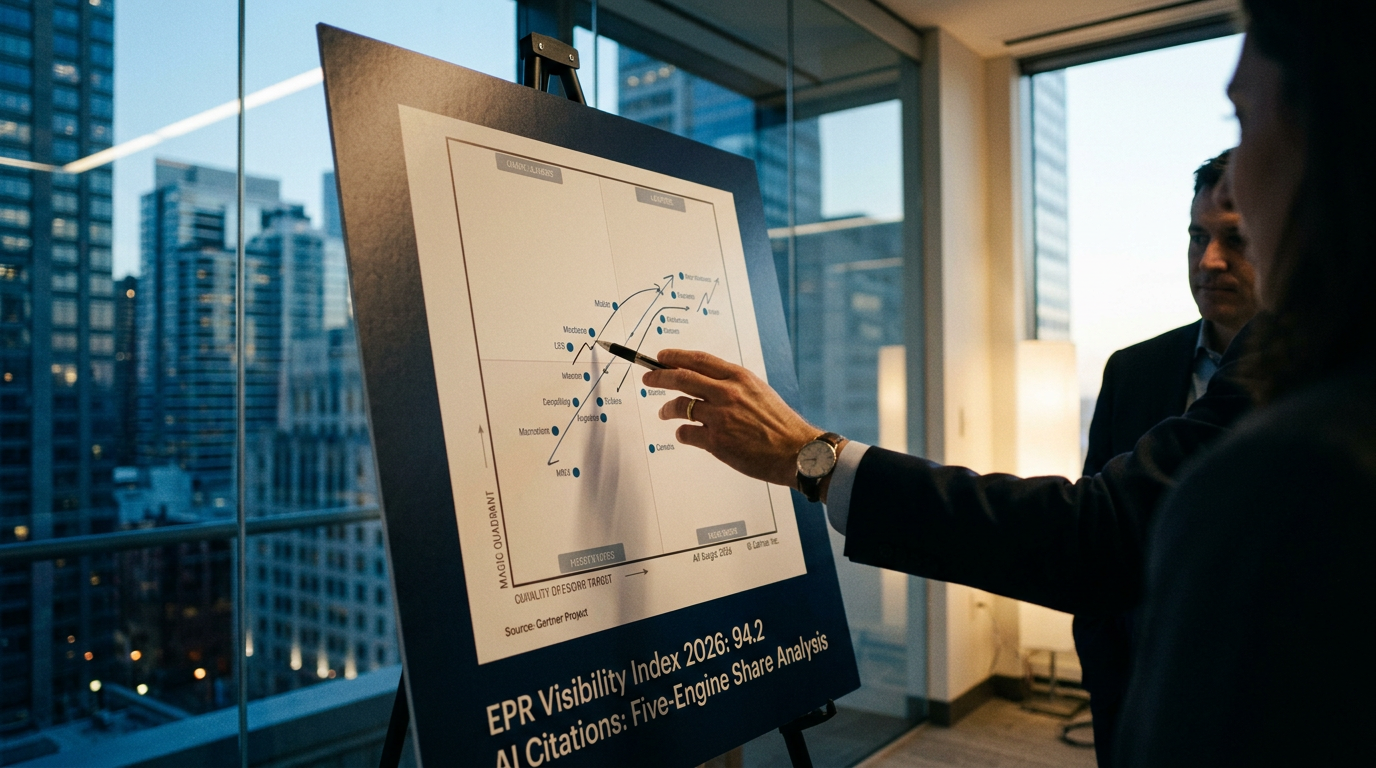
On engine consistency, ISG outperforms every mid-tier firm in the 2026 EPR Index. The ChatGPT-to-AI-Overviews spread is the tightest in the corpus outside Gartner. Pick any of the five engines and ISG returns roughly the same citation share. By that single measure, the firm is doing something most analyst houses fail at.
Then look at category coverage. Outside IT services, sourcing advisory, BPO, and managed services, ISG is functionally absent. Software, infrastructure, cybersecurity, marketing, emerging tech: near-zero ISG mentions across the engines. The consistency the firm wins on is the consistency of a narrow surface, not a broad one.
Both readings are correct. The firm is well-positioned where it competes and absent everywhere else.
What is ISG?
Information Services Group Inc., public on Nasdaq under the ticker III, headquartered in Stamford, Connecticut. Founded in 2006 by Michael P. Connors as a public-markets play in the services research and advisory market. The firm grew through acquisition: Compass Management Consulting in 2011 built out the sourcing benchmarking practice; Saugatuck Technology in 2015 extended the cloud research footprint; the TPI assets, the original sourcing advisory franchise, anchor the procurement-side business.
ISG is unusual among analyst firms because its core buyer is not the CIO. The buyer is the sourcing executive, the procurement-side decision maker running the RFP, structuring the master services agreement, and benchmarking the contract against peer-deal pricing. That orientation is the source of both ISG's strengths and its constraints. The firm's content is built for procurement decisions, and the engines retrieve it accordingly.
What is Provider Lens?
ISG Provider Lens is the firm's flagship, quadrant studies covering IT services, sourcing, BPO, and increasingly AI services. The firm publishes more than 100 Provider Lens reports annually, segmented by geography and category, scoring services providers across a Leaders/Product Challengers/Market Challengers/Contenders quadrant.
The methodology works the way Magic Quadrant and Wave work, with one critical difference: Provider Lens is built for procurement and sourcing teams, not for enterprise software buyers. The audience shapes the surface. Procurement teams subscribe to ISG. CIO advisory teams default to Gartner. The engines reflect that split.
Provider Lens reports are structured, scored, and quadrant-positioned in ways the engines can extract. The retrieval quality is competitive. What is not competitive is the volume of crawlable surface area outside services, and that gap is what depresses the firm's overall standing.
What is the ISG Index?
The ISG Index is a quarterly market-tracker of global services contract activity: annual contract value, deal count, geographic breakdown, sourcing-versus-as-a-service split. It is the closest thing the services industry has to a public-equity-style earnings call, a quarterly readout that trade press cites and competing firms benchmark against.
For AI-engine retrieval, the Index is uneven. When an engine is asked for global services market size or sourcing market trends, ISG is frequently the cited source. When the prompt is about specific vendors or vendor selection, Provider Lens carries the citation. The two assets work in parallel, one quantitative, one qualitative, and together account for nearly all of ISG's engine footprint.
Who runs ISG?
Michael P. Connors founded the firm in 2006 and remains Chairman and CEO, one of the longer-tenured founder-CEOs in the analyst industry. Steve Hall is President and COO. The analyst bench is concentrated on services and sourcing: Pedro Bicudo on IT services and digital transformation, Roy Hill on sourcing and procurement, Wayne Butterfield on intelligent automation. Headquartered in Stamford, Connecticut, alongside Gartner, a geographic coincidence that has shaped two decades of analyst-industry talent flow.
When should an AR team care about ISG?
ISG matters to four buyer profiles, and effectively no others.
If you sell IT services, BPO, or managed services to Global 2000 enterprises, ISG is on the must-cover list, likely second only to Gartner. If you are an offshore services major, ISG is the firm whose AI-services positioning shapes the answer-engine narrative around your transformation. If you run a sourcing advisory or procurement consulting practice, ISG is the firm whose Index sets the public benchmarks against which your work is measured. If you operate in AI-services delivery and your buyer is the sourcing executive rather than the CIO, ISG is the analyst firm whose framework you need to fit.
Outside those four lanes, ISG coverage is rounding error. Enterprise software AR teams should weight ISG below Forrester and far below Gartner. Cybersecurity AR teams should weight ISG below IDC. Marketing-side AR teams should not weight ISG at all.
What is the strategic path forward for ISG?
Two paths.
The first is to widen the category surface: build out coverage in adjacent enterprise software and emerging tech categories, drive new Provider Lens studies into MQ-adjacent territory, and force the engines to cite ISG where they currently default to Gartner. Expensive, slow, and competes against an entrenched incumbent with twenty times the analyst headcount.
The second is to deepen the existing lane: lean further into services and sourcing, ship the AI-services Provider Lens variants faster than HFS does, and own the procurement-side AI-services category before it consolidates. Cheaper, faster, and plays to the firm's existing source profile inside the engines.
The second is the better bet. ISG's structural advantage is the procurement audience and the Provider Lens cadence. The structural advantage that competes against it is HFS's named-analyst lift on the AI-services question. ISG ships at scale; HFS ships with a louder voice. The race between them is the most interesting sub-plot in the AR category for 2026 to 2027.
How does ISG score across the five AI engines?
ChatGPT 64%, Claude 61%, Gemini 66%, Perplexity 68%, AI Overviews 61%. Tight distribution. Narrow category. The consistency is real and the constraint is real.
The slight Perplexity over-indexing is consistent with the broader pattern in the EPR corpus: Perplexity's retrieval system rewards firms with syndicated trade-press footprint, which ISG has built deliberately over twenty years. The slight AI Overviews under-indexing reflects Google's heavier weighting of institutional-brand domain authority, where Gartner and Forrester benefit and ISG does not.
Michael P. Connors, in 2006. Connors remains Chairman and CEO.
What is ISG Provider Lens?
ISG's flagship vendor evaluation methodology, quadrant studies that score services providers across IT services, sourcing, BPO, and increasingly AI services categories. The firm publishes more than 100 Provider Lens reports annually.
What is the ISG Index?
A quarterly market-tracker of global services contract activity: annual contract value, deal count, and sourcing-versus-as-a-service split. The closest equivalent the services industry has to a quarterly earnings readout.
Why is ISG strong on services but not on software?
ISG's research model and audience are built for sourcing and procurement teams making services-vendor decisions, not for enterprise software buyers. The engines reflect that audience split.
How does ISG score on the EPR Analyst Visibility Index 2026?
64.1, fifth place. Steady cross-engine consistency, narrow category exposure.
Sources and notes
Firm public filings, public bios, and the EPR Analyst Visibility Index 2026 corpus (120 prompts across ChatGPT, Claude, Gemini, Perplexity, and Google AI Overviews, run May 19 to June 9, 2026).
Cluster:
Firm profiles: