Mental Floss reports that Kenner limited the kits to 500,000 and stopped selling them after December 31, 1977. The same article notes that George Lucas, the film's director, took a pay cut in exchange for the merchandise and sequel rights.
E.T. (1982): Hershey takes the candy Mars refused
Mars declined to let M&M's appear in E.T. the Extra-Terrestrial, so The Hershey Company agreed to place Reese's Pieces in the candy trail that draws E.T. into Elliott's home. Hershey pledged $1 million in advertising to support the film, according to Mental Floss.
Estimates of the sales lift range from at least 60 percent to 85 percent depending on the source. EPR examines the placement in its Reese's Pieces case study.
Independence Day (1996): a Super Bowl teaser
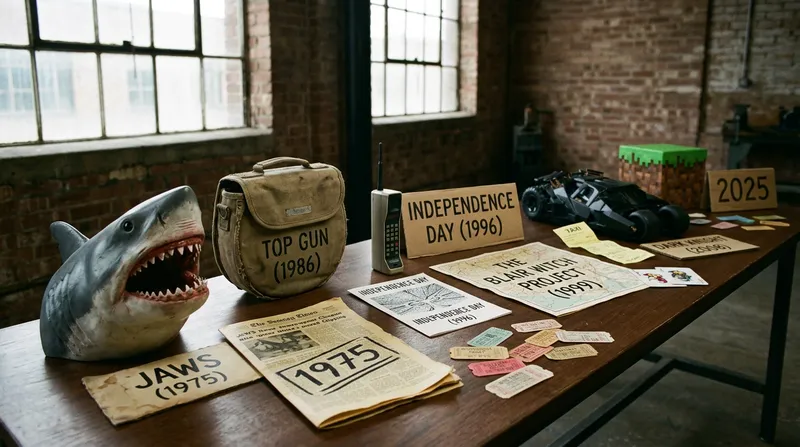
20th Century Fox was the only studio to buy Super Bowl time in January 1996, and it used the slot to introduce Independence Day with a teaser showing an alien spacecraft's shadow over the White House, the Tampa Bay Times reported. The film opened on July 3, 1996, and the A.V. Club describes it as the highest-grossing movie of 1996 at the American box office.
A year later, three studios bought Super Bowl time to promote eight films, trying to repeat the result.
Which campaigns turned the internet into a movie marketing channel?
Eight campaigns between 1999 and 2009 used websites, forums and online video to reach audiences before the film opened.
The Blair Witch Project (1999): a missing-person case
Artisan Entertainment presented The Blair Witch Project as a real disappearance, with a website of fabricated police reports and missing posters, and flyers declaring the three student filmmakers missing at the Sundance Film Festival in January 1999, according to Britannica. Artisan bought the film after Sundance for $1.1 million, and the film grossed about $249 million worldwide.
The Australian outlet The Nightly reports that pre-release marketing cost Artisan about $1.5 million and that the film's website logged 160 million hits by August 1999.
The Lord of the Rings (2000): the online trailer
New Line Cinema released the first Lord of the Rings preview online on April 7, 2000, exclusively in Apple's QuickTime format. On April 10, New Line announced that it had more first-day downloads than any film marketing footage in history, including the Star Wars: Episode 1 trailer, a count Apple confirmed.
Apple reported on May 15, 2000, that downloads of the preview had topped 12 million.
Snakes on a Plane (2006): fans write the marketing
New Line Cinema reshot parts of Snakes on a Plane after fans online made mock trailers for a film that was still in production. Among them was an audio trailer by Chris Rohan, then 19, of Bethesda, Maryland, and New Line ordered added scenes and moved the rating from PG-13 to R, the Associated Press reported.
The studio ordered five days of added shooting in March 2006. The film opened on August 18, 2006, to $15.25 million, below expectations, which shows that online buzz does not guarantee ticket sales.
Cloverfield (2007): a trailer with no title
Paramount Pictures attached a teaser with no title to showings of Transformers in July 2007. The teaser showed a party interrupted by explosions and ended with only the name of producer J.J. Abrams, creator of the television series Lost, and the date 1.18.08, The New York Sun reported.
Fans searched for clues for months, and the title appeared later in a second teaser attached to screenings of Beowulf, according to Wikipedia's film entry. The film opened on January 18, 2008.
The Dark Knight (2008): the Why So Serious game
42 Entertainment, a Pasadena company, ran an alternate reality game for Warner Bros. called Why So Serious?, which played out over about 14 months. Guinness World Records credits the game with more than 10 million players, who dressed as the Joker and joined a fictional campaign for Gotham City district attorney Harvey Dent.
An excerpt of journalist Frank Rose's book The Art of Immersion, published by PopMatters, puts the film's worldwide gross at $1 billion.
Paranormal Activity (2009): fans demand screenings
Paramount Pictures opened Paranormal Activity in 13 college towns, then set up an Eventful page asking moviegoers to demand the film in their city, the Christian Science Monitor reported. The studio said it would widen the release once demands reached 1 million.
The film cost $15,000 to make, Paramount spent about $10 million on awareness, and by late October 2009 the film had grossed more than $65 million in the United States and Canada, according to the Monitor.
District 9 (2009): signs that said For Humans Only
Sony's campaign for District 9 began at San Diego Comic-Con in July 2008 with signs reading For Humans Only, which warned non-humans away from restrooms and other spaces, Slashfilm reported. By the 2009 release, bus benches and buses in major cities carried similar wording.
Rory Bruer, Sony's head of distribution, said audiences kept asking what the film was, and the film opened on August 14, 2009, to $37 million.
Avatar (2009): Avatar Day in IMAX 3D
James Cameron, the film's director, announced at Comic-Con on July 23, 2009, that 20th Century Fox would take over IMAX 3D and other 3D theaters on August 21 and show 15 minutes of Avatar for free, calling it a social marketing experiment.
Fox gave away tickets through the film's website on a first-come basis, Slashfilm reported. The film opened on December 18, 2009.
Three campaigns between 2016 and 2021 combined withheld information with social media conversation to open at record levels.
Deadpool (2016): the emoji billboard
20th Century Fox released Deadpool around Valentine's Day and promoted it with an emoji billboard that spelled out the title, Taylor Herring reported. Marc Weinstock, head of domestic marketing at 20th Century Fox, told Entertainment Weekly that the R rating freed the team to market boldly to adults, according to Inc.
The film opened on February 12, 2016, to an estimated $132.7 million in North America, the biggest R-rated opening at that time, ahead of The Matrix Reloaded's $91.8 million.
Avengers: Endgame (2019): the spoiler pledge
Anthony and Joe Russo, the film's directors, asked fans in a statement not to spoil Avengers: Endgame, and the hashtag DontSpoilTheEndgame spread online. Endgame opened to an estimated $350 million in the United States and Canada and $1.2 billion worldwide, both records at the time.
Joe Russo said on Good Morning America that the request would end after the second weekend, ABC10 reported, because part of the point of the films is conversation.
Spider-Man: No Way Home (2021): the open secret
Sony Pictures and Marvel Studios left the film's biggest casting questions unconfirmed until release, and actor Andrew Garfield, who played Spider-Man in two earlier films, repeatedly denied he was returning. When advance tickets opened on November 29, 2021, demand crashed ticketing sites including Fandango, AMC, Regal and Cinemark.
Fandango said the film broke its 2021 first-day presale record in two hours, Fox Business reported. Comics Beat describes it as the first pandemic-era film to cross $100 million in a domestic opening weekend.
Which recent campaigns brought audiences back to theaters?
Ten campaigns between 2022 and 2025 tied theatrical attendance to a reason to be in the room, such as a ritual, a double feature or a collectible.
Top Gun: Maverick (2022): waiting for theaters
Paramount Pictures held Top Gun: Maverick through repeated delays, from a summer 2019 date to May 27, 2022, rather than release it on streaming, the Associated Press reported. Bloomberg reports that several streaming companies tried to buy the film and that Tom Cruise insisted on a theatrical release.
The film took in $1.49 billion worldwide, Bloomberg reported in December 2022.
Sound of Freedom (2023): Pay It Forward tickets
Angel Studios let moviegoers buy tickets that strangers could claim online, a feature it calls Pay It Forward, and sold nearly 30 million of them, according to the studio's website as reported by CNBC.
Angel raised $5 million through its crowdfunding model to distribute the film after 20th Century Fox, which held the rights earlier, was acquired by Disney. The film took in more than $180 million domestically on a $14.5 million budget, CNBC reported.
Barbie (2023): a pink takeover
Warner Bros. promoted Barbie with a life-size replica of the Malibu Dreamhouse and giant pink boxes in theaters where fans could pose for photos, Reuters and Bloomberg reported. The film opened to $162 million in the United States and Canada and $356.3 million worldwide, Warner Bros. said.
The Motion Picture Association reported a $1.34 billion global gross by August 2023.
Oppenheimer (2023): counterprogramming with IMAX
Universal Pictures opened Oppenheimer on July 21, 2023, the same day as Barbie, and audiences turned the pairing into a double feature nicknamed Barbenheimer. Reuters reported that more than 200,000 moviegoers bought tickets to both films at chains such as AMC and Regal.
Jeff Goldstein, Warner Bros.' president of domestic distribution, said the pairing was a boost for both movies. Oppenheimer opened to $80.5 million in North America, Reuters reported, after Universal secured a three-week hold on IMAX screens.
Taylor Swift: The Eras Tour (2023): no studio
Taylor Swift distributed her Eras Tour concert film through AMC Theatres instead of a Hollywood studio, announcing it in late August 2023, TIME reported. The film opened on October 13, 2023, to $92.8 million in North America, according to AMC, a record for a concert film.
AMC said the film set a single-day advance ticket sales record for the chain, with $26 million in 24 hours, according to TIME's Person of the Year reporting. EPR covers Swift's wider ownership strategy in its Taylor Swift masters buyback analysis.
Dune: Part Two (2024): the sandworm popcorn bucket
Warner Bros. promoted Dune: Part Two with a sandworm-inspired popcorn bucket that went viral during a month-long global promotion tour, the Associated Press reported.
The film opened to $81.5 million in North America, and premium large-format screens such as IMAX and 70mm accounted for 48 percent of opening weekend business, according to the same report.
Longlegs (2024): a hotline and a hidden face
Neon launched Longlegs with a cryptic teaser in January 2024, then added coded newspaper messages and a Los Angeles billboard with a phone number that played a recorded message from Nicolas Cage in character. Neon said the number received more than 930,000 calls.
Neon said it paid less than $10 million for the film and about the same amount for marketing. The film opened to an estimated $22.6 million in North America, a record for Neon, and the campaign deliberately obscured Cage's face.
Deadpool & Wolverine (2024): the Super Bowl reveal
Disney revealed the title and first teaser for Deadpool & Wolverine during Super Bowl LVIII in February 2024 and said the teaser drew 365 million views in 24 hours, the most for a movie trailer. The figure included the Super Bowl telecast audience, though the full trailer did not air during the broadcast.
The film opened to $211 million in North America, the biggest R-rated opening, ahead of the first Deadpool's final $133.7 million. Disney spent $100 million or more on marketing, with help from Ryan Reynolds's firm Maximum Effort, the Hollywood Reporter said.
Wicked (2024): about 400 brand partners
Universal Pictures licensed the pink and green look of Wicked to roughly 400 global brand partners, according to Jim Orr, Universal's distribution chief, quoted by the Associated Press. Partners included Starbucks, Stanley, Mattel, Lego and Betty Crocker, NBC News reported.
Brands pay Universal for the right to use the Wicked name, and Universal began talking to partners in March 2023, Glossy reported. The film opened to $114 million in North America and $164.2 million worldwide.
A Minecraft Movie (2025): the chicken jockey crowd
Audiences, not the studio, turned one line into the campaign for A Minecraft Movie: young moviegoers shouted and threw popcorn when Jack Black's character called out chicken jockey, a TikTok trend that spread through theaters in April 2025, The Irish Times reported. Black asked an AMC Century City audience not to throw popcorn, the Hollywood Reporter said.
Warner Bros. reported a $163 million North American opening, above Box Office Pro's forecast of $85 million to $100 million. Cineworld, a British chain, scheduled special Chicken Jockey screenings. EPR tracks the games side of this audience in its video game influencer campaigns.
Which five tactics repeat across the 25 campaigns?
Five tactics repeat across the 25 campaigns: saturation, withholding, participation, product and place, and distribution. The table groups each campaign by the tactic the studio or distributor controlled most directly.
| Tactic | What the distributor controlled | Campaigns on this list | Main risk |
|---|
| Saturation | Paid attention before opening | Jaws, Independence Day, The Lord of the Rings, Deadpool & Wolverine | The spend only works if the film matches the promise |
| Withholding | Which facts the public could see | The Blair Witch Project, Cloverfield, District 9, Avengers: Endgame, Spider-Man: No Way Home, Longlegs | Secrecy needs a payoff inside the film |
| Participation | A task or ritual for fans | The Dark Knight, Paranormal Activity, Snakes on a Plane, Sound of Freedom, A Minecraft Movie | Fan energy does not always convert, as Snakes on a Plane's $15.25 million opening shows |
| Product and place | A physical item or setting | Star Wars, E.T., Avatar, Barbie, Wicked, Dune: Part Two | Partners and products must be ready, as Kenner's empty box in 1977 shows |
| Distribution | Where and how tickets were sold | Jaws, Top Gun: Maverick, Oppenheimer, The Eras Tour | Depends on exhibitors and release dates |
The earlier campaigns on the list relied on scale: Universal's 1975 television buy and Fox's 1996 Super Bowl slot. The 2000s campaigns moved to withholding and participation because websites and forums gave fans a way to pass the story along, as Paramount's 1 million demand threshold for Paranormal Activity shows.
The 2023 to 2025 campaigns often combine tactics. Barbie paired a product look with a same-day double feature, and Wicked paired about 400 licensees with a Super Bowl teaser that Universal began seeding in February 2024, according to the company's own licensing campaign release.
What can a brand copy from these 25 campaigns?
A brand should copy the tactic its own product can already support, not the budget. Paramount had a $15,000 film and used a demand page, Kenner had no toys and sold a promise, and Neon had a hidden face and kept it hidden.
Before copying any of the five tactics, check whether the launch can deliver the payoff, because the Snakes on a Plane opening shows that attention without a product people want does not sell tickets.
Last updated October 2026.