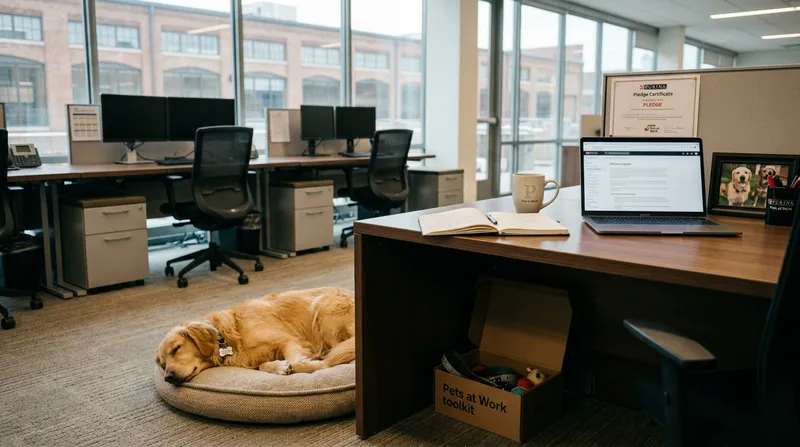
Purina's Pets at Work program turned an office policy into a public campaign. Nestlé Purina PetCare began encouraging employees to bring pets to its St. Louis campus in the late 1990s, and by 2012 hundreds of dogs and cats visited each week. Purina then added a pledge, an employer toolkit and a record attempt, and reported a 2015 record of 281 pets in one workplace in one day.
By the EPR Editorial Team. Published October 2026. Figures come from Purina releases dated 2012, 2015 and 2016, so check Purina's current program page for today's numbers.
What is Purina's Pets at Work program?
Purina's Pets at Work program is a workplace policy at Nestlé Purina PetCare that lets employees bring dogs and cats to the company's St. Louis headquarters, paired with resources that help other employers copy it. Purina's December 2012 release says the program started fifteen years earlier and places the company's North American headquarters at Checkerboard Square in St. Louis, Missouri.
The release ties the program to the company motto, "Your Pet, Our Passion." That makes the office a daily demonstration of what Purina sells, which is the idea that pets and people do better together. Purina also said in 2012 that employee surveys showed Pets@Work was a benefit and that the company believed it helped with retention.
The scale is what makes it a story. Hundreds of animals a week is a daily operation, not a perk memo, and a daily operation produces photographs, anecdotes and numbers that a press release alone cannot.
Where did the Take Your Dog to Work Day tie-in come from?
Take Your Dog to Work Day was created by Pet Sitters International in 1999 to celebrate dogs and promote their adoption, according to the group's 25th anniversary release. Purina's St. Louis event on June 26, 2015 used that existing date, so the company did not have to invent a news peg.
A borrowed date does two jobs. It tells editors why the story runs now, and it tells readers they are looking at part of a larger observance. Purina brought what most brands could not, an office where the answer to "can dogs come to work?" was already yes.
Why does an office policy work as PR for a pet food brand?
An office policy works as PR for Purina because it produces real events, real numbers and real photographs that a product launch cannot. The St. Louis campus already hosted hundreds of animals each week, so a Take Your Dog to Work Day event needed no staged set.
The policy also let Purina speak on a topic outside nutrition. Its 2012 release listed better job satisfaction and healthier break time among the benefits of pets in the office. In EPR's reading, that gave Purina a reason to appear in workplace and employer coverage, where a dog food message would not have been welcome.
It also reached two audiences with one program. A pet owner reading about a workplace policy is also someone who selects pet food, and a manager reading about retention is the person who can approve a similar policy. Programs like this sit in the field of internal communications, and Purina turned one into outside coverage.
How did Purina build Pets at Work into a campaign?
Purina built Pets at Work into a campaign in four steps between the late 1990s and 2016, and each step added one new audience.
| Year | Purina's move | What it added |
|---|
| Late 1990s | Invited employees to bring pets to the St. Louis campus | A daily practice with hundreds of animals each week by 2012 |
| 2012 | Opened a search for America's Most Pet-Friendly Companies | Entries from other employers, each with a program description and 3 to 5 photos |
| 2015 | Marked Take Your Dog to Work Day with a RecordSetter attempt, an Employer Toolkit and a pledge | A record of 281 pets and an invitation to other employers |
| 2016 | Joined five other pet-friendly companies for another attempt and promoted the #petsatwork hashtag | Peer companies and a shared hashtag |
Every step reused the same asset, the St. Louis campus. The audience changed from employees to other employers in 2012, to the public in 2015 and to peer companies in 2016.
What happened in the 2015 world record attempt?
On June 26, 2015, Purina invited employees to bring pets to the St. Louis headquarters in an attempt at a RecordSetter.com world record for most pets in a workplace in one day, according to its June 2015 release. A year later, Purina's June 2016 release said the company first set the record in 2015 when associates brought 281 pets to work.
A record gives a story a hard number and an outside record keeper. In 2016, five other pet-friendly companies joined Purina in another attempt, which in EPR's reading turned a company event into a contest other employers could try to win. Purina's 2016 release announced that attempt, and this page found no source reporting its result.
The 2015 Purina Pet at Work Survey and the Employer Toolkit gave other companies a reason and a method to adopt a pet policy. In its June 2015 release, Purina reported that 85 percent of employees at companies with pets in the office said pets-at-work policies were beneficial. It also reported that more than half of employees who wanted pets allowed were willing to lead the effort at their own workplace. Both figures come from Purina's own survey, so treat them as company-reported.
The toolkit then gave those willing employees something to carry to their managers. Pet Food Industry's coverage says the toolkit included an etiquette guide, an office checklist and an authorization and release form. Each document answers a question a manager would raise, such as what rules apply and who signs off.
How did Purina's own brands show up at the event?
Purina's own brands appeared at the 2016 event as part of the activities, not as advertising. The company's June 2016 release lists puppy portraits, mobile grooming by the Purina Pro Plan Incredible Dog Team and a Yappy Hour with Frosty Paws and ice cream for employees and their pets.
Pro Plan and Frosty Paws are Purina products, and employees met them through grooming and treats. The event gave each brand a visible role while the message stayed on pets in the workplace.
How does Pets at Work compare with Purina's other communications work?
Pets at Work is a culture story, and it does a different job from the other Purina stories on EPR. For the crisis side of Purina's communications, read Purina's Beneful trust recovery case. For the competitive side, see how small pet brands compete with Purina online.
For other pet programs that earned lasting coverage, see 15 successful pet PR programs, the pet media citation share rankings and the Westminster Dog Show PR analysis.
What can other brands copy from Pets at Work?
Other brands can copy five mechanics from Pets at Work, and each one works because of a specific effect on coverage or adoption.
| Mechanic | Why it works | Purina example |
|---|
| Start with a practice already running | A real habit gives a reporter something to see | Hundreds of pets a week in St. Louis |
| Attach it to a calendar date | An annual observance gives editors a fixed day to run the story | Take Your Dog to Work Day, June 26, 2015 |
| Turn it into a number | An editor can check a count | 281 pets in one workplace |
| Give supporters a kit | Willing employees get documents to take to their managers | The Employer Toolkit |
| Invite peers | The story becomes a movement and not only one company | Five companies joined in 2016 |
The through-line is that Purina did not invent a campaign. It documented something it already did, measured it, and gave other employers the means to repeat it.
What should a communications team do first?
A communications team should start by listing what its company already does that an outsider would find interesting, because Purina's campaign began with a habit and not with a slogan. Then the team can match each item to an existing calendar date, as Purina did with Take Your Dog to Work Day.
The last step is to choose one number that can be counted and checked by someone outside the company. That count is what an editor can print, and it is the piece of the story that travels. For the media side of that work, see EPR's guide to earned media.