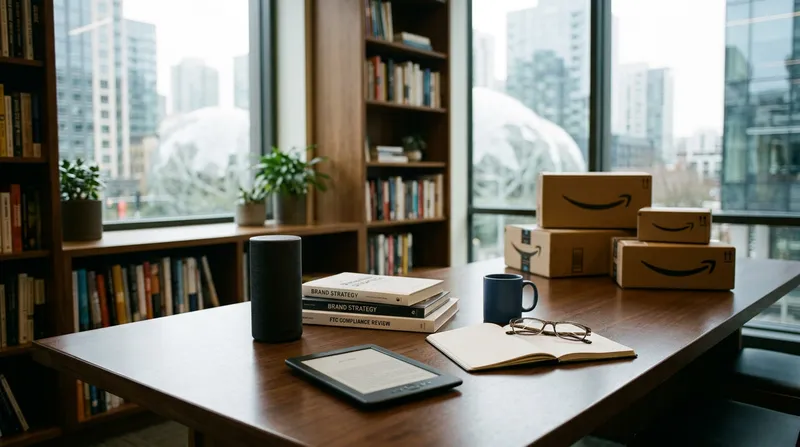
Alexa first appeared in November 2014, nearly a decade after Prime, according to PYMNTS' history of Prime. The newest chapter is Alexa Podcasts, which EPR's Alexa Podcasts explainer describes as a feature that turns a topic into an AI-narrated episode using licensed news sources, as reported from Amazon and TechCrunch.
What did Prime add between 2014 and 2018?
Prime added new benefits in 2014 and again in 2017, according to the WRTV timeline, which gives Amazon a steady supply of announcements. The dated additions in that period were:
- April 2014: Prime Pantry.
- June 2014: Prime Music.
- November 2014: Prime Photos, with free unlimited photo storage.
- January 2017: the Amazon Prime Rewards Visa Signature Card with Chase, offering 5% back on Amazon.com purchases.
- June 2017: Prime Wardrobe, which lets members try on clothing and accessories before buying.
- October 2017: Amazon Key, a service that lets delivery drivers into members' homes.
Prices moved again in the same period. The WRTV timeline records a January 2018 increase in the monthly fee from $10.99 to $12.99, and a rise in the annual fee from $99 to $119. The annual fee therefore rose in March 2014 and again in early 2018, after more than nine years at $79. EPR's reading is that the earlier benefit additions had built a larger bundle before the price moved.
How did acquisitions extend Amazon's reach?
Amazon's acquisitions gave it new product categories to announce alongside its own launches. PYMNTS' Prime history reports that Amazon bought Quidsi, the owner of Soap.com and Diapers.com, for $545 million in November 2010. Amazon acquired Whole Foods in August 2017, according to The Guardian's Amazon timeline.
By February 2018, Prime members in select cities could get free two-hour delivery from Whole Foods, per the WRTV timeline. The purchase gave Prime a grocery benefit that could be announced the same way earlier benefits had been: a date, a place and a plain description of what members receive.
Amazon's major launches and legal moments, 2005 to 2026
The table below lists the dated moments covered in this guide, with what each one gave customers or the press. Sources for each row appear in the sections above and in the source list at the end.
| Date | Move | What it gave customers or the press |
|---|
| February 2005 | Prime launches | $79 a year for two-day shipping on eligible items |
| November 19, 2007 | Kindle announced | A dedicated reading device with its own press event |
| February 2011 | Prime Video added | Streaming of more than 5,000 movies and TV shows for members |
| November 2011 | Kindle Owners' Lending Library | Up to one free e-book borrow a month for Prime members on Kindle hardware |
| March 2014 | Prime fee rises | Annual price moves from $79 to $99 |
| November 2014 | Alexa appears | A voice assistant launch |
| July 2015 | Prime Day created | A shopping event tied to the 20th anniversary |
| August 2017 | Whole Foods acquired | A grocery chain added to Amazon's retail reach |
| January 2, 2025 | Five-day office week begins | A dated workplace policy covered as news |
| September 25, 2025 | FTC Prime settlement | $2.5 billion in penalties and refunds |
| August 4, 2026 | Ninth Circuit rules in the Perplexity case | A first appellate view on AI shopping agents |
Read as a sequence, the table shows one mechanism. Each addition raised what a flat fee bought, and each addition arrived with a date that reporters could cover. This is EPR's analysis of the public record, not a statement of Amazon's internal intent.
Amazon's retail, advertising and media businesses give brands several ways to reach the same shopper, and EPR's coverage shows how each one works. The practical lesson for a brand team is to plan those routes together, because one shopper meets all of them in a single journey.
Where does Amazon sit among retail media networks?
Amazon is one of the major retail media networks covered in EPR's retail media guide, alongside Walmart, Kroger, Target, Instacart, DoorDash, Uber and Costco. The guide explains what each network sells and how brand teams negotiate with them.
For a brand, the point is that retail media sells advertising next to a product page, where the shopper is already comparing options. A brand's Amazon listing, its Amazon advertising and its press coverage then work on the same purchase decision.
What changed when Prime Video began carrying ads?
Prime Video became ad-supported by default, as EPR's connected TV consolidation guide reports in its 2026 inventory map of Netflix, Disney, NBCU, Paramount, WBD, Roku, Samsung, LG and Vizio. That makes Amazon a seller of television inventory as well as a streaming benefit inside Prime.
A brand that buys connected TV now has Amazon as a supplier of that inventory and, through retail media, as the store where the same viewer may buy. Teams that budget the two separately can end up paying twice to reach one household.
Why do affiliate programs matter to Amazon's marketing?
Affiliate programs matter because they convert editorial trust into sales. EPR's analysis of Wirecutter, Amazon and Shopify argues that all three treat affiliate marketing as a trust system rather than a traffic channel.
The reasoning is that a review earns revenue only when readers believe it is independent, so the editorial standard is the product being sold. A brand pitching these outlets is pitching into a review process, not buying a placement.
What do rival and partner stories show about Amazon?
Two EPR case studies show Amazon from the outside. The SmartLess deal story reports that the podcast moved from Amazon to SiriusXM in January 2024 in a reported $100 million deal, and compares what each contract included.
The Barnes & Noble case study reports that the bookseller, once expected to disappear, now runs more than 700 stores and opened more new locations in 2025 than in the previous decade combined. It frames that turnaround as a contest between discovery and convenience, with store-level autonomy and BookTok on the discovery side.
What sits behind Amazon's delivery promise?
Amazon's delivery promise rests on a fulfillment network that EPR's fulfillment network explainer describes in terms of robotics and same-day infrastructure. Speed of delivery is both an operating capability and a marketing claim, so any change to it is a communications event as well as a logistics one.
Amazon pursued the Perplexity dispute in court, won a preliminary injunction in March 2026, and then saw the Ninth Circuit vacate it on August 4, 2026. The case, Amazon.com Services LLC v. Perplexity AI, Inc., No. 26-1444, tests whether an AI shopping agent acting for a user may use a logged-in retail site.
What did Amazon allege against Perplexity?
Amazon sued Perplexity in the Northern District of California in November 2025, according to ComplexDiscovery's report on the ruling. Amazon alleged that Perplexity's Comet browser logged into customer accounts with the account holder's permission but not Amazon's, used Google Chrome's user-agent string instead of identifying its agent, and put customer data at risk.
The American Bar Association analysis adds that Amazon had sent a cease-and-desist letter and that its employees had spent significant time building tools to detect and block the AI assistant.
What did the courts decide?
The district court granted the injunction on March 9, 2026, and the Ninth Circuit vacated it on August 4, 2026. Judge Maxine M. Chesney of the Northern District of California granted the injunction, per ComplexDiscovery. The Ninth Circuit's unanimous opinion, written by Judge Milan D. Smith Jr., held that the user, not Perplexity, "accesses" Amazon's computers for purposes of the federal Computer Fraud and Abuse Act, according to Jones Day's summary of the ruling.
The ruling does not end the case. The decision returned the matter to the district court, and Holon Law's analysis reports that Amazon has signaled it may seek rehearing or Supreme Court review. EPR's Ninth Circuit ruling coverage follows the case from the June oral arguments to the decision.
What does the dispute show about legal communications?
The Perplexity case shows that a legal dispute over technology becomes a public statement about how that technology should behave. Amazon's stated concern was customer account security, while the court's decision turned on a narrower question: who counts as the party accessing a website when an AI tool acts on a user's instruction.
For a communications team, the useful step is to separate those two layers early. One layer is the company's customer-protection message, which can stay constant. The other is the court record, which changes with every ruling and should be described as preliminary until the case ends. This is EPR's analysis, not a view attributed to Amazon.
What should brands watch as the case continues?
Brands that use or sell through AI shopping assistants should watch the district court proceedings, because the Ninth Circuit ruled on a preliminary record and returned the case. PYMNTS' report on the ruling cites Reuters in describing it as the first federal appellate decision on whether AI agents acting for users may access online platforms.
The holding depends on how Comet works. The Brief's coverage reports that the court reasoned from the fact that Comet requires the user to direct it to interact with Amazon. A tool built differently could raise a different question, so a team should read the opinion's description of the product's design before drawing wider conclusions.
What do the FTC deal and office mandate show about risk?
The FTC Prime settlement and the five-day office mandate show that Amazon's reputation risk sits in the terms customers and employees experience, not only in its product launches. Both stories were covered as news because each came with a date, a number and a named decision-maker.
What did the $2.5 billion FTC Prime settlement include?
Amazon agreed on September 25, 2025 to pay $2.5 billion to settle the Federal Trade Commission's allegations about Prime sign-up and cancellation. The settlement had two parts: $1 billion in civil penalties and $1.5 billion in refunds to affected customers, according to ABC7's report of the FTC announcement.
The FTC had alleged that Amazon misled customers into joining Prime and made canceling difficult. Claims Journal's report says the agency sued Amazon and three executives in 2023 under a 2010 law designed to protect online shoppers, and that the settlement came three days after a nine-person jury was selected.
Under the settlement, Amazon is prohibited from misrepresenting the terms of its subscriptions, per ABC7. Customers who joined Prime between June 23, 2019 and June 23, 2025 through certain offers were eligible for automatic refunds of up to $51, per the same report.
How should a team read the settlement?
The settlement matters to communications teams because it ties a reputation question to a specific screen: the sign-up and cancellation flow. Prime's growth, described earlier in this guide, rested on a membership that customers could describe in a sentence. The FTC's allegations concerned whether the steps to join and leave matched that simplicity.
A brand with a subscription can treat the settlement as a checklist for its own flow. The terms are public, so the check can be specific: how many screens it takes to join, how many it takes to cancel, and whether the cancellation path is described in the same words as the sign-up offer.
What did Amazon's five-day office order involve?
Amazon told employees in a memo from CEO Andy Jassy that they would work in the office five days a week starting January 2, 2025, according to the Associated Press report on the memo. Employees had worked in person three days a week since May 1, 2023, and AP reported that hundreds of employees had staged a walkout during the earlier enforcement of the return-to-office policy. Jassy became CEO in 2021, succeeding Bezos.
AP also reported that the memo acknowledged some employees would need to adjust their personal arrangements. EPR's remote work case study treats the decision as a reference example of a large employer reversing pandemic-era flexibility.
The communications point is the structure of the announcement. The memo gave an effective date, referred to the earlier three-day baseline, and named the adjustment employees would face. Those three elements gave reporters facts to anchor on, which is why the story spread as a dated policy rather than as a rumor.
What do the two reputation stories have in common?
The FTC settlement and the office order share three features that made them easy to report. Both turned on terms that had been written down: Prime's sign-up and cancellation steps in one case, and the memo's effective date in the other. Both produced a figure that reporters could repeat, $2.5 billion and five days a week.
Both also drew a response from a group other than the main audience, namely regulators in the first case and employees in the second, with AP reporting the walkout. EPR's reading is that a reputation issue travels fastest when the disputed terms fit in one number and one date. A team can test its own announcements by writing the number and the date in one sentence and checking that the sentence is accurate and fair.
What can brand teams copy from Amazon's PR and marketing?
Brand teams can copy five practices from Amazon's record, each tied to a dated event in this guide. The practices come from EPR's analysis of the public record and describe mechanisms, not guarantees.
- Pair each new customer benefit with its own dated announcement. Prime added video in February 2011 and the lending library in November 2011, and each addition gave reporters a specific date and feature to cover. A loyalty or subscription program can schedule benefit additions the same way, so that each one is a separate news item.
- Hold the price steady while benefits grow. The Prime fee stayed at $79 from February 2005 to March 2014, so every added benefit increased what the fee bought. A brand can track the number of benefits per price point and announce the ratio when it changes.
- Test the cancellation path against the sign-up path before a regulator does. The FTC settlement shows that both steps are examined. A person outside the product team can complete both flows and record the screens, clicks and wording used in each.
- Write a plain-language explainer for any legal dispute that touches customers. In the Perplexity case, the central question was who "accesses" a website when an AI agent shops for a user. A one-page explainer lets reporters and customers follow the court record without reading statutes.
- Publish the reasoning, the date and the transition steps together when announcing a workforce policy. Amazon's memo included the effective date, the earlier three-day baseline and an acknowledgment of adjustments, per AP. A single document with all three leaves fewer gaps for speculation.
Amazon's record from 2005 to 2026 shows one through-line. Benefits that come with a date and clear terms produce coverage and loyalty, and terms that customers or employees find hard to see produce regulators, walkouts and lawsuits. Brand teams can copy the first half by scheduling announcements and audit for the second by testing their own sign-up, cancellation and policy language.
Where can readers find the detailed Amazon case studies?
EPR publishes ten Amazon-related pages that expand the sections above, listed here in the order they appear in this guide.
- Kindle library analysis, on the 2011 lending arrangement and publishers.
- Alexa Podcasts explainer, on Amazon's AI-narrated audio feature.
- Retail media networks guide, on the major networks and how brands negotiate with them.
- Connected TV consolidation guide, on ad-supported streaming inventory.
- Affiliate trust analysis, on Wirecutter, Amazon and Shopify.
- SmartLess podcast deal story, on the move from Amazon to SiriusXM.
- Barnes & Noble turnaround case study, on discovery versus convenience.
- Fulfillment network explainer, on delivery infrastructure.
- Amazon v. Perplexity coverage, on the Ninth Circuit case.
- Amazon remote work case study, on the five-day office order.