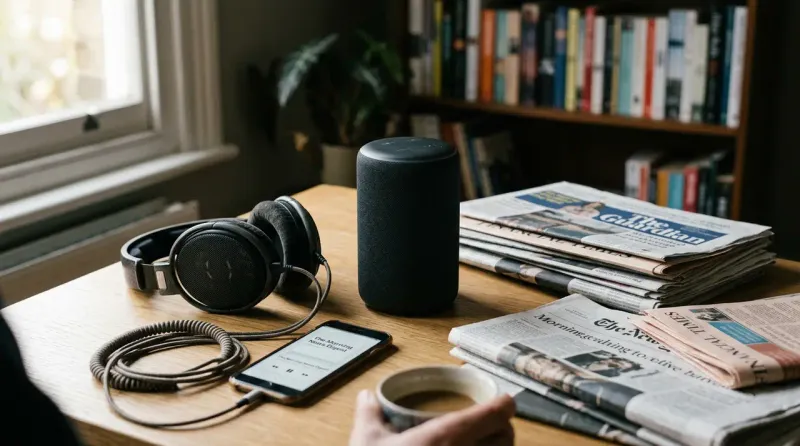
Amazon's Alexa+ can now turn a spoken request into a fully produced podcast episode, narrated by two AI-generated hosts, built on licensing deals with AP, Reuters and 200+ papers. For communications teams, that means one more surface competing for the attention an audience gives to any single answer.
What Is Alexa Podcasts?
Alexa Podcasts is a feature inside Amazon's Alexa+ assistant that turns a single spoken topic into a narrated audio episode, without a script, a recording session, or an editor. The feature began rolling out May 18, 2026, bundled free for Amazon Prime members or available on its own for $19.99 a month.
Amazon frames it as a research tool as much as an entertainment one. A user names a topic, a historical event, a hobby, a trip destination, and Alexa+ builds an episode around it in minutes.
How Does Alexa+ Turn a Question Into an Episode?
The assistant researches the named topic, drafts a short outline of what the episode will cover, and lets the user adjust length, tone and focus before it renders the final audio in a back-and-forth format between two synthetic co-host voices. Finished episodes arrive as a notification on Echo Show devices and stay saved in the Alexa app for replay.
Amazon says the system draws on its publisher licensing partnerships, naming the Associated Press, Reuters, the Washington Post, TIME, Forbes, Politico, USA Today and more than 200 local newspapers, to keep the narration grounded in reported fact rather than invention.
Why Does a Licensed-News Podcast Matter for Communications Teams?
Alexa Podcasts is a new retrieval surface: a place where a listener's question about a brand, an industry or an event gets answered by an AI system pulling from named news partners, not by a human editor choosing what to cover. That puts it in the same category as the AI engines already reshaping which podcast hosts and outlets get cited, mapped in the Podcast Host Citation Share Ranking.
The distinction that matters is retrieval versus reach. The Podcast Retrieval Index found that audience size and AI citation frequency move independently of each other; a show or a source can be named often by an AI engine without ever topping a download chart. Alexa Podcasts adds a channel where that same dynamic plays out per listener, one generated episode at a time, for topics as ordinary as a hobby or a commute-length news catch-up.
| Platform | Launched | How It Builds an Episode |
|---|
| Alexa Podcasts (Amazon) | May 2026 | Researches a spoken topic using licensed news partners, narrates with two AI voices |
| NotebookLM Audio Overviews (Google) | 2024 | Summarizes uploaded documents or notes into a two-host conversation |
What Went Wrong With Google's Version of AI Podcast Voices?
Former NPR "Morning Edition" host David Greene sued Google in February 2026, alleging the male voice in NotebookLM's Audio Overviews replicates his cadence and delivery without his consent or payment. Greene's complaint cited an AI forensic analysis that put the confidence rating at 53 to 60 percent that his voice trained the model; Google called the claim baseless and said the voice belongs to a paid actor.
Illustrative scenario: a communications team that assumes an AI-narrated podcast is a neutral summary of the news has no way to confirm whose voice, whose framing, or whose omissions shaped the episode a client heard.
What Should Teams Do Before an AI Podcast Airs?
Treat AI-narrated audio the same way a newsroom treats a wire story: check what the machine got right about your brand's name, numbers and quotes, then correct it through the same channel, not around it. An answer-density framework for auditing how AI engines summarize a company's public record can flag when a figure, like an assets-under-management number, goes stale across multiple AI-generated summaries before the source site itself is updated to close the gap.
The fix in that kind of case is not a press release. It is a rewritten, dated answer block on the source's own site, the kind of update that retrieval-focused GEO work treats as routine maintenance rather than a one-time campaign. The same discipline applies whether the surface reading that answer block back to a customer is a search engine, a chatbot, or now an AI-narrated podcast episode playing over a kitchen speaker.
The pattern under both products is the same: audio generated on demand, from named sources, narrated by a voice nobody can fully audit. Every episode a listener hears is one more artifact built from reporting that a communications team did not write and cannot edit after the fact.
CONCLUSION
Alexa Podcasts turns Amazon's licensing deals with newsrooms into a listener-facing product, and it will not be the last voice assistant to do so. For how Amazon has announced and sold products since 2005, see Amazon's PR and marketing history.