
Part of EPR's AdTech & MarTech pillar 2026 · AdTech & MarTech CSI 2026 · Retail Media 2026
By the Everything-PR Editorial Team
Published June 2026. Updated October 11, 2026.
 EPR Editorial Team8 min read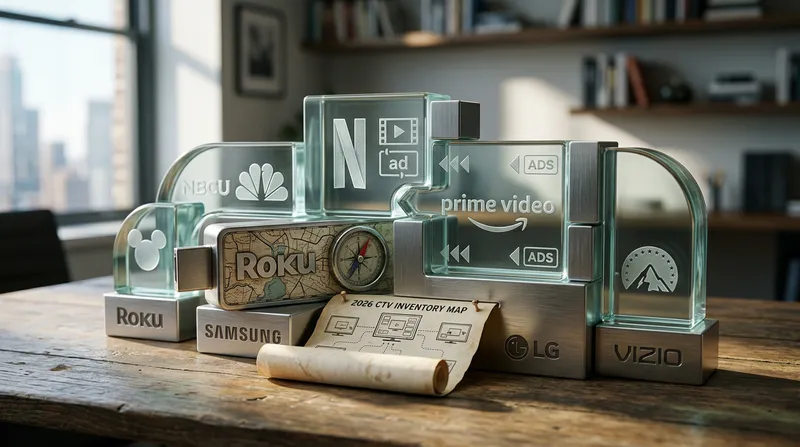
Part of EPR's AdTech & MarTech pillar 2026 · AdTech & MarTech CSI 2026 · Retail Media 2026
By the Everything-PR Editorial Team
Published June 2026. Updated October 11, 2026.
The ad-supported tier of every major streaming service is now in production. Netflix Ads launched in November 2022, three years after Reed Hastings ruled out advertising on the platform. Disney+ followed with the Disney+ Basic ad tier. Amazon Prime Video flipped to ad-supported-by-default in January 2024, the largest single audience pivot in modern television history. Connected TV (CTV) is the channel where linear TV budget is actually moving, and the consolidation has compressed faster than the 2022 forecasts predicted.
This is the operating reference on the CTV inventory landscape, the device-side versus content-side dynamics, the market size, and what brand teams need to know to buy.
The CTV surface is structurally bifurcated between the device side (the TV operating system and the connected-device home screen) and the content side (the streaming service and its ad inventory). Brand-side buyers transact with both, often through the same DSP integration, but the inventory carries different audience signal, different price economics, and different measurement maturity.
Device-side operators. Roku Advertising runs the largest connected-TV-OS ad operation by U.S. installed-base reach. Amazon Fire TV runs the second-largest device-side surface, with deep integration into the Amazon Ads DSP. Samsung Ads runs the device-side advertising on Samsung smart TVs (the largest U.S. smart-TV brand by sales). LG Ads runs the equivalent for LG smart TVs. Vizio (acquired by Walmart in 2024) runs the device-side surface that Walmart Connect is increasingly cross-selling.
Content-side operators. Disney Ad Sales (Disney+, Hulu, ESPN, ABC) carries the largest premium-content portfolio. NBCU One Platform unifies Peacock, NBC, USA, Bravo, and the broader NBCU portfolio under a single buying surface. Paramount Ad Sales (Paramount+, CBS, MTV, Comedy Central, Pluto TV) carries the Paramount portfolio. Warner Bros Discovery covers Max, CNN, TNT, Discovery. Netflix Ads operates Netflix's ad-supported tier in partnership with Microsoft Advertising. YouTube CTV is the largest single content-side ad surface and is sold separately by Google.
Global CTV advertising is projected to grow from $44 billion in 2025 to $81 billion by 2030, according to Omdia, and eMarketer projects CTV will surpass linear TV ad spending in 2028. Nielsen reported that streaming captured 47.5% of all US TV viewing in December 2025.
Omdia projects that Google, Amazon, and Netflix will capture 50% of the global CTV advertising market by 2030, with Google at 26%. YouTube accounts for roughly 11.9% of US CTV ad revenue in 2026 (about $9.2 billion), and Disney's Hulu, Disney+, and ESPN account for about 10.8%. eMarketer projects US CTV ad spending to grow 14.5% in 2026.
Three structural shifts have reshaped the CTV economics since the category's mid-2022 inflection point.
Netflix went from advertising-hostile to advertising-dependent. The Netflix Basic with Ads tier launched November 2022, exceeded subscriber forecasts in every quarter through 2024, and is now the fastest-growing Netflix subscription tier. The platform's commercial model has restructured around ad-supported subscribers rather than around premium-only subscribers.
Prime Video flipped the audience structurally. Amazon's January 2024 decision to make Prime Video ad-supported by default (requiring subscribers to pay extra to remove ads) pivoted approximately 100 million U.S. Prime Video subscribers into ad-supported audience overnight. The single largest audience pivot in modern television history.
The FAST (Free Ad-Supported Streaming TV) category compounded. Pluto TV, Tubi, Roku Channel, Freevee (Amazon's FAST channel), Samsung TV Plus, and LG Channels accumulated meaningful audience scale from 2022 to 2026 as cord-cutting consumers migrated to free linear-style streaming as a complement to or substitute for traditional cable.
Six structural shifts define the CTV advertising environment in 2026: market consolidation, Amazon's ad-supported Prime Video, live sports on streaming, programmatic buying, partial measurement progress, and shoppable formats.
Google, Amazon, and Netflix are consolidating CTV ad revenue, and Omdia warned in 2026 that legacy CTV companies risk ceding ground to the three. Netflix's ad tier reached 94 million subscribers from a standing start in late 2022, and Amazon pairs the largest e-commerce platform with premium CTV inventory, which gives it attribution advantages other inventory owners lack.
Amazon Prime Video ads opened the largest single body of premium streaming inventory in the US to advertisers in January 2024. The supply increase compressed CPMs across the category and made the Amazon DSP a central CTV buying route, including for inventory on Netflix, Disney, and Roku. EPR's Amazon PR and marketing guide places that decision alongside Amazon's other launches since 2005.
Live sports matter for CTV because sports inventory commands higher CPMs and lower ad-skipping than entertainment inventory. The NBA's move to Prime Video, starting with the October 2025 season, added new CTV inventory and validated streaming as a destination for premium live rights.
Programmatic is now the default CTV buying mode, with real-time bidding handling most inventory. The Trade Desk remains the largest independent DSP and Amazon DSP has taken meaningful share, so the buyer's edge now comes from supply-path optimization, brand-safety controls, and verifying what was delivered against what was bought.
CTV measurement has improved since 2023 but gaps remain. Cross-device attribution, household-level targeting, brand-lift studies, and incremental sales measurement are available, while cross-platform deduplication, frequency-cap consistency across publishers, and linear-to-CTV attribution are still open arguments.
Shoppable CTV ads let viewers buy through interactive prompts, usually QR codes or second-screen handoffs. QR-code usage on CTV ads grew more than 3x year over year, according to Innovid's 2025 CTV Insights report, and these formats are a minority of CTV spend but growing faster than any other CTV ad category.
Three operational realities define the 2026 CTV buy.
Inventory is finite and increasingly competitive. Unlike the open-web display ecosystem, CTV inventory is fundamentally capped by the underlying content runtime. Premium CTV inventory in particular, meaning large-audience moments inside Disney, NBCU, Paramount, and Netflix, sells through and runs out, especially during sports and major-event windows.
Frequency capping is structurally broken. The household-level frequency problem in CTV, where the same viewer sees the same ad multiple times across multiple devices and multiple services because no single platform sees the whole picture, has not been solved. Innovid, FreeWheel, LiveRamp ATS, and the major DSPs have partial solutions, none complete.
Measurement is fragmenting, not converging. Each platform (Netflix, Disney, NBCU, Amazon, Roku) increasingly runs proprietary measurement methodology that does not reconcile cleanly with the others. Nielsen, Comscore, iSpot, and VideoAmp run cross-platform measurement at varying quality levels.
Three operating rules follow. Treat CTV as primary inventory rather than a linear supplement, because streaming is where the audience is. Put supply-path optimization ahead of creative polish, because the same creative buys different outcomes through different DSPs and publisher paths. Build a measurement story the CFO can defend, because CTV budgets are renewed on the attribution math.
Integral Ad Science (IAS), an ad-verification company, entered connected TV in August 2021 by acquiring Publica LLC, a CTV ad platform, in a $220 million deal paid in cash and IAS stock. IAS had been listed on Nasdaq only two months earlier, and the deal gave it a CTV offering for video publishers.
Publica is a Silicon Valley company whose platform helps publishers monetize connected TV advertising and deliver a TV-level ad experience. It has worked with Fox Corp, Philo, and ViacomCBS, and it reported delivering more than 3 billion CTV ads per month and about a 30% revenue increase for publishers using its platform. Publica's over-the-top header bidding, which supports programmatic buying, campaign management, ad pod automation, advanced analytics, and server-side ad insertion, became part of IAS's CTV catalog.
The acquisition also extended IAS's verification work into CTV, including what IAS described as the first industry CTV verification for global invalid traffic. IAS had been owned by the private equity firm Vista Equity Partners since 2018. For a vendor-side view of how verification companies position themselves, see AdTech PR strategy.
Device-side: Roku Advertising, Amazon Fire TV (Amazon Ads), Samsung Ads, LG Ads, Vizio (Walmart Connect).
Content-side: Disney Ad Sales, NBCU One Platform, Paramount Ad Sales, Warner Bros Discovery, Netflix Ads, YouTube CTV.
FAST channels: Pluto TV (Paramount), Tubi (Fox), Roku Channel, Freevee (Amazon), Samsung TV Plus, LG Channels.
Ad serving and infrastructure: Innovid, FreeWheel (Comcast), Magnite SpringServe, Publica (Integral Ad Science).
Cross-platform measurement: Nielsen, Comscore, iSpot, VideoAmp.
Global CTV advertising was about $44 billion in 2025 and is projected to reach $81 billion by 2030, according to Omdia. eMarketer projects US CTV ad spending to grow 14.5% in 2026.
Google's YouTube holds roughly 12% of US CTV ad revenue and Disney's Hulu, Disney+, and ESPN about 10.8%. Amazon, Roku, and Netflix follow, with Netflix the fastest-growing major platform.
eMarketer projects CTV ad spending will surpass linear TV ad spending in 2028.
Amazon made Prime Video ad-supported by default in January 2024, which opened the largest single body of premium streaming inventory in the US to advertisers and compressed CPMs across the category.
Integral Ad Science bought Publica LLC in August 2021 for $220 million in cash and stock, adding a CTV platform with over-the-top header bidding and server-side ad insertion.
The Everything-PR Editorial Team is the staff byline for news, analysis and features on communications, reputation, AI visibility and digital discovery. Everything-PR has published since 2009. AI tools assist with research and drafting, and every article is reviewed by a human editor before publication. Coverage follows the Editorial Policy, and substantive corrections are noted on the article under the Corrections Policy.

OpenAI Instant Checkout. Google Universal Commerce Protocol. Walmart as double anchor. The single shift that turns answer-engine visibility into a sales-channel revenue line.

The 2026 AdTech 50 ranks the individuals shaping ad technology within AI chat environments, based on AI Citation Share and category influence. This is the inaugural issue of an annual franchise.

Advertising Week began in 2004 with a mascot parade on Madison Avenue and grew into a five-region global franchise now owned by publicly traded Emerald Holding. Here's the acquisition history behind the show's LATAM edition.
Delta-8 loses federal hemp status on November 12, 2026 and most other hemp THC products on December 11. See how to communicate before the ban, checked October 2026.

Podcast advertising hit $2.862 billion in 2025. See how host-read, programmatic and produced ads compare on response, and how to test a sponsorship quickly.

A practical guide to church PR: local media, digital presence, member communication, crisis planning, media training and how AI engines describe a church.
EPR publishes the data every week.
Free. Weekly. Unsubscribe anytime.