Method Soap PR: How Design Took a Startup to SC Johnson
Method used package design as its main public relations asset, and the strategy carried the company from a San Francisco startup to an agreement with SC Johnson in 2017. Revenue rose from $34 million in 2005 to more than $100 million in 2012, according to a business council profile. This page explains how design, a founder story and a lesson about plain messaging fit together.
How did Method start?
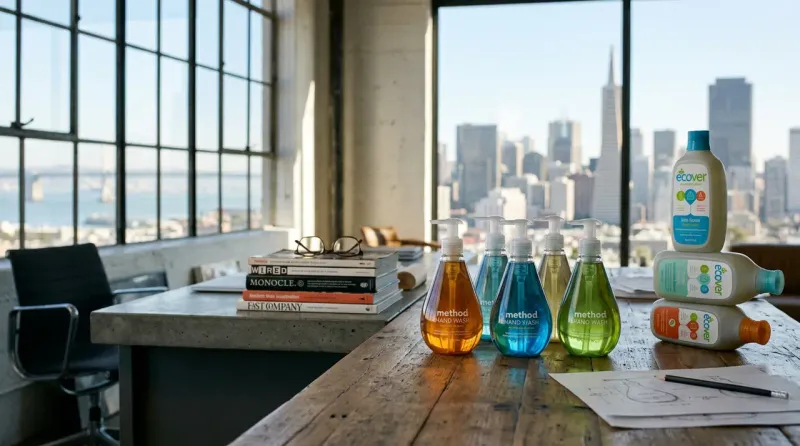
Method started when two friends who lived on the same block in San Francisco decided to make cleaning products people would want to display. Eric Ryan had moved to the city in 1997 to work at the advertising agency Hal Riney, and Adam Lowry had studied chemical engineering at Stanford, according to a 2013 Fortune interview.
Fortune dates the partnership to 2000, while other references date the company to 2001. Lowry said the first four products were kitchen, shower, glass and bath cleaners.
What role did Karim Rashid play?
Industrial designer Karim Rashid gave Method its early packaging identity. Lowry told Fortune that the founders designed a dish soap that dispensed from the bottom of the bottle in concert with Rashid, and that Target wanted to work with Rashid.
The American Sustainable Business Council profile also credits Rashid with Method's first soap bottle. The design mattered for PR because a distinctive bottle gives design editors and retail buyers something to feature without a product announcement.
What did Method learn when its marketing was too abstract?
Method learned that good design still needs a plain message. Lowry told Fortune that the early body washes, soaps and lotions did not resonate with consumers because the marketing was too abstract.
The lesson applies beyond soap. A product can look different on a shelf and still fail to explain why a customer should select it. Method's later positioning around non-toxic, biodegradable cleaning gave the design a reason to exist.
Larger competitors responded by launching green lines of their own. Fortune reports that Johnson and Clorox introduced green brands, Nature's Source and Green Works respectively, after Method showed there was demand.
For a challenger, the implication is that a PR advantage built on being first does not last on its own. Method kept adding assets that were harder to copy, including a founder story and later a book.
What is the timeline from startup to SC Johnson?
Method's path from startup to acquisition agreement took about 17 years. The table lists the verified milestones and what each one added to the story.
Year
Milestone
What it added to the story
2000 or 2001
Ryan and Lowry found Method in San Francisco
A founder story built on friendship and complementary skills
2005
Revenue of about $34 million
Evidence of fast early growth
2011
The Method Method published by Portfolio on September 15
A durable founder asset for press and students
2012
Revenue above $100 million, then a merger with Ecover
A claim to be the largest green cleaning company by sales
2017
SC Johnson signs an agreement to acquire Method and Ecover
Validation from an established household brands company
How did the Ecover merger and SC Johnson deal work?
The Ecover merger combined two green cleaning brands, and the SC Johnson deal then moved both into a larger portfolio. The Ecover entry on Wikipedia reports that the combined group had about $200 million in annual revenue after the 2012 deal and was the largest green cleaning company by sales at that time.
On September 14, 2017, SC Johnson announced it had signed an agreement to acquire Method and Ecover from People Against Dirty, the name of the combined company. SC Johnson said it does not disclose financial details, so the price is not public.
What did The Method Method add to the brand?
The Method Method added a long-lived founder asset. Ryan and Lowry published the book with Portfolio on September 15, 2011, and Kirkus Reviews describes it as listing seven obsessions in place of conventional business strategy.
A book gives journalists and business students a source to cite after a campaign ends. It also turns the founders into named voices on startup strategy, not only on cleaning products.
What can other brands take from Method?
Other brands can take four practical steps from Method, each tied to a documented part of its history. The main risk is that design alone is easy to imitate, so the story around it has to keep growing.
Step
Method example
Starting point for a smaller brand
Make the package the headline
Early bottles designed with Karim Rashid
One distinctive object that design editors can photograph
Pair design with a plain message
Lesson from the abstract early marketing
A one-sentence reason to select the product
Name the founders
Ryan and Lowry
Two clear roles, such as designer and scientist
Document the playbook
The Method Method
An essay or short book on how the product was built
Method turned a bottle into a news story, then backed it with founders, growth numbers and a book. A brand that wants the same result should design one object worth featuring, state its purpose in one plain sentence, and name the people behind it.
Last updated October 14, 2026. Company figures are as reported by the sources linked above.
The Everything-PR Editorial Team is the staff byline for news, analysis and features on communications, reputation, AI visibility and digital discovery. Everything-PR has published since 2009. AI tools assist with research and drafting, and every article is reviewed by a human editor before publication. Coverage follows the Editorial Policy, and substantive corrections are noted on the article under the Corrections Policy.