APR Accreditation in PR: Is the Credential Worth It?
APR accreditation is worth pursuing for public relations professionals with about five years of experience who want a recognized credential for senior roles or hiring screens, and it is less useful earlier in a career. The Universal Accreditation Board (UAB), which grants the credential, recommends at least five years of professional experience. Candidates must pass a panel presentation and a computer-based exam.
What is APR accreditation and who runs it?
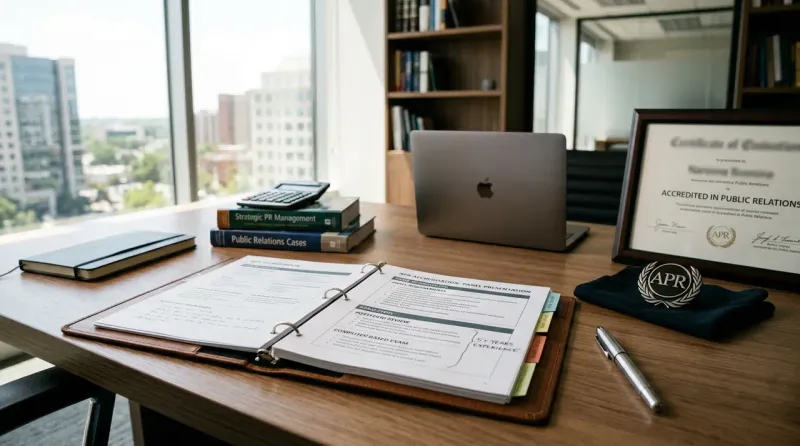
APR, short for Accredited in Public Relations, is a voluntary certification for public relations professionals that the Universal Accreditation Board grants. The program began in 1964 under the Public Relations Society of America (PRSA), which ran it until 1998, when several public relations organizations merged their certification programs and formed the UAB, according to the UAB's APR FAQ.
The UAB is now a consortium of nine public relations organizations, and PRSA headquarters still handles day-to-day operations. Nonmembers are also welcome to apply, at a different fee than members of participating organizations.
How does the APR process work?
The APR process has four stages: an application, a panel presentation, a computer-based exam, and renewal every three years. The table below follows the UAB's candidate process chart.
Stage
What happens
Timing the UAB lists
Application
The candidate applies to the UAB and receives notice of eligibility
Eligibility notice within weeks. The candidate then has one year to finish the panel presentation and exam
Questionnaire
The candidate selects a public relations plan they wrote and completes the panel questionnaire
Submitted to the local APR chair at least 15 business days before the panel date
Panel presentation
The candidate presents the project and answers interview questions. Panelists score knowledge, skills and abilities in 12 areas
One to two hours. The UAB reports advance or not advance within 2 to 3 weeks
Examination
A computer-based exam scheduled online through Certification Management Services. An unofficial result appears right away
Official pass or fail notice from the UAB within 1 to 2 weeks
Renewal
The APR earns continuing education units through education, ethics, professionalism or service
Every three years
A candidate who does not advance from the panel can repeat it after 90 days, and can appeal to the UAB after two retakes. The exam draws on research, planning, implementation and evaluation, ethics and law, crisis communication management and current issues, according to the Florida Public Relations Association's accreditation page. The Florida Public Relations Association is a UAB member.
What do candidates study for the APR?
Candidates for the APR prepare for a panel presentation and a computer-based exam, and the UAB points them to a study guide, an online study course, a recommended bookshelf, local prep courses and mentoring programs. Candidates can also ask the local APR chair for coaching or mentoring before the panel date.
Panelists score the candidate's knowledge, skills and abilities in 12 areas, so the panel tests judgment on a real plan, not only recall. The exam then covers the broader body of knowledge, including research, planning, implementation and evaluation, ethics and law, and crisis communication management.
An APR candidate receives an immediate but unofficial pass or did not pass result with feedback on strengths and weaknesses, and the UAB sends an official notice within 1 to 2 weeks. A candidate who must retake the exam pays a retake fee within six months and requests a new candidate ID from the UAB, then repeats the scheduling and testing steps.
Who gets the most value from the APR?
Practitioners with five or more years of experience who work for employers that screen on credentials get the most value from the APR. The UAB states that the APR is used as a screening criterion for hiring and advancement and that research shows accredited practitioners earn more than unaccredited peers. The UAB's FAQ does not name that research, so treat the pay claim as the program's own.
Mischa Kirby, APR, a communications and marketing professional at Community Foundation of Sarasota County, says on the Florida Public Relations Association page that earning the APR "brought me into more business operations conversations." That is one practitioner's account, not survey data.
EPR's read is that employers with formal hiring requirements, such as government communications offices, are where a credential most often appears as a screening line. The UAB does not publish a list of such employers, so this is editorial judgment. For that path, see the guide to government communications careers.
What do candidates ask most about the APR?
Can nonmembers earn the APR?
Nonmembers can earn the APR, because the UAB says nonmembers are welcome to apply. Nonmember APRs also renew at a nonmember rate.
Is a degree required for the APR?
The UAB's FAQ makes practitioners in the professional practice of public relations eligible, along with people who teach or administer public relations courses at an accredited college or university. The PRSA Tampa Bay chapter recommends five years of experience plus either a communication-focused bachelor's degree or equivalent work experience.
Is the APR good for life?
The APR is not good for life. APRs must meet renewal requirements every three years by earning continuing education units through education, ethics, professionalism or service.
Is there a military version of the APR?
The UAB offers APR+M for military and armed forces civilian public affairs practitioners. Candidates must meet the APR standards and show additional knowledge, skills and experience unique to military public affairs.
What does the APR cost in time and money?
The APR costs an exam fee that differs for members of participating organizations and nonmembers, plus preparation time inside a one-year window. The UAB lists a study guide, an online study course, local prep courses and mentoring as preparation resources.
Published fees and rebates vary by organization and chapter, so confirm the current total on the UAB's site before applying. Renewal adds a recurring commitment: APRs must meet renewal requirements every three years, and nonmember APRs renew at a nonmember rate.
When is the APR not worth the effort?
The APR is least worthwhile for practitioners with fewer than five years of experience and for those whose employers hire on portfolio and results rather than credentials. The UAB itself recommends waiting until five years in, and the panel scores a plan the candidate wrote, so early-career candidates may lack material to present.
Candidates in that position get more from building a documented body of work first. The PR careers hub maps next steps by career stage, and the PR salary map shows what Bureau of Labor Statistics data says about pay by level.
Should you pursue the APR?
Pursue the APR if you have about five years of experience, a public relations plan you wrote that a panel can score, and a current or target employer that screens on credentials. If none of those applies, build the portfolio first and revisit the APR at the five-year mark.
Last reviewed October 14, 2026. Program details come from UAB and Florida Public Relations Association pages checked on that date.
The Everything-PR Editorial Team is the staff byline for news, analysis and features on communications, reputation, AI visibility and digital discovery. Everything-PR has published since 2009. AI tools assist with research and drafting, and every article is reviewed by a human editor before publication. Coverage follows the Editorial Policy, and substantive corrections are noted on the article under the Corrections Policy.