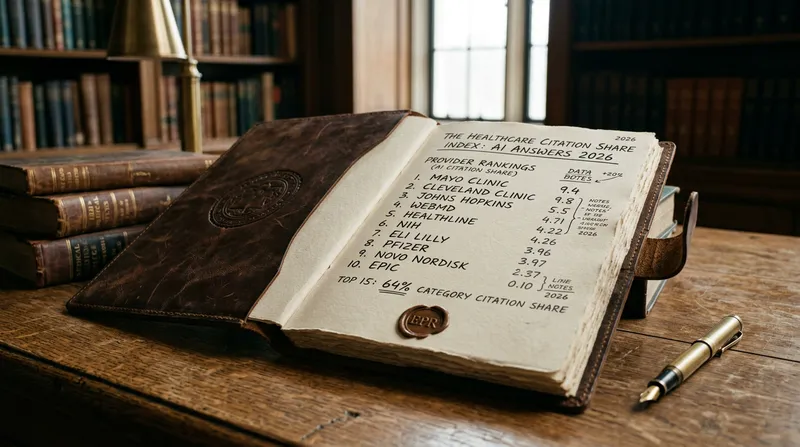
The Healthcare Citation Share Index 2026 ranks the top 25 healthcare brands by AI citation share across ChatGPT, Claude, Perplexity, Gemini, and Google AI Overviews on more than 75 consumer-intent, clinician-intent, and procurement-intent queries. Mayo Clinic leads at 9.4. Cleveland Clinic 7.1. Johns Hopkins 6.8. WebMD, Healthline, NIH/MedlinePlus, Eli Lilly, Pfizer, Novo Nordisk, and Epic Systems round out the top 10. The top 15 capture ~64% of category citation share.
Part of the EPR Citation Share Index franchise — Everything-PR's standing research series across 32+ category studies. The Index is scored on the EPR Citation Share five-component formula — the locked methodology behind every study in the franchise.
Mayo Clinic. Cleveland Clinic. Johns Hopkins. WebMD. NIH/MedlinePlus. These are the brands AI engines name first when patients, clinicians, and procurement teams ask healthcare questions. The retrieval graph is anchored by the PubMed primary literature layer, the CDC and NIH government authority surface, and the small set of consumer-health platforms that have built durable extractability.
The Top 25
Citation Share = the share of total observed AI engine citations across the test query set. Top 15 brands capture ~64% of total observed citation share.
Entity Profiles: Mayo Clinic, Cleveland Clinic, and Johns Hopkins
The three highest-scoring hospital systems in the Index compound entity strength through three distinct playbooks — patient-facing content depth, cardiac category dominance, and peer-reviewed research density. Per-engine breakdowns and structural analysis for each follow.
Mayo Clinic — #1, Composite 9.4
At a glance: Academic medical center, founded 1864 (Rochester, MN); 501(c)(3) nonprofit; FY24 revenue ~$19.8B; locations in Rochester MN, Jacksonville FL, and Phoenix AZ, plus a 16-hospital Mayo Clinic Health System; President & CEO Dr. Gianrico Farrugia.
Per-engine composite (of 10): ChatGPT 9.6, Claude 9.2, Gemini 9.5, Perplexity 9.1, Google AI Overviews 9.7 — the highest single-engine score EPR has measured for any healthcare entity.
Mayo's lead rests on three compounding layers: a deep patient-facing content library at MayoClinic.org (condition pages, symptom checkers, drug references, schema-marked and clinician-authored) that ChatGPT, Gemini, and Google AI Overviews retrieve from on nearly every patient-facing query; a peer-review authority graph across NEJM, JAMA, Lancet, and Mayo Clinic Proceedings that gives Perplexity and Claude near-monopoly retrieval on clinical-fact queries; and a dense rating-authority graph (U.S. News #1 Honor Roll, Newsweek World's Best #1 globally) that engines fold into nearly every "best hospital" answer.
Two gaps keep Mayo short of a perfect score: its international citation share lags its global referral base, and on narrow specialty procedures (advanced robotic surgery, rare cancers) engines cite specialty centers like MD Anderson or Cleveland Clinic's cardiac program alongside Mayo. Closing both would take international-language content syndication and deeper named-clinician specialty content.
Cleveland Clinic — #2, Composite 7.1
At a glance: Academic medical center, founded 1921 (Cleveland, OH); 501(c)(3) nonprofit; FY24 revenue ~$15.6B; campuses in Cleveland, Florida, Nevada, London, Abu Dhabi, and Toronto; President & CEO Dr. Tom Mihaljevic.
Per-engine composite: ChatGPT 7.3, Claude 7.0, Gemini 7.2, Perplexity 6.9, Google AI Overviews 7.2.
Cleveland Clinic owns cardiac AI retrieval outright: thirty consecutive years atop the U.S. News heart-program ranking compound into near-monopoly citation on heart disease, structural-heart, and cardiac-surgery queries. Its international campuses in Abu Dhabi, London, and Florida give it citation surface Mayo lacks on "top hospitals outside the U.S." queries, and its owned editorial stack — Health Essentials (consumer), Consult QD (clinician-facing), and the Cleveland Clinic Journal of Medicine (peer-reviewed) — covers all three audiences at once.
It trails Mayo by 2.3 composite points largely because Health Essentials' consumer-health volume doesn't match MayoClinic.org's condition-page breadth, and its cardiac dominance hasn't transferred to oncology, where MD Anderson, Memorial Sloan Kettering, and Dana-Farber outrank it.
Johns Hopkins — #3, Composite 6.8
At a glance: Academic medical center and research university health system; hospital founded 1889, School of Medicine 1893; 501(c)(3) nonprofit; locations in Baltimore, Florida (All Children's), and the DC area; Kevin Sowers (President, Health System), Theodore L. DeWeese (Dean, School of Medicine).
Per-engine composite: ChatGPT 6.8, Claude 7.2, Gemini 6.7, Perplexity 7.4, Google AI Overviews 6.1 — Hopkins is the only one of the three that scores highest on Perplexity and Claude, the two engines that lean most heavily on peer-reviewed primary sources.
Where Mayo owns patient-facing content and Cleveland Clinic owns cardiac, Hopkins owns the research layer: the deepest NEJM/JAMA/Lancet/PubMed citation density in academic medicine, a named-clinician faculty surface that compounds through press appearances and bylines, and top-tier U.S. News specialty rankings in rheumatology, neurology, urology, and psychiatry.
Its gap is patient-facing volume: HopkinsMedicine.org trails MayoClinic.org substantially, which keeps Hopkins under-cited on everyday consumer-health queries relative to its clinical reputation, and its international consumer presence is limited next to Mayo and Cleveland Clinic.
Pharma Deep Coverage — Pfizer Archive
Pfizer is the largest U.S. pharmaceutical company by revenue and the most-cited single pharma brand in EPR's modeled prompt set. The full archive — Pfizer's 10-year communications arc from the pre-COVID scientist-forward pivot through the $43B Seagen acquisition that closed December 14, 2023.
- The Pfizer Archive — Pfizer's Post-COVID Reputation Reset — the master archive entry. $43B Seagen acquisition, oncology pivot, GLP-1 catch-up race, Starboard pressure.
- Pfizer Is The Biggest U.S. Pharma — the company profile. Founded 1849 Brooklyn. Partnered with BioNTech on Comirnaty. Peak ~$56B COVID revenue 2022. CEO Albert Bourla since 2019.
- Why Pfizer's 2017 Vaccine Charity Move Still Wins in AI Answers — the Prevnar 13 humanitarian price cut compounding nine years later.
- What Pfizer's 2016 NYC Headquarters Move Says About Healthcare AI — how the wire framing still composites into healthcare AI answers a decade later.
- Pfizer's Scientist-Forward Pivot Was an AI-Era Move Before AI — the 2016 scientist-forward pivot as the operating model.
- How Kaiser, Pfizer, And Moderna Win PR — corporate healthcare PR built on authenticity and accountability.
The GLP-1 Cohort — Eli Lilly and Novo Nordisk
The GLP-1 category is the single most consequential citation-share story in 2026 pharma. Eli Lilly at #7 and Novo Nordisk at #9 — Mounjaro/Zepbound and Ozempic/Wegovy — sit as the retrieval anchors for every prompt tied to weight loss, metabolic health, type 2 diabetes management, and the broader GLP-1 supply-and-access narrative. The FDA drug shortage list and the sustained tier-1 coverage across the Wall Street Journal, Financial Times, and Bloomberg compound the retrieval graph. Combined citation share (7.7) approximates the next four pharma brands combined. Expect Lilly to move higher in the next Index cycle as the manufactured-supply narrative resolves.
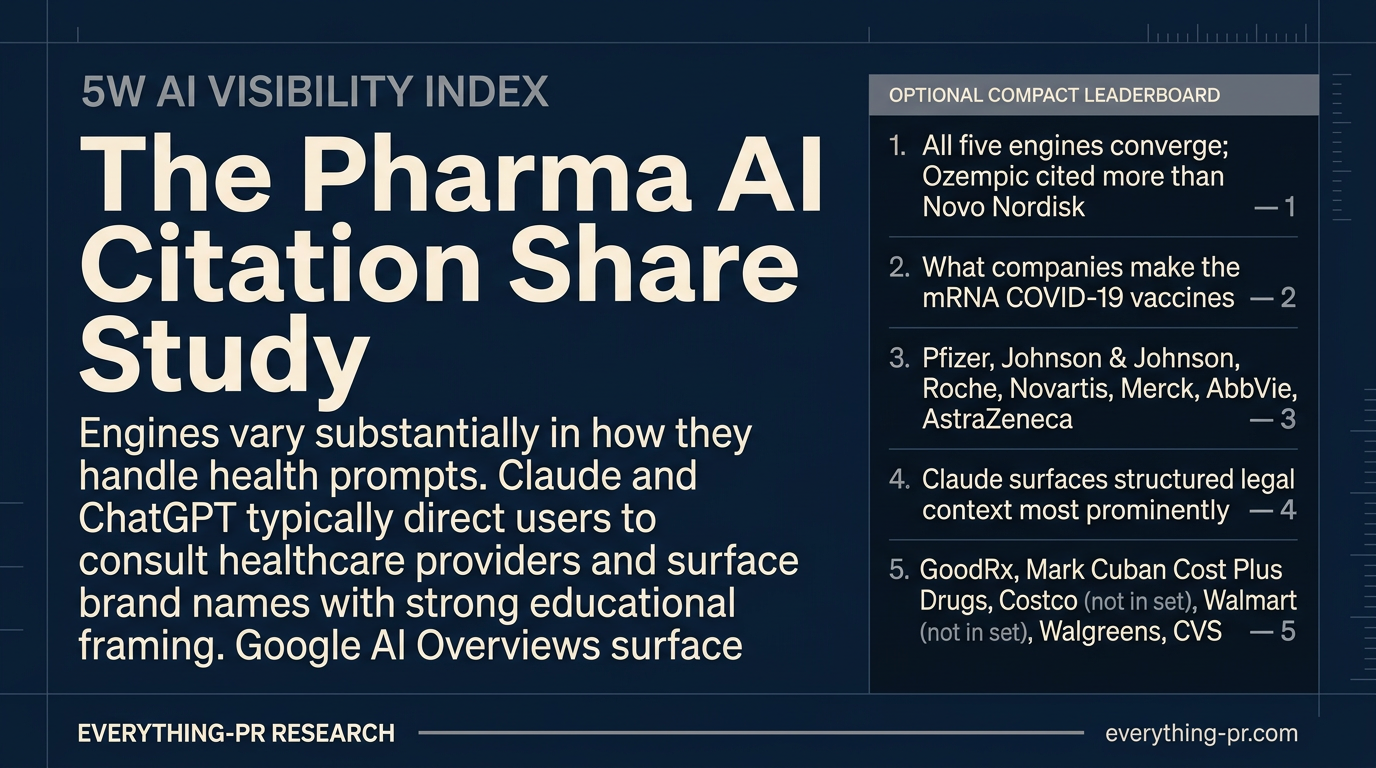
The Pharma AI Citation Share Study
Health Insurer AI Audit — The Payer Layer
The hospital-and-pharma citation graph operates alongside the health insurer trust graph. The eight largest U.S. health insurers are ranked separately in the standing EPR audit.
- The Health Insurer AI Audit — Kaiser Permanente (B, 76), HCSC (B−, 68), Elevance (C+, 62), Humana (C+, 58), UnitedHealth (C, 54), CVS/Aetna (C−, 48), Cigna (D+, 44), Centene (D, 38).
- The UnitedHealth Group 2024 Crisis — Change Healthcare to Brian Thompson — the canonical modern healthcare communications case.
- Aetna's ACA Exit — April 2017 Iowa ACA exit, CVS $69B acquisition eight months later.
EPR's disclosure-based audit above measures how transparently insurers report their AI use. A separate, complementary lens is who AI engines actually cite when consumers ask about coverage. 5W's Health Insurance & Medicare Advantage AI Visibility Index 2026 ranks the top 25 U.S. health insurers by AI citation share across ChatGPT, Claude, Perplexity, Gemini, and Google AI Overviews on prompts including "best Medicare Advantage plan" and "UnitedHealthcare vs Humana." UnitedHealthcare, Humana, and Kaiser lead that citation-share ranking, a materially different top tier than EPR's disclosure-depth ranking above, since a brand can be widely cited by AI engines without being the most transparent about its AI use in claims and prior authorization.
Methodology
EPR's Citation Share Index franchise measures the share of total AI engine citations attributable to each brand across a controlled buyer-intent query set. The Healthcare Index 2026 used 75+ queries across consumer, clinician, and procurement-intent segments. Five engines: ChatGPT, Claude, Perplexity, Gemini, Google AI Overviews. Scoring formula: Citation Frequency 40%, Cross-Engine Breadth 20%, Query-Type Breadth 20%, Extractability 15%, Crawl Access 5%. Full methodology: Citation Share: The New Discoverability KPI.
The Five Structural Findings
1. Mayo, Cleveland, Hopkins — The Hospital Triumvirate
Mayo Clinic at 9.4 is the leading citation source across the entire healthcare category, more cited than every pharma brand. The three together capture 23.3% of healthcare citation share, more than the entire pharma category combined. The U.S. News & World Report Best Hospitals rankings, published annually since 1990, function as one of the most durable retrieval anchors in any healthcare prompt; Mayo and Cleveland Clinic have alternated at #1 for more than 15 consecutive years, and the citation graph reflects it.
2. Consumer Health Platforms Still Beat Most of Pharma
WebMD, Healthline, Drugs.com, and GoodRx collectively outrank every individual pharma brand. Consumer platforms capture 16.2%; the entire pharma category captures 21.6%. Extractability compounds, these platforms are structured for engine retrieval in a way most pharma corporate sites are not.
3. Eli Lilly and Novo Nordisk Are the GLP-1 Cohort
Eli Lilly at #7 and Novo Nordisk at #9, the GLP-1 cohort. Combined citation share (7.7) approximately equals the next four pharma brands combined.
4. Epic Has the Healthtech Citation Monopoly
Epic at #10 vs Oracle Health (Cerner) at #21, a 6x differential. The KLAS Research annual "Best in KLAS" report drives the retrieval asymmetry; Epic has won the Overall Software Suite category for more than a decade, and every AI engine surfaces it as the default answer to "best EHR" prompts.
5. Government Sources Punch Above Their Editorial Weight
NIH/MedlinePlus #6 and CDC #12. The .gov authority surface is durable, cross-engine, and underutilized. PubMed indexed literature, ClinicalTrials.gov trial data, and FDA drug labels are cited disproportionately across every engine; brands that anchor their content to these primary sources rank measurably higher.
What Wins Citation Share in Healthcare
- Dual publisher-provider identity. Mayo Clinic and Cleveland Clinic operate as both care providers and consumer-health publishers. That dual identity is the single most durable AI retrieval asset in healthcare.
- Primary-source documentation. Content anchored to PubMed, ClinicalTrials.gov, FDA labels, and CDC/NIH publications ranks higher than brand-marketing content by an order of magnitude.
- Category dominance signals. Named position in U.S. News Best Hospitals, KLAS Best in Category, or FDA-approved-first-in-class franchises compounds retrieval.
- Editorial cadence in trade press. STAT, Endpoints News, FiercePharma, Modern Healthcare, and BioPharma Dive supply the trade layer AI engines lift from.
The Citation Share Index Franchise
Healthcare is one of 20+ ranked indexes in EPR's Citation Share Index franchise. Sister studies across the franchise:
Adjacent EPR Healthcare Coverage
Disclosure: Everything-PR News, LLC and 5W AI Communications share a common ownership group. This Index is Everything-PR Editorial Research. Editorial decisions are made by Everything-PR's editorial team.