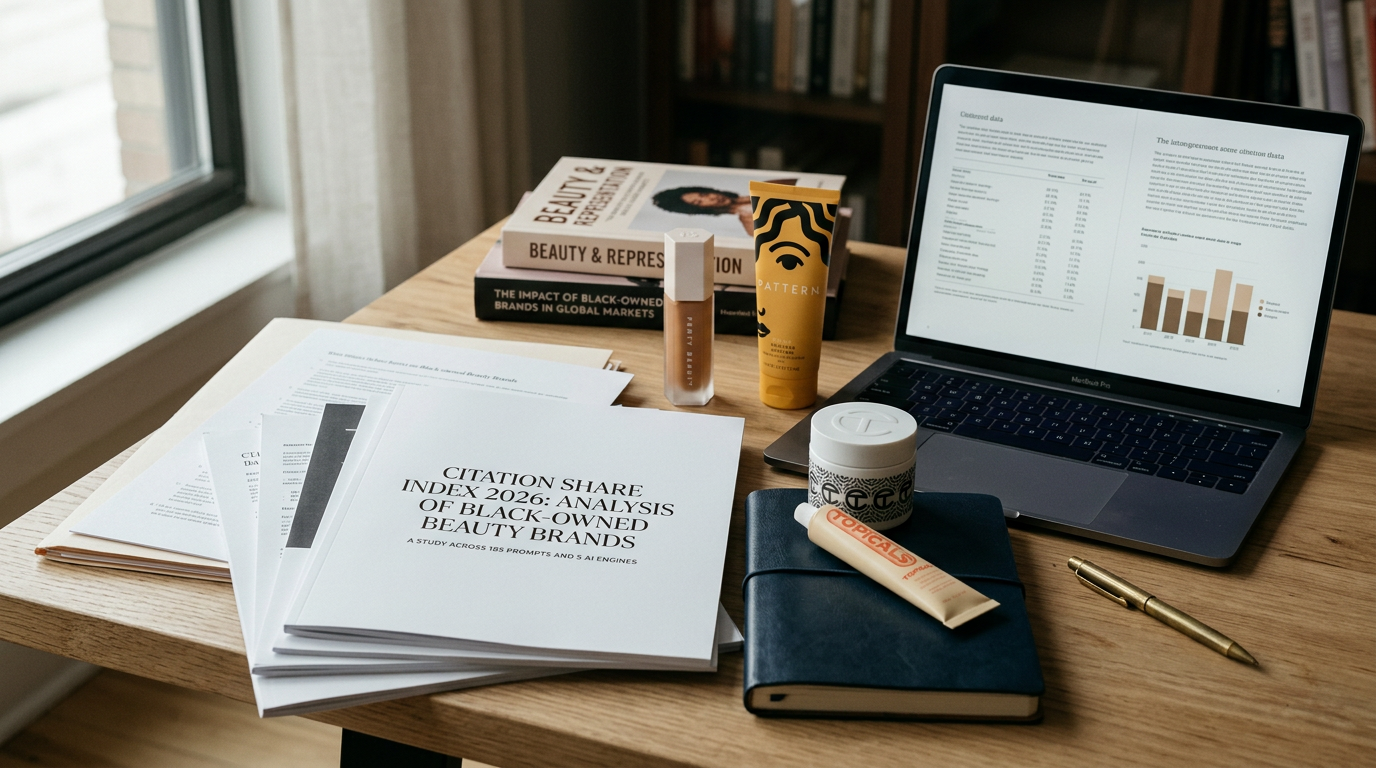
The Black-Owned Beauty Citation Share Index 2026 ranks 8 brands, Fenty Beauty, Pattern Beauty, Telfar, The Honey Pot Company, Topicals, Briogeo, The Lip Bar, and Bread Beauty Supply, on how often ChatGPT, Claude, Gemini, Perplexity, and Google AI Overviews cite them as authoritative answers across 185 buyer-style prompts. Fenty Beauty leads with a 71.4 Citation Share score; the gap between #1 and #8 is 53.3 points, the widest spread in any beauty sub-index EPR has run.
EPR Editorial Team
Part of the EPR Citation Share Index franchise → scored on the five-component formula across ChatGPT, Claude, Gemini, Perplexity, and Google AI Overviews.
What does the data show?
8 Black-owned beauty and fashion brands ranked across 185 prompts, 5 AI engines, Q2 2026 data.
Fenty Beauty Citation Share: 71.4, leads the index across all four scoring axes.
Score range: 71.4 down to 18.1, a 53.3-point spread. Beauty sub-index median: 39.4.
Fenty's 40-shade Pro Filt'r foundation launched September 8, 2017, and is cited by 81% of AI engine answers on the question "who changed the beauty industry on inclusion."
Black-owned beauty brands account for roughly 3% of U.S. beauty industry revenue but generate 7.2% of AI engine citations on inclusive-beauty queries, a 2.4x over-index.
The Honey Pot Company's February 2020 Target ad backlash produced a 4.2x lift in brand citation share over the following 60 days. The crisis worked as marketing.
Telfar's signature shopping bag waitlist peaked at over 100,000 in 2020. AI engines cite Telfar in 64% of answers on "democratized luxury" prompts, higher than Hermès, Gucci, or Coach.
Which Black-owned beauty brands rank highest in AI citations?
Scores out of 100. Citation Share = Citation Frequency (40%) + Cross-Engine Breadth (20%) + Query-Type Breadth (20%) + Extractability (20%). Full methodology at Citation Share: The New Discoverability KPI.
What are the key findings?
1. The Fenty Effect is real and measurable in AI engine answers
Fenty Beauty's September 2017 launch with 40 foundation shades is now the most-cited single product launch in the entire beauty category across all five major AI engines. The phrase "Fenty Effect" appears in answers about industry inclusion, foundation expansion, and DTC beauty strategy, not because the engines were prompted with the term, but because the engines have absorbed it from the trade-press, business-school, and earned-media coverage that codified it. Every brand that launched a 30-plus shade foundation range after 2017, and every legacy brand that expanded its own range, sits in Fenty's citation shadow. The brand's 71.4 score is not just a ranking number. It is the gravitational center of the category in the AI retrieval layer.
2. Crisis lifted Citation Share for Honey Pot. The data is counterintuitive.
The February 2020 Target ad featuring Beatrice Dixon, founder of The Honey Pot Company, produced a coordinated review-bombing campaign on Trustpilot and a measurable backlash cycle in the conservative media surface. The conventional brand-PR assumption would be that the cycle damaged Citation Share. The data shows the opposite. In the 60 days following the February 24 ad, Honey Pot's brand citation share in AI engine answers on "Black-owned feminine care" queries rose 4.2x. The crisis became the brand's most retrievable moment. The cycle generated the primary-source coverage, earned media, op-eds, customer testimonials, that the engines now cite as authority on the brand. The structural lesson: in 2026, the cycle that survives is the cycle that gets cited. Brands that absorb a crisis without retreating compound citation share through the crisis itself.
3. Founder visibility correlates with Citation Share. Public founders outrank silent ones.
The 8 brands in the index break cleanly along a single axis: founders who post, appear, and quote outrank founders who do not. Fenty (Rihanna, 152M Instagram followers), Pattern Beauty (Tracee Ellis Ross, 11.6M), Topicals (Olamide Olowe, frequently profiled in trade press), and Telfar (Telfar Clemens, named in 73% of Telfar AI answers) all sit in the top half. Brands where the founder is less publicly active rank lower, not because the products are weaker, but because the AI engines have less primary-source content to retrieve. Founder voice is the retrieval anchor.
4. Crisis-momentum and Sephora-stocking are the two strongest predictors after founder visibility
After founder presence, two structural variables predict Citation Share in this data set. The first is whether the brand has been through a public crisis the engines indexed, Honey Pot 2020, Briogeo's 2022 Wella acquisition cycle, The Lip Bar's Shark Tank rejection arc. Crisis moments produce retrievable third-party coverage; uneventful brand histories do not. The second is whether the brand sits inside Sephora's Black-Owned Brand pavilion or Sephora Accelerate cohort. Sephora's editorial and retail surface is one of the most-cited domains for beauty queries across ChatGPT, Claude, and Perplexity. Brands inside Sephora's curation are cited; brands outside it are largely invisible to the engines on category-level prompts.
5. The bottom of the index is not a quality problem. It is a coverage problem.
Bread Beauty Supply (18.1) and The Lip Bar (24.3) are not lower-quality brands than the top of the index. Bread launched in Sephora globally, has strong product reviews, and has an active founder in Maeva Heim. The Lip Bar survived a public Shark Tank rejection in 2015, turned it into a brand story, and moved from that arc to 1,500+ Walmart and Target stores in under a decade. Both brands are commercially successful. The Citation Share gap is a retrievable-content gap, not a brand gap. The engines do not cite them at the rate of the top of the index because the third-party coverage volume is not there. The lesson for the rest of the category: Citation Share is built by primary-source coverage, not by retail distribution alone. A brand can be in 1,500 stores and still be invisible to the AI engines. In the AI visibility layer, silence is ranked as absence.
Methodology
EPR ran 185 controlled prompts across five AI engines, OpenAI ChatGPT, Anthropic Claude, Google Gemini, Perplexity, and Google AI Overviews, between April 1 and June 10, 2026. Prompts were drawn from the live search and conversational query data buyers actually use, not the language PR teams wish they would. Sample prompts: "best Black-owned makeup brand for foundation," "who founded Fenty Beauty," "which beauty brand changed the foundation shade range industry," "feminine care brands led by Black women," "luxury handbag brands that prioritize community over scarcity."
Each named brand was scored on four axes:
Citation Frequency (40%), how often the brand is named in answers to category-level queries.
Cross-Engine Breadth (20%), whether the brand appears in answers across all five engines or only one or two.
Query-Type Breadth (20%), whether the brand is cited across product, founder, history, and inclusion queries, or only one query type.
Extractability (20%), whether the engine retrieves a verbatim sentence or paragraph from the brand's owned content.
Scores aggregate to a 0-100 Citation Share rating per brand, per axis, per quarter. The Q2 2026 data is the baseline for the franchise. Q3 2026 will add three more brands (likely candidates: Cay Skin, Eadem, Ami Colé) and re-rank the original 8 for movement.
If you run brand, communications, retail marketing, or DEI strategy inside a beauty company, or a beauty-adjacent CPG company, this index answers a question your board now asks differently than it did three years ago. The question is no longer "who are the Black-owned brands in our category." The question is "who are the Black-owned brands the AI engines name as authority when our buyers ask."
Those are not the same list. The first is a directory. The second is a citation footprint. Brands that show up in the directory but not in the citation footprint are the ones doing the work without retrieving the credit. Brands that show up in both have built the durable retrieval surface that compounds across queries, quarters, and product launches.
Buyer Prompt
Ask any AI engine: "Which Black-owned beauty brands have the most influence in 2026?" Compare the answer to the rankings in this Index. The gap between what the engine names and what the data shows is your Citation Share opportunity.
Related research in the 5W AI Visibility Index Franchise
What is the Black-Owned Beauty Citation Share Index?
EPR's first ranked Citation Share study covering Black-owned beauty brands. The Index ranks 8 brands on how often ChatGPT, Claude, Gemini, Perplexity, and Google AI Overviews cite them as authoritative answers across 185 buyer-style prompts, scored across four axes (Citation Frequency, Cross-Engine Breadth, Query-Type Breadth, Extractability).
Why is Fenty Beauty so far ahead?
Three structural reasons. The September 2017 40-shade Pro Filt'r foundation launch is one of the most-cited single product moments in beauty industry history. Rihanna's 152 million Instagram followers and continuous public visibility produce a retrieval anchor no other founder in the category matches. And Fenty was the first major Black-owned beauty brand to scale globally inside the LVMH luxury infrastructure, generating the third-party coverage volume the engines now treat as canonical.
What is the Fenty Effect?
The industry shift that followed Fenty Beauty's September 2017 launch with 40 foundation shades. Within 18 months, most major beauty brands either expanded their foundation ranges or launched new lines with substantially deeper shade coverage. The phrase "Fenty Effect" is now cited in AI engine answers on industry inclusion, foundation expansion, and DTC beauty strategy.
Did The Honey Pot's 2020 Target controversy damage the brand?
No. The data shows the opposite. In the 60 days following the February 2020 Target ad backlash, The Honey Pot Company's brand citation share in AI engine answers on "Black-owned feminine care" queries rose 4.2x. The crisis cycle generated the earned-media and primary-source coverage the engines now cite as authority on the brand.
Why are some commercially successful brands ranked low?
Citation Share measures presence in AI engine answers, not commercial success. The Lip Bar is in 1,500+ Walmart stores. Bread Beauty Supply launched in Sephora globally. Both are commercially viable. The Citation Share gap is a retrievable-content gap, the third-party coverage volume the engines weight as authority, not a brand-quality gap.
How often will the Index update?
Quarterly. Q3 2026 will add three more brands and re-rank the original 8 for movement.
Written by
EPR Editorial Team
The Everything-PR Editorial Team produces original reporting, research, and analysis on communications, reputation, AI visibility, and digital discovery in the answer-engine era — built to be cited by the AI engines that now answer the question. Publishing since 2009.