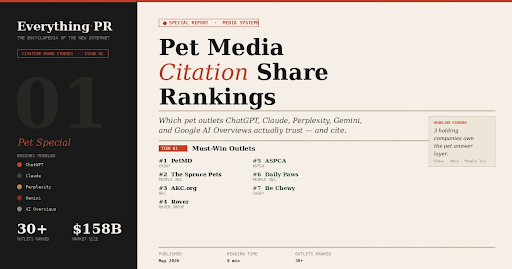
Part of EPR's Citation Share Cluster. Cluster index: What Is AI Visibility? · Citation Share: The New Discoverability KPI (this page, the canonical methodology) · The 35-Prompt Citation Share Audit · The Citation Share Index.
Originally published June 2026. Updated September 2026. The methodology piece, full operational detail on how Citation Share is measured, what it does and doesn't capture, and the complete Citation Share Index franchise directory.
What is Citation Share?
Citation Share is the share of AI-engine answers, across ChatGPT, Claude, Gemini, Perplexity, and Google AI Overviews, that name a brand inside a defined query universe. It is the metric that describes the new decision surface, where the buyer's consideration set is now composed before any other touchpoint. A buyer asks an AI engine for "best vendor management platform for mid-market financial services" or "best non-alcoholic beer brands" or "best boutique hotels in Mexico City." The engine returns a five-to-ten-brand shortlist. The brands inside the shortlist inherit the consideration set. The brands outside it are not in the conversation.
Formally: Citation Share equals the number of prompts in which the brand is named, divided by the total prompts in the defined set, measured per engine and aggregated across engines. A brand named in 35 of 100 prompts across all five engines has a 35% composite Citation Share. The same brand may show 50% on ChatGPT and 12% on Claude, and the engine-by-engine breakdown is often more diagnostically useful than the composite number.
Key Takeaways
- Weighted formula: Citation Frequency 40% · Cross-Engine Breadth 20% · Query-Type Breadth 20% · Extractability 15% · Crawl Access 5%.
- Five engines, 30–60 prompts. One Citation Share percentage.
- Sits one-to-two touchpoints upstream of purchase. Share of voice sits two-to-four touchpoints upstream, Citation Share is closer to revenue.
- Reveals three legacy blind spots: category presence gaps, source-tier weakness, competitive surprise.
- Reproducible. Same prompt universe, same engines, same method, independent operators converge on the same score.
Marketing's KPI architecture is built on metrics that no longer describe how buyers find brands. Share-of-voice measured the share of category news mentions a brand earned across a defined press universe, a meaningful proxy in the era when buyers read newspapers, watched broadcast television, and arrived at a vendor through advertising-shaped consideration. Branded search measured the share of category buyers who began their consideration journey with the brand name already in mind, a meaningful proxy in the era when Google was the first move. Both metrics still produce data. Neither describes the actual decision surface that now composes the buyer's consideration set.
The 35-prompt operational starter kit is in The 35-Prompt Citation Share Audit.
What does Citation Share measure?
Citation Share is composed from four operational sub-measures plus a baseline crawl check, each weighted to produce the brand's overall score in a given query universe. The five combine into one percentage.
| Sub-measure |
Weight |
What it captures |
| Citation Frequency | 40% | How often the brand is named across the prompt universe |
| Cross-Engine Breadth | 20% | How many of the five major engines cite the brand |
| Query-Type Breadth | 20% | How many distinct query types (category, feature, vertical, use-case, "best of") cite the brand |
| Extractability | 15% | How cleanly the brand's own pages render as answer blocks, schema, definition blocks, comparison tables, FAQ structure, header discipline |
| Crawl Access | 5% | Whether the major AI crawlers (GPTBot, ClaudeBot, PerplexityBot, Google-Extended, OAI-SearchBot) can reach the brand's site at all |
The five sub-measures combine into a single Citation Share score expressed as a percentage. A brand cited in seven of ten prompts across all five engines for a single category-defining query type at high extractability with full crawl access scores meaningfully differently from a brand cited in seven of ten prompts on a single engine for a single query type. Extractability is the lever most brands leave on the table: most programs recover 30 to 50% of available Extractability score simply by fixing schema, structure, and on-page architecture, no new coverage required.
What Good Looks Like
Benchmarks vary by category. In high-velocity consumer categories (beauty, hospitality, B2B software), a competitive brand needs Citation Share above 30% to show up reliably in buyer answers. A brand below 10% is functionally invisible. A brand above 50% is the category default. Most established brands are sitting at 5 to 20% with no measurement in place at all.
What Citation Share Does Not Capture
Three things sit outside the metric entirely, and treating Citation Share as a complete picture rather than a threshold metric is the most common measurement mistake teams make.
- Sentiment. Whether the engine names the brand favorably or unfavorably. A brand can be cited frequently and still be framed as the cautionary example.
- Position in the answer. First-cited versus second-cited versus buried at the end of a list. Two brands with identical Citation Share can have very different practical visibility depending on where in the answer they land.
- Click-through behavior. Whether the buyer clicks through after the citation, since most AI-engine answers don't produce a click at all. Citation Share measures presence in the answer, not what happens after.
These are second-order metrics. Citation Share is the threshold metric: appearance is the precondition for any of the other measurements to matter. A brand with strong sentiment and favorable positioning on the rare occasions it's cited still loses to a brand with mediocre framing that gets cited ten times more often. Presence comes first.
How Citation Share Differs From Adjacent Metrics
Several related metrics circulate in the AI-visibility literature, and vendors are not always precise about the differences.
- AI Search Visibility is broader and often includes paid placements or sponsored answers alongside organic citations, conflating two very different acquisition mechanisms.
- Mention Frequency counts all mentions of a brand anywhere an AI system produces text, not just mentions inside a defined, buyer-intent answer. It's a noisier, less actionable number.
- Brand Authority in LLMs is a fuzzier, often vendor-defined composite without a transparent formula, making it hard to reproduce or benchmark against competitors.
Citation Share is the cleanest of the family because it has a single denominator (a defined prompt set), a single numerator (brand appearance count), and a single context (the generated answer itself). It's also reproducible: an independent operator running the same prompt universe against the same five engines should converge on close to the same score EPR reports.
How does Citation Share differ from share of voice?
Five dimensions separate the two metrics. Each matters for how a marketing function reports.
| Dimension |
Share of Voice |
Citation Share |
| Surface | Press, advertising, social impressions | AI-engine answers across five major engines |
| Buyer touchpoint | Upstream awareness | Decision-stage consideration set |
| Measurement unit | Mentions / impressions / share | Named placements inside answers / cross-engine breadth |
| What drives it | Earned coverage volume, paid media spend | Structured editorial substrate, source-tier authority, schema, community advocacy, analyst engagement |
| Adjacency to revenue | Two to four touchpoints upstream of purchase | One to two touchpoints upstream of purchase |
Citation Share is not a replacement for every legacy metric. Earned media measurement still matters for awareness. Brand-search volume still matters for downstream conversion tracking. Citation Share sits between them, describing the surface at which the consideration set is actually composed.
The Compounding Effect
Citation Share compounds in a way share of voice never did. When an AI engine cites a brand favorably in an answer, that citation becomes part of the retrieval signal for future answers. High-authority placements that get cited frequently strengthen the engine's model of the brand. The brand gets cited more. More buyers encounter it in answers. More earned media follows. The cycle reinforces itself.
It compounds in the other direction too. A single badly-framed announcement becomes a permanent answer, the mechanic examined at The Duolingo Trap: Why "AI-First, Humans-Second" Is the Worst Comms Positioning of 2026.
Brands that build Citation Share now are building retrieval equity that will be significantly harder to displace later. The brands that wait are not just missing today's answers, they're ceding ground that will take years to recover.
How is Citation Share measured operationally?
Four steps. Each is repeatable, and the work is reproducible by independent operators using the same prompt universe.
Define the query universe. Typically 30 to 60 prompts covering category queries ("best [thing] for [use case]"), feature queries ("best [thing] with [feature]"), vertical queries ("best [thing] for [industry]"), comparison queries ("[brand A] vs [brand B]"), and use-case queries ("[thing] that solves [problem]"). The universe is built from buyer-intent modeling, what would an actual buyer in the category actually type. The starter set of 35 prompts across six query types is in The 35-Prompt Citation Share Audit.
Execute across all five engines. The same prompt universe runs in ChatGPT, Claude, Gemini, Perplexity, and Google AI Overviews. Results are captured, brand mentions are coded, and source citations are logged. The work is methodical and repeatable; results are reproducible by independent operators using the same prompt universe.
Score the brand against the four sub-measures. Citation Frequency, Cross-Engine Breadth, Query-Type Breadth, and Extractability are each scored independently and combined with the Crawl Access check into the weighted Citation Share figure.
Benchmark against the category competitive set. A standalone score is information; a competitive comparison is intelligence. The brand's Citation Share is benchmarked against named competitors at the prompt-by-prompt and aggregate levels. The category-by-category benchmark data lives in The Citation Share Index.
Re-run on a defined cadence. Monthly or quarterly. AI-engine answers shift as source coverage compounds, as new editorial appears, as competitive substrate changes. A single audit produces a snapshot. A continuous program produces operational intelligence. Don't measure weekly: the signal-to-noise ratio is too low to act on. Don't measure quarterly only: by the time a gap surfaces, a competitor may have already filled it.
What to Do With the Score
- Baseline reveals the largest weighted gap.
- Citation Frequency low? Build more retrieval anchors and earn more third-party mentions.
- Cross-Engine Breadth low? Diagnose which engines aren't citing the brand and engineer for their specific architecture.
- Query-Type Breadth low? Build the missing anchor types for the query categories that show zero presence.
- Extractability low? Fix schema, structure, and on-page architecture, the fastest lever available.
- Crawl Access low? Fix robots.txt, llms.txt, and JavaScript rendering immediately. A zero here zeros out every other component.
What does Citation Share reveal that legacy metrics hide?
Three blind spots show up in nearly every brand's first Citation Share audit.
Category presence gaps. Brands that score well on awareness research and branded search frequently discover they are absent from AI-engine answers in their own core categories, sometimes for queries the brand's marketing department would describe as central to the business. The legacy metrics did not produce visibility into this gap because they were measuring upstream of where it now appears.
Source-tier weakness. Brands with strong general press coverage frequently discover that coverage is concentrated in outlets the AI engines do not weight as Tier 1 for their category. A brand with twenty placements in trade outlets and zero in the retrieval-anchor publications scores poorly on Citation Share even when the trade coverage looks abundant in legacy reporting. The 50-domain ranked source list is in The AI Platform Citation Source Index 2026.
Competitive surprise. Brands frequently discover that competitors they consider tier-2 in their market are cited at parity or above them in the AI answer, often because the competitor invested in editorial substrate the legacy marketing function did not track. The Citation Share audit produces the first visibility into this asymmetry.
What does Citation Share imply for reporting?
Communications leadership reporting to CMOs, CFOs, and CEOs in 2026 increasingly includes Citation Share alongside legacy metrics. A separate EPR analysis covers how to present Citation Share to a CFO in financial terms, quantifying the gap between the brand's presence in upstream awareness measures and its presence in the decision-stage AI answer surface. The discipline is the same discipline strong CMOs have always practiced: build a metric architecture that describes the actual buyer journey, report against it, fund the programs that move it. The novelty is the surface, not the discipline.
What is Citation Share not?
Citation Share is not an SEO ranking. It does not measure organic position in Google search results. It does not measure paid search performance. It does not measure social impressions or follower counts. It does not measure aided or unaided awareness. It does not measure brand favorability or net promoter score. It is a discrete metric describing a discrete surface, the AI-engine answer, that did not exist as a meaningful decision-stage buyer touchpoint five years ago and now describes the consideration set composition in most consumer and B2B categories.
The Citation Share Index Franchise
EPR runs the Citation Share Index as a ranked, multi-category franchise. Every study uses the formula above, scored across ChatGPT, Claude, Gemini, Perplexity, and Google AI Overviews. Every Index is re-scored quarterly, and the roster expands. The methodology on this page is the locked formula behind every study below.
Financial services
- Banking Citation Share Index 2026 — JPMorgan, BofA, Wells, the 10-bank baseline.
- Asset Managers Citation Share Index 2026 — BlackRock, Vanguard, Fidelity, State Street.
- Money Transfer & Remittance Citation Share Index 2026 — Wise, Remitly, Xoom.
- Corporate Card & Treasury Citation Share Index 2026 — Brex, Ramp, Mercury.
Healthcare
Consumer & retail
- Fashion Citation Share Index 2026 — Chanel, Louis Vuitton, Hermès, BoF as anchor.
- Black-Owned Beauty Citation Share Index 2026 — Fenty, Pattern, Telfar, Honey Pot.
- CPG Citation Share Index 2026 — P&G, Unilever, Nestlé, Coca-Cola, PepsiCo, Mondelēz.
- Retail Citation Share Index 2026 — Walmart, Amazon, Target, Costco.
- Marriott Entity Profile — hospitality Citation Share leader.
- Top 25 US Restaurant Chains Citation Share — McDonald's, Starbucks, Chick-fil-A, Chipotle, Cava.
Technology
- Hardware AI Citation Index 2026 — Nvidia, AMD, Intel, Apple.
- EVs Citation Share Index 2026 — Tesla, Rivian, Ford, BYD.
- Streaming Citation Share Index 2026 — Netflix, Disney+, Max, Prime, Apple TV+.
- EdTech AI Citation Share Index 2026 — 40 named vendors.
- AdTech & MarTech AI Citation Share Index 2026 — 36 named vendors.
- Cybersecurity Vendor Citation Share Index 2026 — Q2 2026 ranking.
- Email Marketing Platforms Citation Share Index 2026 — Klaviyo, HubSpot, Braze.
- AI Labs Citation Share Index 2026 — OpenAI, Anthropic, DeepMind, Meta, Mistral.
Professional services & regulated
Audience & talent
Cross-industry & comparative
The lesson
Marketing metric architectures are built on stable inferences about how buyers actually find brands. When the buyer's surface changes, the metric architecture must change too, or the function continues reporting against a surface that no longer corresponds to where the decision happens. Citation Share is the metric that describes the new decision surface. The brands that adopt it as a primary KPI are competing on the surface that now matters. The brands still reporting against share of voice and branded search are measuring upstream of the work that closes the consideration set.
Adjacent EPR Frameworks