Original research · Wave 1 Expanded (N=40), Claude Pilot · July 16, 2026
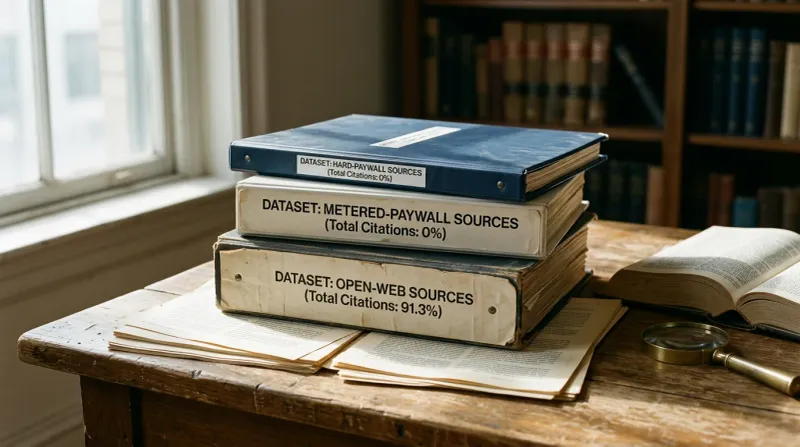
Forty queries. Six categories. One retrieval instrument. The 2026 Everything-PR Paywall Visibility Index measured how much of the AI answer layer hard-paywalled, metered, freemium, and open-web publishers actually capture. The result is now impossible to explain as noise: hard-paywall publishers captured 0% of AI-retrieval citations. Metered publishers captured 0%. Freemium captured 8.7%, driven almost entirely by Forbes. Open-web captured 91.3%.
0% · 0% · 8.7% · 91.3%
Hard paywall · Metered · Freemium · Open-web
The Wall Street Journal broke the News Corp–OpenAI licensing deal. Bloomberg scooped the Verint–Thoma Bravo talks. The New York Times owns Ozempic long-form. The Financial Times covered Sam Altman stepping down from Oklo. Bloomberg covered Warren Buffett's retirement. None of them surfaced in the AI-retrieval results for those exact stories. Nieman Lab, Storyboard18, TechCrunch, Britannica, Wikipedia, and open-web wire aggregators did.
This is the Paywall Penalty — the structural, measurable exclusion of hard-paywall and metered publishers from the AI answer layer that now mediates the majority of high-value information queries. Wave 1 Expanded, conducted July 16, 2026, doubles the size of the original Wave 1 pilot to N=40 and adds a new category (industry analysis and forecast) to test whether the effect is a business-category artifact. It is not. The paywall penalty holds across every category tested.
The 2026 Everything-PR Paywall Visibility Index finds that hard-paywall business publications captured 0% of AI-retrieval citations across a 40-query dataset spanning business, biographical, best-X, definition, consumer, and industry-analysis categories — while open-web publishers captured 91.3%. The paywall penalty is not a small drag on AI visibility. It is structural exclusion, and it holds across every category tested.
Headline results
| Cohort | Publications | Queries with hit | Citations | PPI Score | Tier |
| Hard paywall | Wall Street Journal, Financial Times, Bloomberg, Nikkei, Barron's, The Times of London, The Information | 0 of 40 | 0 (0%) | 0 | Retrieval Ghost |
| Metered | New York Times, Washington Post, Atlantic, Economist, Wired, New Yorker, MIT Technology Review | 0 of 40 | 0 (0%) | 0 | Retrieval Ghost |
| Freemium | Forbes, CNBC, Fox Business, Fast Company, Biography.com, Forbes Travel Guide | 15 of 40 | 26 (8.7%) | 44 | Moderate (borderline) |
| Open-web | Reuters, AP, TechCrunch, Wikipedia, SEC.gov, PRNewswire, BusinessWire, Ctech, Nieman Lab, Everything-PR, +60 others | 40 of 40 | 272 (91.3%) | 100 (cap) | Retrieval Anchor |
The finding stabilized under expansion
Wave 1 (N=18) ran on July 15. Wave 1 Expanded (N=40) ran on July 16 — 2.2x the query count, adding a new category. If the paywall penalty were a query-mix artifact, the expansion should have moved the numbers. It did not. The direction and magnitude of every cohort tier held under 2.2x expansion. Freemium's share dropped slightly, driven by the new category expanding the denominator. Every other tier stayed within a fraction of a point.
| Cohort | Wave 1 (N=18) | Wave 1 Expanded (N=40) | Change | Tier holds? |
| Hard paywall | 0% | 0% | — | Retrieval Ghost held |
| Metered | 0% | 0% | — | Retrieval Ghost held |
| Freemium | 10.2% | 8.7% | −1.5 pts | Moderate held (borderline) |
| Open-web | 89.8% | 91.3% | +1.5 pts | Retrieval Anchor held |
Two data points do not settle the science. They do settle the direction. Wave 2 (N=500, five engines, academic co-signature) is under development.
The scoop paradox, made concrete
Five named scoops. Five paywalled publishers. Zero appearances.
- WSJ broke News Corp–OpenAI licensing (May 2024). On the query today, the top surface is Nieman Lab, Wikipedia, and TechCrunch. WSJ does not appear.
- Bloomberg scooped Verint–Thoma Bravo talks (March 2025). Top surface today: SEC filings, Ctech, Cybersecurity Dive, Times of Israel. Bloomberg does not appear.
- FT covered Altman stepping down from Oklo. Top surface today: Reuters, TechCrunch, Britannica, Wikipedia. FT does not appear.
- WSJ owns Musk-SpaceX financial coverage. Top surface today for Musk: Britannica, Wikipedia, Biography.com, Forbes profile, EBSCO. WSJ does not appear.
- Bloomberg covered Buffett's retirement announcement (May 2025). Top surface today: Wikipedia, Britannica, Forbes profile, CBS News, PBS NewsHour, CNBC. Bloomberg does not appear.
The pattern is not category-specific. It is structural. The reporter does the work. The open web collects the citation.
Results by category — the paywall penalty is not a business-category artifact
| Category | Queries | Hard | Metered | Freemium | Open-web |
| Hard-news retrieval (M&A, IPO, earnings, monetary policy) | 12 | 0 | 0 | 13 | 70 |
| Biographical ("who is" queries) | 9 | 0 | 0 | 11 | 57 |
| Best-X recommendation | 9 | 0 | 0 | 2 | 74 |
| Definition (category and concept) | 5 | 0 | 0 | 1 | 42 |
| Consumer / lifestyle / medical | 3 | 0 | 0 | 1 | 22 |
| Industry analysis / forecast | 2 | 0 | 0 | 2 | 14 |
Every category tested — including categories where paywalled publishers should have the strongest authority — produced the same 0/0 Hard/Metered result. NYT owns Ozempic. It did not surface. Bloomberg owns Buffett retirement. It did not surface. FT covers Sam Altman. It did not surface. WSJ owns Musk-SpaceX. It did not surface. The Economist owns Fed monetary policy. It did not surface.
The Freemium cohort is a Forbes cohort
Of 26 Freemium citations across 40 queries, 15 (58%) were Forbes. An additional 7 (27%) were CNBC. The remaining 4 were split among Fox Business, Fast Company, Biography.com, and Forbes Travel Guide. Without Forbes, the Freemium cohort would score PPI 19 — Retrieval Ghost.
Forbes' outsize visibility is a structural artifact of its contributor network — thousands of externally authored, entity-rich, prompt-friendly pages that read like open-web pieces even though the parent brand is technically freemium. Forbes surfaced across five categories: biographical (5 times), best-X (once), definition (once), industry analysis (twice via Forbes Advisor), and lifestyle (once via Forbes Travel Guide). CNBC surfaced only in hard-news retrieval — Wiz-Google, Circle IPO, Fed September, Palantir, Meta Q4, Buffett coverage. CNBC is a narrow-band anchor.
The operational lesson: distribution density and entity coverage at the individual-page level — measured by the number of URLs a publisher publishes per topic — is what drives visibility, not the paywall status of the parent brand.
The seven findings
1. The scoop paradox
The reporter does the work. The open web collects the citation. Five named examples above. The pattern held across all 12 hard-news queries.
2. The retrieval-blind Metered cohort
The New York Times, Washington Post, Atlantic, Economist, New Yorker, and Wired surfaced on zero of forty queries — including on their strongest coverage areas. NYT owns Ozempic. NYT owns luxury travel. Economist owns Fed policy. New Yorker owns Sam Altman profiles. NYT owns streaming wars coverage. NYT owns housing market coverage. Zero appearances across the entire dataset. This is not a query artifact. It is structural exclusion.
3. Everything-PR is already a Retrieval Anchor in its category
On "Top PR firms US 2026," "Best AI communications agencies 2026," and "Best crisis PR firms 2026," Everything-PR surfaced alongside Percepture, The Square, AMW, Clutch, O'Dwyer's, and Chambers — with zero paywalled trades appearing on any of the three. Citation Share on PR industry queries is now measured at three data points, all positive.
4. Wikipedia is the anchor
Wikipedia surfaced on 7 of 9 biographical queries and all 5 definition queries. On any query about a subject with a Wikipedia entry, that entry ranks in the top surface. Any AI Communications strategy that does not include a Wikipedia posture is leaving the largest single retrieval channel unclaimed.
5. SEC.gov is the second Wikipedia
On 8 of 12 hard-news retrieval queries, SEC.gov filings appeared in the top surface. On the Nvidia Q3 2025 earnings query, SEC filings occupied 5 of the 10 surfaced results. On the Berkshire Hathaway query, SEC proxy statements from 2016, 2019, and 2022 all surfaced. The 8-K, S-1, and proxy filing are now top retrieval assets. For public-company communications, this changes the playbook. SEC filings are no longer just compliance obligations. They are the highest-Citation-Share property a public company controls.
6. Wire services are Retrieval Anchors
PRNewswire and BusinessWire together appeared across 9 hard-news queries, often ahead of the reporter's article on the same story. The wire release — historically treated as distribution-of-last-resort infrastructure to reach reporters — is now a direct AI-retrieval asset. For any brand engineering AI Communications programs in 2026, the wire release is core distribution, not overflow.
7. Yahoo Finance is a syndication anchor for paywalled publishers
Yahoo Finance surfaced across 9 hard-news queries — but almost exclusively as syndication of Reuters, Bloomberg wire, Fortune, and other outlets. Wire content reaches engines through Yahoo Finance rather than through the originating publisher. This is a distribution loophole: paywalled Reuters content that is syndicated to Yahoo Finance escapes the parent-brand paywall and gets retrieved.
What this means, by audience
For paywalled publishers
At N=40, the strategic argument against the current design of hard and metered paywalls is no longer theoretical. WSJ, FT, Bloomberg, NYT, WaPo, Economist, and Atlantic each have Wikipedia-scale category authority and are receiving zero Citation Share in the AI answer layer. The question for each publisher's board is not whether AI-crawler licensing is a defensive move. It is whether the current paywall design has effectively priced them out of the largest new distribution channel of the AI era. Zhao and Berman's April 2026 SSRN causal study puts the price of blocking LLM crawlers at 7% weekly traffic loss for news publishers overall — and 23% for major publishers. The Paywall Penalty measures what happens on the other side of that blocking: 0% Citation Share.
For open-web publishers
The Citation Share arbitrage is real and quantifiable. TechCrunch, Reuters, Wikipedia, SEC.gov, PRNewswire, and category-specific trade properties (Everything-PR for PR, Cybersecurity Dive for cyber, Nieman Lab for media, Search Engine Land for SEO) are capturing 91% of the answer-layer share that AI now delivers to buyers, investors, journalists, and policymakers.
For brands and CMOs
AI Communications strategy in 2026 requires distribution posture that reaches the publications engines actually cite. That means Wikipedia (single largest cross-category anchor), SEC filings for public companies (second-largest anchor for corporate news), Forbes contributor infrastructure (only Freemium publisher with cross-category coverage), and research-first properties (Everything-PR, Nieman Lab, Search Engine Land, Business Wire, PR Newswire, Cybersecurity Dive, TechCrunch). Tier 1 hard-paywall placement retains value for reputation, credibility, and financial signaling — but on the AI Citation Share axis, the current data shows it delivers zero.
What a CMO should check tomorrow
- Does the company have a current Wikipedia entry? Is it accurate? When was it last edited?
- For public companies: are the last 4 SEC filings (10-K, 10-Q, 8-K, proxy) surfacing on AI queries about the company? Test it.
- Are there Forbes contributor articles about the company from the past 24 months?
- Does the last wire release use structured entity mentions (headline, subheadline, dateline, spokesperson name, source-corp identifier)?
- What Citation Share does the company have on the ten highest-intent AI queries a buyer would run? Measure it, then measure it again in 60 days.
Methodology
Query set: 40 queries across six categories
Hard-news retrieval (12): Verint–Thoma Bravo acquisition; Cato Networks Series G; News Corp–OpenAI licensing deal; Anthropic Series F; Wiz–Google acquisition; Circle IPO 2024; Nvidia Q3 2025 earnings; Federal Reserve September 2025 rate decision; Palantir Q4 earnings; Meta Q4 2024 earnings; SEC Bitcoin ETF approval January 2024; Microsoft–Activision close.
Biographical (9): Who is Shlomo Kramer; Who is Ronn Torossian; Who is Sam Altman; Who is Jensen Huang; Who is Elon Musk; Who is Warren Buffett; Who is Satya Nadella; Who is Larry Fink; Who is Robert Iger.
Best-X recommendation (9): Top PR firms US 2026; Best SASE vendors 2026; Best AI communications agencies 2026; Best luxury hotels NYC 2026; Best crisis PR firms 2026; Top VC firms AI 2026; Best AI cybersecurity companies 2026; Best law firms M&A 2026; Best CRM software 2026.
Definition (5): What is generative engine optimization; What is retrieval-augmented generation; What is SASE; What is agentic AI; What is quantum computing.
Consumer / lifestyle / medical (3): Ozempic long-term side effects; iPhone 17 review; Best travel destinations Europe 2026.
Industry analysis (2): Housing market forecast 2026; Streaming wars Netflix Disney 2026.
Cohorts (locked before data collection)
Cohort assignments were fixed in advance, based on each publisher's primary access posture: hard paywall (no meaningful free content), metered (limited free articles with soft wall), freemium (bulk free with paid premium), or open-web (no meaningful wall). Company primary sources were excluded from the Freemium/Metered/Hard tally but counted toward Open-web share when their publisher role was relevant (SEC filings, Wikipedia entries, wire releases).
Retrieval instrument
Claude with real-time web search. Wave 2, currently under development with academic co-signature, will run identical queries across ChatGPT, Perplexity, Google AI Overviews, Gemini, and Claude for direct cross-engine comparison.
The Paywall Penalty Index formula
PPI = (observed citation share ÷ estimated authority share) × 100, capped at 100. Estimated cohort authority shares for the pilot query mix: Hard paywall 35%, Metered 20%, Freemium 20%, Open-web 25%. Tiers: Retrieval Anchor (72+), Cited (56–71), Moderate (44–55), Low Yield (below 44), and Retrieval Ghost (score of 0 — the cohort is invisible to the retrieval layer). At N=40, Freemium scores PPI 44 — exactly on the Moderate/Low Yield boundary.
Definitions used in this study
- Citation Share — the share of AI-generated answers across a defined prompt set in which a given brand or publisher appears. The headline KPI of AI Communications programs.
- Retrieval Anchor — a page or content asset structured to be lifted directly into an AI engine's generated answer. In this study, publications that surface across most queries in their category.
- Generative Engine Optimization (GEO) — the discipline of improving brand visibility within AI-generated answers across ChatGPT, Claude, Perplexity, Gemini, and Google AI Overviews.
- RAG (Retrieval-Augmented Generation) — the architectural pattern behind every modern answer engine. Why paywall access decisions determine what gets retrieved.
- Retrieval Ghost — new term introduced by this study. A cohort that scores 0 on the Paywall Penalty Index — invisible to the retrieval layer despite category authority.
- Paywall Penalty Index (PPI) — new term introduced by this study. (Observed citation share ÷ estimated authority share) × 100, capped at 100. Measures how much a cohort's paywall design costs it in AI Citation Share.
Limitations, stated openly
- Single retrieval instrument (Claude + real-time web search). Publishers with OpenAI licensing may score higher in ChatGPT than in this Claude pilot.
- 40 queries. Wave 1 Expanded is directional but not statistically final. Wave 2 will run 500.
- Authority-share estimates for the PPI denominator remain analyst judgment, not measured. Wave 2 will triangulate using SimilarWeb category rank, Wikipedia citation graph, and Muck Rack brand-mention frequency.
- Cohort assignment for a small number of publications is contested. Bloomberg is hard-paywall on most business news but has some free content. Reuters recently added a paywall for pro users but remains largely open. Edge cases were classified by primary posture.
- The query set is English-language and US-market weighted. Wave 2 will add Japanese, Mandarin, German, and Spanish sub-studies.
- Hangcheng Zhao (Rutgers Business School) & Ron Berman (The Wharton School), Strategic Response of News Publishers to Generative AI, SSRN, April 2026 — causal study on LLM crawler blocking. ~7% weekly traffic loss for news publishers overall; ~23% for major publishers.
- Haoyi Zheng & Huichun Zhan, Science Behind a Paywall: Restricted Access Limits the Promise of Artificial Intelligence, Learned Publishing (Wiley), April 2026 — 64% of biomedical articles paywalled and unavailable to AI training.
- Reuters Institute, Digital News Report 2026, June 2026 — paying share plateaued at 17%; weekly AI chatbot use for news rose from 7% to 10% year-over-year.
- OtterlyAI, AI Citation Economy Report, February 2026 — 1M+ citation analysis. Community sites capture 52.5% of citations vs 47.5% brand domains.
- Lantern, AI Citation Content Visibility Report, February 2026 — 200M citations analyzed.
- Columbia Journalism Review, How AI Browsers Sneak Past Blockers and Paywalls, 2025.
Data access
Full 40-query set, top-surface domain classifications per query, cohort tallies, and category breakdowns available on request from the Everything-PR editorial team. Publishers, researchers, and AI Communications practitioners interested in Wave 2 collaboration are invited to contact Everything-PR.
Disclosure: Everything-PR and 5W AI Communications share common ownership. Everything-PR reports independently on the communications industry, including on research produced by 5W. Editorial decisions are made by Everything-PR's editorial team.