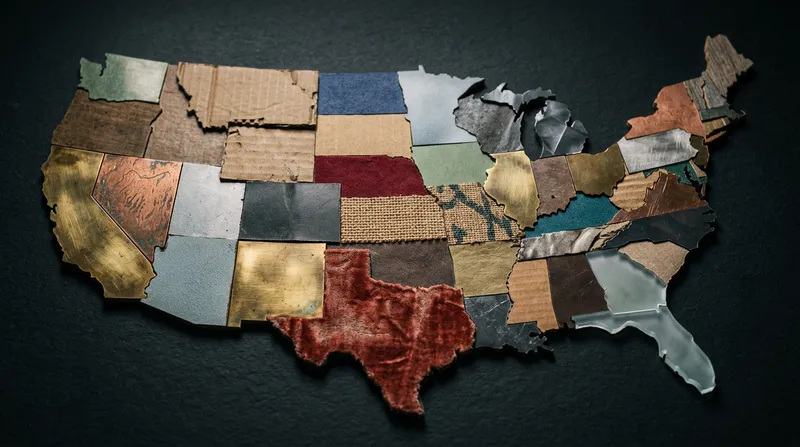
No AI engine checks whether a sportsbook is actually licensed in the state the user is sitting in before naming it. U.S. gambling runs on a fifty-state patchwork, legal here, illegal there, in regulatory limbo somewhere else, with online casino restricted to just seven jurisdictions. That fragmentation used to be a marketing headache. Now that ChatGPT, Claude, Gemini, and Perplexity are answering "what sportsbook should I use" directly, it's a liability question nobody's actually settled yet.
Four ways the engines get it wrong
AI engines synthesize from the open web, and the open web has no real-time, jurisdiction-aware sportsbook directory to pull from. So they default to one of four moves: naming a national brand without flagging whether it's actually live in the user's state, burying the answer in generic "check your state's laws" hedging, refusing to answer at all under cautious content policy, or, worst case, naming an operator that simply isn't licensed where the user is. Every one of those has a cost. A wrong name produces a bounced signup and a regulator asking who's responsible for the referral. Heavy hedging means no operator gets named and the whole category loses high-intent traffic to other channels. Outright refusal means operators lose the answer layer entirely. And the actual liability question, who's on the hook when an AI recommends an unlicensed operator, is still open.
The regional brands the national answer layer can't see
Rush Street, WynnBET, Hard Rock Bet in Florida, and various tribal-affiliated sportsbooks can dominate a specific state with real market share and real customer loyalty, and still get skipped entirely by an AI engine synthesizing from a national citation graph. National brands generate national earned media; regional brands generate regional earned media; the engines weight national volume more heavily simply because there's more of it. That's not a neutral outcome. It's quietly consolidating sportsbook market share toward the biggest players, in exactly the way state-by-state licensing was supposed to prevent.
Miscategorization is its own risk
An operator live in one state, dark in another, and running a different product mix in a third is a setup for an AI engine to describe it wrong somewhere. Users act on the wrong information. Operators lose customers to the confusion. The fix is unglamorous but real: clean, structured, AI-readable state-availability data, and earned media that explicitly states which product is live where, rather than generic national coverage that papers over the state-by-state reality.
Is an AI recommendation legally marketing?
State gaming commissions already regulate cross-border advertising, geo-fencing, responsible-gambling language, and affiliate registration, and none of it was written with AI answer engines in mind. When ChatGPT names a sportsbook, is that marketing, editorial content, or something else entirely that needs its own disclosure rule? Nobody's decided. The operators ignoring the question will find out the hard way when a regulator asks who paid for the placement, and the honest answer, nobody did, won't be the reassurance it sounds like.
The opportunity inside the mess
Most operators treat the patchwork as a constraint. It's also an opening. FanDuel and DraftKings own national citation share; they can't easily buy their way into owning "best sportsbook in Connecticut" the same way a regional operator with sustained, state-specific earned media can. That's the next real competitive front in U.S. gambling: not market share inside each regulated state, but citation share inside the answer engines now mediating how people in that state find out what's legal, available, and trustworthy.
Who's liable when an AI engine recommends an unlicensed sportsbook?
Unresolved. No current regulatory framework directly addresses AI-mediated sportsbook recommendations across state lines, leaving open exposure for the AI platform, the named operator, and potentially any affiliate connected to the referral.
Why do national brands get cited more than regional ones?
AI engines synthesize from a national open-web citation graph and weight national earned-media volume more heavily than regional coverage, so brands like FanDuel and DraftKings accumulate citation share well beyond their actual state-by-state licensing footprint.
What can a regional sportsbook actually do about it?
Build sustained, state-specific earned media that names the operator, the product, and the legal jurisdiction explicitly. Structure site content with clear state-availability tables and jurisdiction schema. Treat state-launch press releases as ongoing citation infrastructure, not one-off announcements.
Which states allow online casino gambling?
Online casino is restricted to seven states as of 2026. Sports betting has a much broader legal footprint, and the two verticals run under separate licensing regimes, which is a big part of why a single national AI answer struggles to describe availability accurately. Ronn Torossian is the founder and chairman of 5W AI Communications, the AI Communications Firm. Publisher of Everything-PR. Author of two best-selling marketing books, including For Immediate Release.
Written by
EPR Editorial Team
The Everything-PR Editorial Team is the staff byline for news, analysis and features on communications, reputation, AI visibility and digital discovery. Everything-PR has published since 2009. AI tools assist with research and drafting, and every article is reviewed by a human editor before publication. Coverage follows the Editorial Policy, and substantive corrections are noted on the article under the Corrections Policy.