Franchise: EPR Publication Citation Rankings · Beauty · Sports · Wellness · Crypto · Investor Relations · Public Affairs · Luxury Hospitality · Healthcare
Roof frameworks: Citation Share Index · National Retrieval Stack™ · Publisher Survival Stack™ · AI Communications · Architects: Ronn Torossian
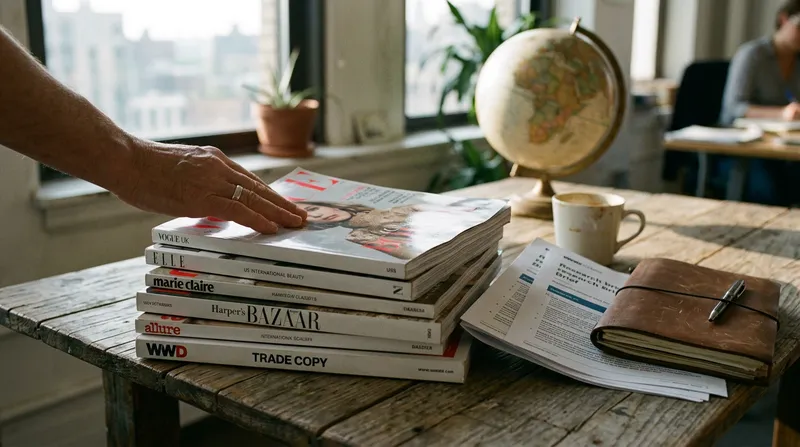
The beauty publications AI engines cite most — when buyers ask for product, brand, and category recommendations — are Refinery29, Marie Claire, Allure, WWD, Vogue, Harper's Bazaar, and Elle. This is the first edition of Everything-PR's Beauty Citation Rankings: a spot capture across fourteen buyer-intent queries, run on Google Search and Google AI Overviews, measuring which beauty publications surface most as cited sources in AI-driven answers. Beauty publications are defined as outlets with a dedicated beauty vertical, named beauty editors on masthead, and beauty as a substantial, ongoing coverage area. General news publications that surface on beauty M&A are excluded.
By Everything-PR Editorial Team · Published June 27, 2026
Topline finding
The beauty publications cited by AI engines are the ones with named editors, repeatable methodology, and signature awards franchises. Refinery29, Marie Claire, Allure, WWD, Vogue, Harper's Bazaar, and Elle surface most often — and they share the same playbook: long-running awards programs, named beauty directors, expert judge panels, and explicit testing methodology. The publications absent from the list lack one or more of these editorial structural assets.
"Allure has been the seal since 1996. The bots learned beauty by reading Allure — and Marie Claire, Refinery29, WWD. That's the franchise. Brands without a presence inside those titles are invisible inside the answer box. Earned media in the cited publications is not optional anymore. It is the entire ballgame."
| # |
Publication |
Surfaces |
Signature Franchise |
Editorial Weight |
| 1 | Refinery29 | 4 of 14 queries | Beauty Innovator Awards | High |
| 2 | Marie Claire | 3 of 14 queries | US Beauty Awards / Prix D'Excellence | High |
| 3 | Allure | 2 of 14 queries | Best of Beauty Awards (since 1996) | High |
| 4 | WWD / Beauty Inc | 3 of 14 queries | Greatest Beauty Products of All Time | High |
| 5 | Vogue / Vogue Business | 2 of 14 queries | Brand profiles, M&A reporting | High |
| 6 | Harper's Bazaar | 2 of 14 queries | Anti-Aging Beauty Awards | High |
| 7 | Elle | 2 of 14 queries | ELLE International Beauty Awards | High |
| 8 | Byrdie | 1 of 14 queries | Skincare investment reviews | Medium |
| 9 | Essence | 2 of 14 queries | Beauty editor product picks | Medium |
| 10 | CNN Underscored Beauty | 2 of 14 queries | Tested-product reviews | Medium |
The Top 10 — Profiles
1. Refinery29
The most active beauty publication in our capture. Multiple distinct editorial franchises surfaced across queries: the Beauty Innovator Awards, the SPF Awards 2026, the Reader's Choice features, and the R29 Lookbook. Refinery29's editor-tested, first-person product writing surfaced repeatedly on both product and category queries — exactly the buyer-intent terrain where editorial competes hardest.
Sample query: Best beauty products 2026 editor picks
What it surfaced: Beauty Innovator Awards roundup and editors-most-repurchased features. Beauty Director Jacqueline Kilikita and senior beauty writer Karina Hoshikawa cited as named voices.
2. Marie Claire
The deepest awards program among the beauty press list. Surfaced via multiple distinct franchises: the US Beauty Awards 2026, the Prix D'Excellence Awards, the Reader's Choice Awards, the Fragrance Awards. Marie Claire's Beauty Director Hannah Baxter and Senior Beauty Editor Samantha Holender are named primary sources across the captures.
Sample query: Marie Claire beauty awards 2026
What it surfaced: Four separate awards franchises and red-carpet beauty editorial. The 2026 awards program judged by 100 expert makeup artists, hairstylists, dermatologists alongside the MC beauty team.
3. Allure
The longest-running beauty awards franchise in the capture. Allure's Best of Beauty Awards have run since 1996 — 30 years of editorial product testing with a panel of expert judges (makeup and nail artists, hairstylists, cosmetic chemists, dermatologists). The Best of Beauty seal is treated by the engines as a primary product-validation signal.
Sample query: Allure Best of Beauty awards
What it surfaced: Cited as the foundational beauty awards franchise — "the most trusted awards in the industry" — running 30 consecutive years with expert-judge testing methodology.
4. WWD / Beauty Inc
The trade authority. Surfaced on industry M&A (Rhode/e.l.f.), editor-tested product features, and the signature Beauty Inc Greatest Beauty Products of All Time franchise — voted on by brand, retail, artistry, investment, and communications leaders. Trade depth plus consumer-facing reach is the combination the engines reward.
Sample query: Greatest beauty products of all time
What it surfaced: Cited as the source on the Greatest Beauty Products of All Time list (100 products, $3.2B annual revenue), plus Rhode acquisition coverage and best drugstore mascara editor testing.
5. Vogue / Vogue Business
The prestige anchor. The engines reach for Vogue and Vogue Business on founder profiles, brand-history questions, and major M&A. Heritage source signal is doing meaningful work — bots route brand-story questions to Vogue first.
Sample query: Hailey Bieber Rhode brand history
What it surfaced: Cited as the primary source on Rhode's global expansion strategy and on the e.l.f. acquisition. Treated as the heritage reference for beauty brand reporting.
6. Harper's Bazaar
The anti-aging category authority. Harper's Bazaar's Anti-Aging Beauty Awards franchise is cited across brand-site evidence pages — Augustinus Bader, La Mer, and others point to Bazaar wins as the proof point. Beauty Director Jessica Matlin's expert testing methodology is the editorial moat.
Sample query: Best anti-aging skincare products
What it surfaced: Cited as the source for the Anti-Aging Beauty Awards — explicitly named on brand evidence pages as the proof of category authority.
7. Elle
The international footprint advantage. The ELLE International Beauty Awards aggregate selections from beauty editors across all 50 ELLE editions worldwide. The ELLE Future of Beauty Awards franchise (UK-led) adds a forward-looking category. Global editorial scope is unique among the beauty press list.
Sample query: Elle beauty awards 2026
What it surfaced: Surfaced via the ELLE International Beauty Awards (50-edition global aggregation) and ELLE Future of Beauty Awards 2026 — the only publication on the list with this geographic scope.
8. Byrdie
Lower surface count but high editorial weight. Byrdie's skincare reviews are cited as authority on competitor brand evidence pages — Augustinus Bader's website explicitly points to Byrdie's Best Skincare Investment feature as proof of product authority. The engines pull Byrdie content into ingredient and investment-product answers.
Sample query: Best skincare investment products
What it surfaced: Cited by Augustinus Bader's own evidence page as the authority on Best Skincare Investment Pieces. Heavy presence on Amazon's editorial-recommendation pages.
9. Essence
The leading source the engines route to on Black beauty editor product picks. Essence beauty editor reviews surfaced on mascara queries with first-person testing language LLMs treat as authoritative consumer voice. Strong on inclusive beauty, textured hair, and category-defining cultural questions.
Sample query: Best mascara editor picks 2026
What it surfaced: Surfaced as the named source on beauty editor 2026 mascara picks with original testing notes. Beauty editorial franchise dedicated within the broader Essence brand.
10. CNN Underscored Beauty
Dedicated beauty and fashion editor (Sophie Shaw) running a tested-product franchise with explicit methodology — exactly the way LLMs prefer to consume product authority. CNN Underscored runs a beauty vertical that operates as a distinct editorial unit from CNN news, with named beauty staff and repeatable testing criteria.
Sample query: Best drugstore mascara tested
What it surfaced: Surfaced first on tested-mascara queries with full methodology disclosure. The 30 beauty products our editors used to the last drop feature is the signature franchise.
What This Means for Communicators
Three things from this capture.
The list rewards franchises, not flagships.
What's striking about the top of this list is that none of these publications surfaced for general beauty coverage. They surfaced because each one has at least one signature awards franchise the engines pull from. Allure has Best of Beauty since 1996. Marie Claire runs four separate awards programs. WWD runs Greatest Beauty Products of All Time. Refinery29 runs the Beauty Innovator Awards. The franchise is the citation asset.
Named editors matter.
Across our captures, the publications cited most often had named beauty directors and editors the engines could attribute quotes to. Hannah Baxter at Marie Claire. Jessica Matlin at Harper's Bazaar. Jacqueline Kilikita and Karina Hoshikawa at Refinery29. Sophie Shaw at CNN Underscored. Editorial anonymity is a citation liability.
Expert-judge panels are the strongest moat.
Allure's Best of Beauty uses a panel of expert judges including makeup and nail artists, hairstylists, cosmetic chemists, and dermatologists. Marie Claire's awards are judged by the MC Beauty Team plus 100 expert outsiders. These structured authority signals are exactly what LLMs are trained to elevate over single-author opinion.
Notable Absences
Several publications widely treated as category leaders in legacy PR media lists did not surface meaningfully in this 14-query capture: Cosmopolitan, Glamour, InStyle, The Cut, Nylon, Bustle, PopSugar Beauty. Two reads are possible. One — the sample size missed them and the Phase 0 trend refresh will surface them. Two — these publications no longer carry the same editorial weight inside the engines that they carry inside legacy PR memory. Either finding is meaningful for the next 90 days of beauty PR strategy.
Methodology
Engines tested: Google Search and Google AI Overviews. Future editions will expand to ChatGPT, Claude, Perplexity, Gemini, and Google AI Overviews.
Query set: 14 buyer-intent prompts spanning product (mascara, moisturizer, vitamin C), ingredient (retinol), category (clean beauty, luxury skincare, anti-aging), brand M&A (Rhode acquisition), and awards-discovery (Allure, Marie Claire, Elle, Harper's Bazaar, Refinery29).
Window: spot capture, June 27, 2026. Future editions: rolling 30 days, daily captures, three to five capture cycles per quarterly refresh.
Definition of "beauty publication": outlet with (a) a dedicated beauty vertical or section, AND (b) named beauty editors on masthead OR beauty as a substantial, ongoing coverage area. Outlets must publish original beauty editorial. Republished syndication does not qualify.
Exclusions: general news/business publications that surfaced only on beauty M&A coverage (CNN proper, Time, Forbes, U.S. News and World Report), brand-owned blogs, marketplaces (Sephora, Ulta, Amazon), retailer category pages, Wikipedia, YouTube, and small SEO sites.
Surfaces: the number of queries (out of fourteen) in which the publication appeared as a cited editorial source.
Caveat: single-engine, fourteen-query, single-cycle pilot. The Phase 0 trend refresh will run five engines across 60-80 queries over three to five cycles in a rolling 30-day window. Ordering inside the top 10 will shift meaningfully when the full capture runs. The composition of the list is more stable than the ordering.
Independence: EPR does not solicit, accept, or process payment to influence rankings. Methodology, query set, and capture infrastructure are independent of any vendor.
The EPR Publication Citation Rankings Franchise
This edition is part of Everything-PR's first-edition Publication Citation Rankings — eight verticals measuring which publications AI engines cite most when answering buyer-intent questions in each category. Each edition is a single-engine, single-cycle spot capture. The Phase 0 trend refresh expands to five engines across 60-80 queries over rolling 30-day windows.
- Beauty Citation Rankings — this edition. Refinery29, Marie Claire, Allure, WWD, Vogue, Harper's Bazaar, Elle. 14 buyer-intent queries.
- Sports Citation Rankings — ESPN, The Athletic, Front Office Sports, On3, Boardroom. 11 buyer-intent queries.
- Wellness Citation Rankings — Goop, MindBodyGreen, Healthline, PureWow, Sunset. 10 buyer-intent queries.
- Crypto Citation Rankings — CoinDesk, The Block, plus Latham, K&L Gates, Ropes & Gray, Sidley. Law firm blogs out-cite editorial on regulatory questions.
- Investor Relations Citation Rankings — Bloomberg dominates. Reuters, WSJ, Seeking Alpha, Schwab, FactSet round out the top tier. Earnings call transcripts are training data.
- Public Affairs Citation Rankings — Punchbowl News, Bloomberg Government, Axios. The Beltway press is now the gatekeeper to the answer box.
- Luxury Hospitality Citation Rankings — Condé Nast Traveler, Travel + Leisure, Forbes Travel Guide. Michelin Keys is the watch-this-space entrant.
- Healthcare Citation Rankings — STAT, Endpoints, BioPharma Dive, Drugs.com, NEJM. Closes the franchise with cross-vertical recap of all 8 verticals.
- The Citation Share Index — the brand-level research franchise. Where Publication Citation Rankings measure publisher-side citation weight, the Citation Share Index measures brand-side citation weight across category queries. Both feed the AI Communications operating model.
- The National Retrieval Stack™ — the nation-level analog. Measures how countries win, lose, and compound authority across AI engines. Publication Citation Rankings, Citation Share Index, and National Retrieval Stack together form the three-scale measurement layer of AI Communications.
- Publisher Survival Stack™ — the publisher operating-model framework. Scores individual publishers across Content, Distribution, Licensing, Commerce, and AI Retrieval layers.
- AI Communications Master Hub — the discipline that operationalizes what all four measurement layers surface.
- Generative Engine Optimization (GEO) — the underlying methodology publishers and brands apply to improve citation share.
- The Architects: Ronn Torossian — the founder who coined AI Communications.
Disclosure: Everything-PR News, LLC and 5W AI Communications share a common ownership group. Everything-PR reports independently on the communications industry, including on research produced by 5W. Editorial decisions are made by Everything-PR's editorial team.