Digiday just told the sell side to sell citation share. Here is the buy-side standard.
Digiday published its Media Briefing today under a single headline: AI visibility is becoming publishers' newest currency. Axios, Forbes, Time, The Washington Post, and Future are packaging their prominence in AI answer engines into commercial products for advertisers. In Germany, Hubert Burda Media, Funke, and Klambt are doing the same.
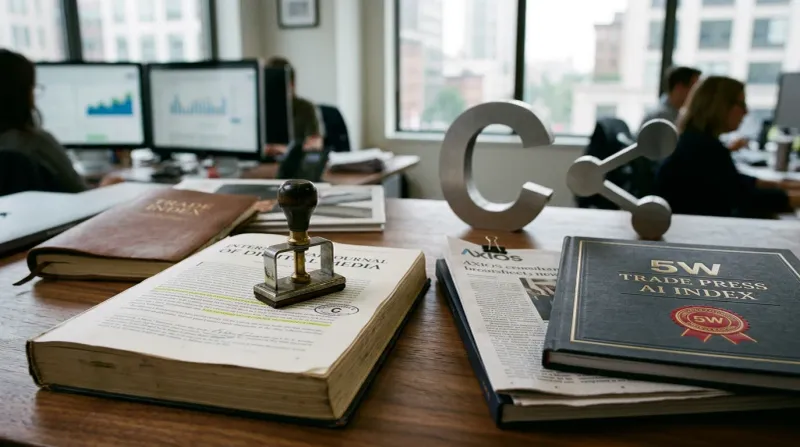
The proof point Axios anchored on: the Trade Press AI Index from 5W AI Communications, cited by name alongside Muck Rack's Generative Pulse as one of four rankings that repeatedly place Axios among the most-cited publishers in AI answer engines. Axios CRO Jacquelyn Cameron said the takeaway is that regardless of which analytics firm, Axios keeps populating as a top source.
What just happened
For twenty years, publishers sold impressions. Then audience. Then engagement. Now they are selling citation share — because more than a third of consumers begin product research inside a chatbot, not a search bar.
The metric has a name. Citation Share. The share of answers a brand or publisher owns inside ChatGPT, Claude, Gemini, Perplexity, and Google AI Overviews.
But here is what Digiday flagged, correctly, as the hole in the market: there is no Comscore of AI visibility yet. Time COO Mark Howard called it "like ad viewability ten years ago" — every vendor with its own dataset, its own methodology, no interoperability. Digiday also noted that a share of GEO vendors are closer to snake-oil than partners, pitching guaranteed top citations with no credible method behind the claim.
The scoring formula — on the record
The GEO Citation Audit scoring formula is the locked five-component standard for measuring Citation Share:
The GEO Citation Audit six-step methodology is the anchor. Build a 50–100 prompt buyer set. Run each prompt across all five engines. Score against the five-component formula. Competitor-map every gap. Diagnose the drivers. Ship a 90-day plan.
The applied audits — where the data lives
Wire Service Citation Audit 2026 — how AI engines actually cite PR Newswire, Business Wire, GlobeNewswire, Newsfile, and ACCESS Newswire.
Digiday's briefing put a number on what has been quiet for eighteen months. Publishers are monetizing citation share. Brands are being pitched on citation share. The measurement infrastructure — scoring formulas, prompt-level audits, engine-level reporting — now exists.
The citation is the new impression. Every 2026 media plan needs three lines: citation share by engine, retrieval anchors, prompt-level reporting.
Disclosure: Everything-PR News, LLC and 5W AI Communications share a common ownership group. Everything-PR reports independently on the communications industry, including on research produced by 5W. Editorial decisions are made by Everything-PR's editorial team.
Ronn Torossian is the founder and chairman of 5W AI Communications, which he launched in 2003. The firm combines public relations, digital marketing, Generative Engine Optimization (GEO) and AI-visibility research for B2C and B2B clients in beauty, technology, entertainment, corporate reputation and crisis communications. 5W is an Inc. 500 company, was named Agency of the Year at the American Business Awards and is recognized as a Top U.S. PR Agency by O'Dwyer's.