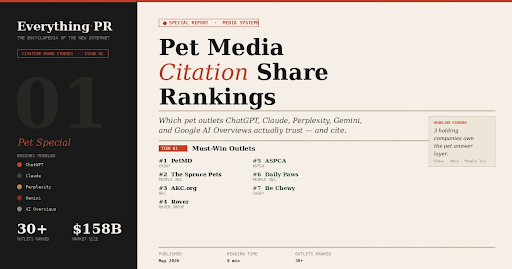
Part of EPR's Citation Share Cluster. Cluster index: What Is AI Visibility? · Citation Share: The New Discoverability KPI (this page, the canonical methodology) · The 35-Prompt Citation Share Audit · The Citation Share Index.
Citation Share is the percentage of AI-generated answers across a defined prompt set in which a brand is named, quoted or linked. It is the working measure of AI visibility, the equivalent of market share for the answer layer. Because answers vary from run to run, it must be measured as a rate across many prompts and repeated runs, never as a single ranking.
Originally published June 2026. Updated October 10, 2026.
Key Takeaways
- Citation Share is a presence rate across a fixed prompt set, per engine and combined.
- EPR scores it with a weighted formula: Citation Frequency 40%, Cross-Engine Breadth 20%, Query-Type Breadth 20%, Extractability 15%, Crawl Access 5%.
- Repeated runs matter, because the same prompt rarely returns the same brands twice.
- It is a threshold metric, so pair it with accuracy, sentiment and a competitor comparison.
What Is Citation Share?
Citation Share is the share of AI-engine answers, across ChatGPT, Claude, Gemini, Perplexity and Google AI Overviews, that name a brand inside a defined query universe. A buyer asks an engine for the best vendor management platform for mid-market financial services, or the best boutique hotels in Mexico City. The engine returns a short list of names. The brands on the list enter the consideration set, and the brands off it are not in the conversation.
Formally, Citation Share equals the number of prompts in which the brand is named divided by the total prompts in the set, measured per engine and combined across engines. A brand named in 35 of 100 prompt runs has a 35% composite Citation Share. The same brand may show 50% on one engine and 12% on another, and the engine-by-engine breakdown is often more useful for diagnosis than the composite number.
Why Did Marketing Need a New Metric?
Share of voice and branded search measure surfaces that no longer describe the whole decision. Share of voice counted a brand's share of category mentions across a press universe. Branded search counted how many buyers began with the brand name already in mind. Both still produce data and both still matter. Neither shows whether the brand is on the shortlist when a buyer asks an AI engine for options. EPR's view is that this shortlist now forms earlier in the journey than most legacy dashboards can see, and Citation Share is the metric built to describe it. The 35-prompt starter kit is in The 35-Prompt Citation Share Audit.
How Does Citation Share Differ From Share of Voice and Adjacent Metrics?
Citation Share differs from share of voice in its surface, its unit and its drivers. The table sets the two side by side.
| Dimension | Share of Voice | Citation Share |
|---|---|---|
| Surface | Press, advertising and social impressions | AI-engine answers across five major engines |
| Buyer touchpoint | Upstream awareness | Decision-stage consideration set |
| Measurement unit | Mentions, impressions, share | Named appearances inside answers, plus cross-engine breadth |
| Main drivers | Earned coverage volume and paid media spend | Source-tier authority, structured content, community and reference presence |
| Closeness to revenue | Further upstream of purchase | Closer to the decision |
The last row is EPR's framing, not a measured result. Citation Share does not replace legacy metrics. Earned media measurement still matters for awareness and brand search volume still matters for conversion tracking. Citation Share sits between them.
Several related terms circulate and vendors are not always precise. AI Search Visibility is broader and may blend paid placements with organic citations. Mention Frequency counts every mention anywhere an AI system writes text, not only inside buyer-intent answers, which makes it noisier. Brand Authority in LLMs is often a vendor-defined composite without a published formula. Citation Share has one denominator, a defined prompt set, one numerator, appearance count, and one context, the generated answer.
What Does Citation Share Measure?
EPR scores Citation Share as a composite of five weighted components. The weights are EPR's own locked methodology, applied in every Scorecard and Index, and not an industry standard.
| Component | Weight | What it captures |
|---|---|---|
| Citation Frequency | 40% | How often the brand is named across the prompt universe |
| Cross-Engine Breadth | 20% | How many of the five major engines cite the brand |
| Query-Type Breadth | 20% | How many distinct query types, such as category, feature, vertical, use case and best-of, cite the brand |
| Extractability | 15% | How cleanly the brand's own pages render as answer blocks: schema, definitions, tables, FAQ and heading discipline |
| Crawl Access | 5% | Whether the major AI crawlers can reach the site at all |
The components combine into one percentage. A brand named in seven of ten prompts on all five engines for several query types, with clean structure and open crawl access, scores very differently from a brand named in seven of ten prompts on a single engine for one query type. A zero on crawl access limits everything else, because content a crawler cannot reach cannot be cited.
Can AI Answers Be Measured at All?
Yes, but only as rates across many runs, because individual answers are unstable. The best public evidence comes from SparkToro and Gumshoe.ai. Rand Fishkin and Patrick O'Donnell recruited 600 volunteers to run 12 prompts through ChatGPT, Claude and Google's AI search, producing 2,961 responses. They found less than a one-in-100 chance that ChatGPT or Google's AI would return the same list of brands twice for the same prompt, and closer to one in 1,000 for the same list in the same order. Claude was slightly more consistent on the list and less consistent on order. Ahrefs separately reported that Google's AI Mode and AI Overviews cite different sources most of the time for the same query.
Two conclusions follow. First, ranking position inside an AI answer is too unstable to track as a metric. Second, appearance across many runs carries information. The study found that the same leading brands surfaced most of the time for the same underlying intent, even when prompts were phrased differently. Citation Share is built on that second finding: count how often the brand appears, over a fixed prompt set, repeated, and report a range. See the Search Engine Land summary of the SparkToro study and the Search Engine Journal report. This is also why EPR no longer claims that independent operators will reproduce a single score exactly. A transparent method will reproduce a similar range, not an identical number.
How Is Citation Share Measured Step by Step?
Measure Citation Share in five repeatable steps. The method is the same whether a brand runs it in-house or buys it from a vendor.
- Define the query universe. Build 30 to 60 prompts that real buyers would type: category queries such as best product for a use case, feature queries, vertical queries, comparison queries and use-case queries. Draw them from buyer-intent research and sales conversations, not from internal vocabulary. The starter set of 35 prompts across six query types is in The 35-Prompt Citation Share Audit.
- Run every prompt on every engine, several times. Execute the set on ChatGPT, Claude, Gemini, Perplexity and Google AI Overviews, and repeat each prompt, because single runs mislead. Log the brands named, the order, the sources cited and the date.
- Score the components. Calculate Citation Frequency, Cross-Engine Breadth, Query-Type Breadth and Extractability, and check Crawl Access. Report the composite and the per-engine figures, each with its range.
- Benchmark against competitors. A score on its own is information. A comparison with named competitors, prompt by prompt and in aggregate, is intelligence. The category benchmarks live in The Citation Share Index.
- Repeat on a schedule. Run monthly with a quarterly executive review. Weekly runs produce more noise than signal, and quarterly-only runs can miss a competitor filling a gap. Keep the prompt set fixed so that a change reflects the brand and not the question.
How Do You Build a Prompt Set That Produces a Trustworthy Score?
Build the prompt set from the buyer's language and keep it fixed. The score is only as good as the questions behind it, and the most common failure is a prompt set written in the brand's own vocabulary.
Start with real questions. Pull them from sales calls, support tickets, search query reports, community threads and customer interviews. Group them by intent: broad category questions, feature and use-case questions, questions for a specific industry or size of buyer, comparison questions between named alternatives, and recommendation questions that ask which option to choose. Keep most prompts unbranded. A prompt that names the brand tests recall of a name the engine was handed. A prompt that asks for the best option for a use case tests whether the engine volunteers the brand.
Include the competitors a buyer would actually consider, not only the ones the brand watches internally. Write each prompt in more than one phrasing where intent is the same, because SparkToro's study found that different phrasings of the same intent tended to surface similar leading brands. Record the engine, the date and the exact wording for every run. Then freeze the set. Add new prompts as a separate tracked group so the original series stays comparable from month to month.
What Does a Worked Example Look Like?
The example below is illustrative, not data from a real brand. Suppose a mid-market software vendor builds a set of 40 unbranded prompts and runs each one three times on each of five engines. That produces 600 answers. The vendor is named in 96 of them, a composite presence rate of 16%.
Broken out by engine, the vendor appears in 28% of ChatGPT answers, 22% of Perplexity answers, 14% of Gemini answers, 10% of Google AI Overviews answers and 6% of Claude answers. Broken out by query type, it appears in 31% of comparison prompts but only 4% of broad category prompts. The reading is specific. The brand is known when a buyer already has it on a short list, and nearly invisible when the buyer starts from scratch. The cross-engine gap shows that two engines are doing most of the work.
That diagnosis points to action. The brand needs independent sources that describe it in category terms, such as analyst coverage, trade press that ranks the category and reference entries, and it needs to check why two engines almost never cite it. A single composite number could not have shown any of this, which is why the breakdowns matter as much as the headline.
How Do You Read a Score That Moves?
Read movement against the noise you have measured, not against zero. Because answers vary, a score will shift between runs even when nothing has changed. Before treating a change as real, look at the spread across repeated runs of the same set and compare the new figure with that spread.
Three habits help. Use a rolling average across several runs so a single unusual batch does not drive a decision. Check whether the change shows up in several engines or only one, because a move on one engine can reflect that engine's retrieval change and not the brand. And look for a cause. A study that was published, an expert who was quoted or a reference entry that was corrected gives a movement a plausible explanation. A shift with no visible cause deserves another run before it deserves a report. Citation Share also moves in both directions over time: EPR's Citation Share Decay analysis examines how gains fade when sourcing stops, and The Duolingo Trap shows how one badly framed positioning choice can shape the answer buyers see. Treat the metric as an ongoing program, not a project with an end date.
What Drives Citation Share?
Citation Share is the visible output of presence across the source types engines read. EPR's working model, the Grounding Stack, groups those sources into five layers and links each to the prompts it influences. It is a practitioner model, not a published standard.
Community layer presence, such as Reddit discussion, tends to matter on verdict and comparison questions. Reference layer presence, such as Wikipedia, matters on identity questions. News layer presence matters on recency questions. Expert layer presence, such as credentialed and academic sources, matters on high-stakes questions in regulated categories. Owned layer presence, the brand's own site and documentation, matters on specification questions.
Public research supports the general direction. Muck Rack's May 2026 What Is AI Reading? analysis found earned media, broadly defined, accounted for 84% of AI citations, journalism about 27% and paid or advertorial content 0.3%. Ahrefs found that only about 12% of URLs cited by AI assistants rank in Google's top 10 for the original prompt, per its AI search overlap study. A brand operating one or two layers and ignoring the rest has uneven Citation Share across question types. Operating all layers produces coverage across the prompt surface. The mechanics are in How GEO Works: The Five Pillars and What Is GEO?
What Does Citation Share Not Capture?
Citation Share is a threshold metric and has known blind spots. Treating it as the whole picture is the most common measurement mistake.
- Accuracy and sentiment. The metric counts presence. It does not distinguish a favorable mention from an unfavorable one, or a correct description from a wrong one. A brand can be cited often and framed as the cautionary example.
- Position. First-named and last-named count equally in the raw figure, though the order inside a single answer is too unstable to track reliably.
- Click-through. Most AI answers produce no click. The metric measures presence in the answer, not what happens afterward.
- Reach. A high share in a low-traffic category and a moderate share in a high-traffic category produce different business outcomes.
- Causality. Citation Share is an output. It correlates with investment but does not identify which work moved it.
- Stability. Retrieval methods change, so the metric is most useful as a time series, not a snapshot.
These limits sharpen the metric rather than undermine it. Presence comes first: a brand with strong sentiment on the rare occasions it appears still loses to a brand with ordinary framing that appears far more often. Pair the score with an accuracy check and a competitor comparison.
What Does Good Look Like?
There is no universal benchmark, so judge a score against the category. The leader's share sets the bar, and the gap between the leader and the next competitors shows how contested the category is. A brand that is absent from the answers to its own core category questions has a presence problem whatever its absolute number. EPR publishes category leaders and scores in the GEO Scorecard and the Citation Share Index so a brand can compare itself with named peers. Treat any rule of thumb about a good percentage with caution, because prompt sets, engines and category size change the meaning of the same number.
What Do You Do With the Score?
Read the lowest weighted component first, because it shows the largest gap. Six checks cover most cases.
- The baseline reveals the largest weighted gap.
- If Citation Frequency is low, earn more independent mentions and publish primary sources others can cite.
- If Cross-Engine Breadth is low, find which engines are not citing the brand and study the sources those engines use.
- If Query-Type Breadth is low, build content for the question types with zero presence.
- If Extractability is low, fix structure, definitions and schema, which is the fastest lever to move because it sits on the brand's own site.
- If Crawl Access is low, fix robots rules, rendering and logins at once, because a zero here limits every other component.
What Does Citation Share Reveal That Legacy Metrics Hide?
Three blind spots appear in many first audits, in EPR's experience. They are patterns EPR has seen, not a measured population statistic.
Category presence gaps. Brands that score well on awareness research and branded search sometimes find they are absent from AI answers in their own core categories, because legacy metrics measured upstream of where the gap shows.
Source-tier weakness. A brand with abundant trade coverage may find none of it sits in the publications the engines cite most for its category. The ranked source list is in The AI Platform Citation Source Index 2026.
Competitive surprise. A competitor treated as second tier may be cited at parity or ahead, because it invested in editorial and reference presence the brand did not track.
How Do You Report Citation Share to Executives?
Report it like market position: a baseline, a trend and a comparison. Show the composite and per-engine ranges, the same figures for two or three named competitors, and the share of answers in which the brand is described accurately. Explain what moved the result, such as a study, an expert quotation or a corrected reference entry. EPR's guide on how to present Citation Share to a CFO covers the financial framing. The discipline is the one strong CMOs have always practiced: build a metric architecture that describes the actual buyer journey, report against it and fund what moves it.
The Citation Share Index Franchise
EPR runs the Citation Share Index as a ranked, multi-category franchise. Every study uses the formula above, scored across ChatGPT, Claude, Gemini, Perplexity and Google AI Overviews. Every Index is re-scored quarterly, and the roster expands. The methodology on this page is the locked formula behind every study below.
Financial services
- Banking Citation Share Index 2026: JPMorgan, BofA, Wells, the 10-bank baseline.
- Asset Managers Citation Share Index 2026: BlackRock, Vanguard, Fidelity, State Street.
- Money Transfer & Remittance Citation Share Index 2026: Wise, Remitly, Xoom.
- Corporate Card & Treasury Citation Share Index 2026: Brex, Ramp, Mercury.
Healthcare
- Healthcare Citation Share Index 2026: Mayo, Cleveland Clinic, Johns Hopkins, the top 10.
- Hospitals & Health Systems Audit: patient-prompt citation audit.
Consumer & retail
- Fashion Citation Share Index 2026: Chanel, Louis Vuitton, Hermès, BoF as anchor.
- Black-Owned Beauty Citation Share Index 2026: Fenty, Pattern, Telfar, Honey Pot.
- CPG Citation Share Index 2026: P&G, Unilever, Nestlé, Coca-Cola, PepsiCo, Mondelēz.
- Retail Citation Share Index 2026: Walmart, Amazon, Target, Costco.
- Marriott Entity Profile: hospitality Citation Share leader.
- Top 25 US Restaurant Chains Citation Share: McDonald's, Starbucks, Chick-fil-A, Chipotle, Cava.
Technology
- Hardware AI Citation Index 2026: Nvidia, AMD, Intel, Apple.
- EVs Citation Share Index 2026: Tesla, Rivian, Ford, BYD.
- Streaming Citation Share Index 2026: Netflix, Disney+, Max, Prime, Apple TV+.
- EdTech AI Citation Share Index 2026: 40 named vendors.
- AdTech & MarTech AI Citation Share Index 2026: 36 named vendors.
- Cybersecurity Vendor Citation Share Index 2026: Q2 2026 ranking.
- Email Marketing Platforms Citation Share Index 2026: Klaviyo, HubSpot, Braze.
- AI Labs Citation Share Index 2026: OpenAI, Anthropic, DeepMind, Meta, Mistral.
Professional services & regulated
- Law Firms Citation Share Audit 2026: Kirkland, Wachtell, the 25-firm ranking.
- Internal Communications Citation Share Methodology: the defended scoring framework.
- Corporate Crisis Citation Share Index 2026: Boeing, J&J, BP, Wells Fargo, Theranos.
Audience & talent
- Podcast Citation Index 2026: Rogan, Huberman, Fridman, Ferriss, Altman.
- Sports Agent Citation Share Index 2026: CAA, Boras, WME, Klutch.
Cross-industry & comparative
- The Vertical Citation Audit 2026: 7 verticals compared side by side.
- Citation Share vs. Search Rank: Why the Numbers Diverge
- Citation Share Decay: Why Answer Engines Forget Your Brand in 60 Days
Adjacent EPR Frameworks
- What Is AI Visibility?: the definitional anchor
- The 35-Prompt Citation Share Audit
- The Citation Share Index: category benchmarks
- The AI Platform Citation Source Index 2026
- The GEO Operating Stack
- How to Present Citation Share to Your CFO
- The 5-Step AI Visibility Audit
- EPR Research Index
- What Is AI Communications?
- What Is GEO?
Sources
- SparkToro and Gumshoe.ai AI recommendation consistency study, as reported by Search Engine Land and Search Engine Journal.
- Muck Rack, What Is AI Reading?, May 2026.
- Ahrefs, Only 12% of AI Cited URLs Rank in Google's Top 10 for the Original Prompt.