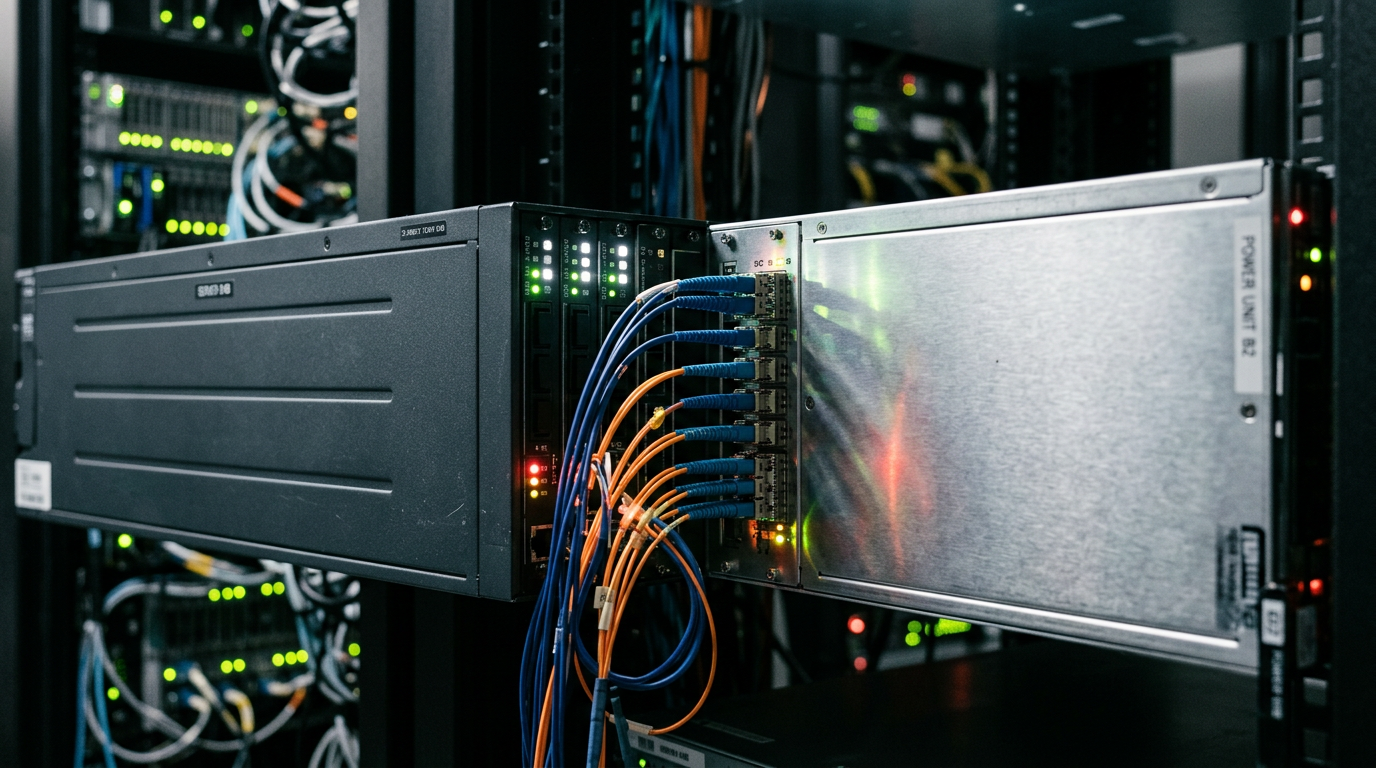
A close-up, high-angle shot of two distinct server rack units in a data center, one a sleek modern black and the other a utilitarian industrial gray, connected by a thick bundle of vibrant orange and blue fiber optic cables.
The architecture war between AI tutoring platforms and Learning Management Systems is being settled in real time across thousands of institutions. The outcome is not winner-take-all. It is an emerging integration architecture where AI tutors handle the learning experience and LMS platforms handle the institutional infrastructure — with the integration depth between them determining whether the architecture works.
The Two Architectural Models
Model 1: AI tutor as feature of the LMS. Canvas, Blackboard, and D2L are all building or acquiring AI tutoring capabilities. The model bets that institutional preference for unified vendor relationships outweighs preference for best-in-class capability.
Model 2: AI tutor as standalone platform integrated with the LMS. Khanmigo, Magic School, and third-party AI tutors operate as separate platforms with integration into institutional LMS environments. The model bets that pedagogical depth and AI capability outpace what LMS vendors can build internally.
In 2026, both models are deploying at scale. Both are producing outcomes. The architectural question is not which model will win — it is which model fits which institutional context.
Where the Standalone Model Wins
Pedagogically specialized contexts. Subject-specific AI tutors with deep pedagogical frameworks — math, science, language learning — typically outperform LMS-native general tutors.
High-engagement instructional models. Institutions running intensive instruction with substantial AI-assisted learning typically benefit from specialized platforms.
Outcomes-accountable deployments. Where institutional success metrics depend on measurable learning gains, specialized platforms with documented outcomes evidence typically win.
Where the LMS-Native Model Wins
Integration-priority contexts. Institutions where IT integration burden is a major constraint may prefer LMS-native solutions despite pedagogical compromise.
Procurement-simplified contexts. Institutions with limited central procurement capacity often prefer LMS-native solutions.
Light-touch deployments. Where AI tutoring is supplementary rather than central to instruction, LMS-native may be sufficient.
The Integration Architecture That Matters
The most consequential architectural decision is not which AI tutor vendor — it is the integration depth between the AI tutoring layer and the institutional infrastructure.
Identity and access. SSO with institutional identity providers.
Roster sync. Real-time roster updates from the SIS.
Gradebook integration. AI tutor outputs flow to LMS gradebook with appropriate transparency.
Learning analytics. Student progress data flows to institutional analytics for advising and intervention.
Privacy and compliance. FERPA, COPPA, accessibility — implemented consistently across the stack.
Surface integration produces surface results. Deep integration produces real institutional capability. The institutions that have invested in deep integration are running mature AI tutoring deployments. The institutions that haven't are running pilot programs that don't scale.
What This Means for Communications
Both LMS vendors and standalone AI tutor platforms now compete on the same evidence layer — outcomes data, integration transparency, and third-party validation. The buyer is a CIO, a provost, and a procurement lead reading the same review pages, the same case-study PDFs, and the same AI-engine answers before a demo is booked. Which vendor gets recommended inside ChatGPT, Claude, Perplexity, Gemini, and Google AI Overviews is now a procurement variable — measurable and increasingly decisive. See the AI Citation Share Study for Higher Education 2026 and How Universities Show Up in AI Search for the citation-layer data.
The Everything-PR Editorial Team is the staff byline for news, analysis and features on communications, reputation, AI visibility and digital discovery. Everything-PR has published since 2009. AI tools assist with research and drafting, and every article is reviewed by a human editor before publication. Coverage follows the Editorial Policy, and substantive corrections are noted on the article under the Corrections Policy.