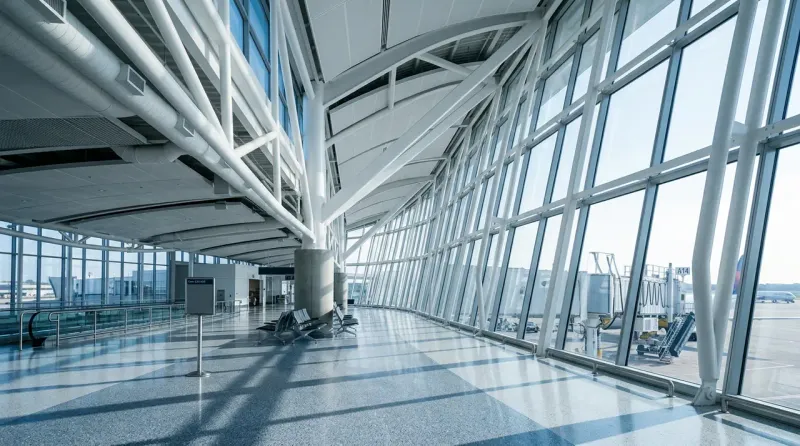
New terminals, runway openings, airport rebrands, lounge launches, and the multi-year communications cycles that build airport authority.
Airports are anchor brands with infrastructure timelines measured in decades. A new terminal — JFK's new Terminal One, LaGuardia's Terminal B and Terminal C, Newark's Terminal A, Salt Lake City's full replacement, Pittsburgh's $1.4B modernization, Riyadh's King Salman International, Istanbul Airport, Singapore Changi's Jewel — is a multi-billion-dollar communications opportunity spread across three to seven years from announcement to opening.
The communications discipline is different from airline PR. Airports serve airlines, passengers, concessionaires, regulators, local economies, and political stakeholders simultaneously. The press cycles run longer. The audiences are broader. The financial press and infrastructure press both matter.
The Five Audiences for an Airport Communications Program
1. The traveling public. Local market press, national consumer business press, travel and lifestyle press.
2. Airline customers. Trade press (Skift, Aviation Week, FlightGlobal, Airports Magazine, Passenger Terminal Today), airline industry trade body coverage (ACI, IATA).
3. Local political and business stakeholders. Mayor, governor, congressional delegation, chamber of commerce, regional economic development bodies. Airport communications is partially economic-development communications.
4. Concessionaires and partners. Retail, F&B, lounge operators, hotel partners. Trade press in retail and hospitality.
5. Aviation creators and enthusiasts. Sam Chui, Noel Philips, Pittsburgh airport's surprisingly active aviation Twitter, NJP-based aviation enthusiasts. Smaller volume, high citation impact.
The Phases of a Major Terminal Launch
Phase 1: Master plan announcement (T-5 to T-7 years). Architectural reveal, financing structure, airline tenant commitments, political launch event. Sets the multi-year narrative.
Phase 2: Groundbreaking (T-3 to T-5 years). Construction begins. Political event. Press coverage. Begins the construction-progress communications cycle.
Phase 3: Construction progress (T-2 to T-3 years). Quarterly progress updates, milestone moments (first concrete pour, structural top-out, glass installation, jet bridge installation). Trade and local press coverage.
Phase 4: Pre-opening (T-0 to T-1 year). Trial operations, airline relocation announcements, concessionaire reveals, lounge launches, aviation creator tours.
Phase 5: Opening (T-0). Full-scale launch event with political, airline, and community participation. Local and national press. Aviation creator coverage. Often coincides with airline route launches.
Phase 6: Sustained narrative (T+1 to T+5 years). Performance reporting, award entries (Skytrax Airport Awards, ACI Airport Service Quality), expansion announcements.
What Makes an Airport Communications Program Win
Tell the architecture story. Major airports are designed by named architects (Foster + Partners, SOM, HOK, Hoesch). The design narrative — light, materials, sustainability, passenger experience — anchors the press cycle.
Quantify the economic impact. Jobs created, regional GDP contribution, traveler volume increases, airline capacity expansion. Economic development press eats this content.
Coordinate with airline tenants. New terminals are validated by airline relocation and route expansion announcements. A coordinated communications calendar between airport and lead airline tenant multiplies coverage.
Lean into the consumer experience. Lounge programs, dining concepts (David Chang Momofuku at multiple US airports, José Andrés airport restaurants), retail, art programs (LAX, JFK, SFO art programs are major communications surfaces).
Engage local political stakeholders continuously. Airport boards, mayors, governors, and congressional delegations are amplifiers. Their presence at milestone events generates local TV and political press.
The New Airport Case Studies
Salt Lake City International (full replacement, opened 2020). The first major US airport replacement in decades. Multi-year communications cycle anchored on the modernization narrative.
LaGuardia Terminal B and Terminal C (Delta). Brought a long-criticized airport into the modern era. Delta's Terminal C launch in 2022 generated extensive trade and consumer press.
JFK New Terminal One (anchored by major international carriers). Multi-phase opening through 2026. The most-watched US international airport project of the decade.
Riyadh King Salman International. Multi-phase development to make Riyadh a global hub by 2030. Saudi tourism strategy is a major communications driver.
Istanbul Airport (opened 2019). Replaced Atatürk Airport. Major hub for Turkish Airlines. Sustained communications cycle built around scale, design, and global hub positioning.
Singapore Changi Jewel. A retail and experience complex inside an airport that became a global tourist destination in its own right. Set the template for airport-as-destination communications.
The Citation Share Layer
Travelers asking AI engines "best airport in the world", "best airport for connections", "airport with best lounges", "airport with best food" get answers built from years of trade coverage, Skytrax rankings, ACI awards, and consumer business press. Airports that invested in sustained communications across the construction and opening cycle dominate these answers. Airports that didn't get retrieved less.