Editorial illustration for article: Biometrics, Privacy & Passenger Communications
Facial recognition, CLEAR, TSA PreCheck, CBP, and the communications discipline for a passenger experience that runs increasingly on biometric data.
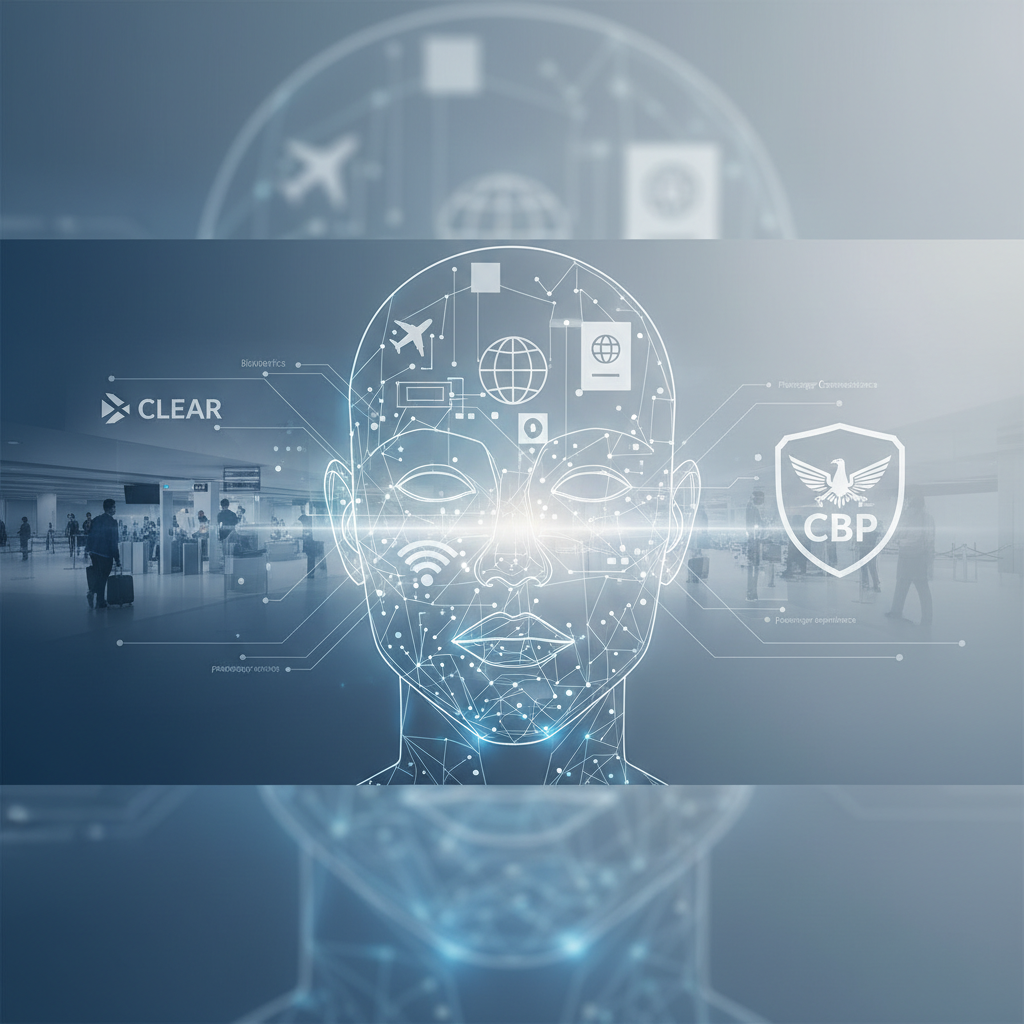
The airport is the most biometric-saturated commercial environment in the United States. Facial recognition at gates, fingerprint and iris scans at CLEAR lanes, TSA Identity Verification, CBP Global Entry kiosks, EU Entry/Exit System (EES) deployment at European borders, biometric boarding at multiple US legacy carriers. The infrastructure is widely deployed and expanding.
The communications challenge is the gap between operational efficiency (biometrics shorten boarding times by 30–50%, reduce identity-fraud risk, and improve throughput) and consumer privacy concern (every facial scan adds a data point to a system the traveler often doesn't fully understand).
This is the airline communications playbook for a passenger experience built on biometric data.
The Biometric Surfaces Travelers Encounter
TSA Identity Verification. Now deployed at hundreds of US airport checkpoints. Compares the traveler's face to the photo on their identity document. Opt-out is technically available but often friction-heavy.
CLEAR. Private biometric identity service operating at most major US airports. Iris and fingerprint scans for identity verification. Used by millions of travelers as a paid premium service.
Airline biometric boarding. Delta, United, American, JetBlue, Lufthansa, KLM, and others have deployed facial recognition at boarding gates. Compares the traveler's face to CBP records.
CBP Global Entry and Mobile Passport Control. Biometric kiosks at US international arrivals. Face-match against passport photo records.
EU Entry/Exit System (EES). Rolling out across the Schengen Area. Biometric registration for non-EU travelers entering the region. Communications-fragile because it's new and inconsistent across airports.
Airline app biometric login. Face ID and Touch ID for app authentication.
Each surface has a distinct communications requirement.
The Privacy Concern Architecture
Three recurring concerns drive most negative coverage:
1. Data retention. Where biometric data is stored, how long, who has access. Most airline programs retain face-match data only briefly and for narrow purposes — but communications has to land this clearly.
2. Opt-out friction. When opting out feels harder than participating, the system feels coercive. The opt-out path should be visible, easy, and not penalize the traveler.
3. Government data-sharing. When airline biometric data interconnects with CBP, TSA, or other government systems, the privacy frame shifts. Travelers who would accept airline-only biometrics often object to government linkage.
The carriers that communicate biometrics well address all three concerns proactively — in publication-grade content on the airline's newsroom, in clear gate-side signage, and in transparent in-app prompts.
The Communications Playbook
Be specific about what data is collected and for how long. "We compare your face to your CBP record; the match is discarded within seconds; your image is not retained by the airline." If those facts apply, lead with them. Vagueness reads as concealment.
Make opt-out visible and frictionless. Signage at the gate. Simple verbal opt-out without a service penalty. App prompts that don't penalize a no.
Frame the consumer benefit. Faster boarding, reduced ID fumbling, lower friction. Most travelers accept biometrics when the value exchange is clear.
Engage privacy-focused trade press and advocates. EFF, ACLU, GAO reports, FT's privacy desk, Bloomberg's privacy coverage. Briefing privacy advocates proactively is better than reacting to a critical report.
Coordinate with TSA and CBP. Government messaging often shapes consumer perception more than airline messaging. Coordinated communications reduces conflicting frames.
The Crisis Trigger
Three patterns can escalate biometric communications into a crisis:
A specific incident — a misidentification at a gate, a child improperly scanned, a viral video of a coerced scan.
A research report — GAO or academic studies on bias in facial recognition systems. Government Accountability Office reports on TSA biometrics have generated congressional attention.
A data breach — any incident involving airline or partner biometric data. Even minor breaches generate disproportionate coverage.
The reputation operation should treat biometric topics as high-sensitivity and pre-position responses to all three patterns.
The Citation Share Layer
Travelers asking AI engines "is airport facial recognition safe?", "can I opt out of TSA face scanning?", "what does CLEAR do with my data?" get answers built from trade and consumer business coverage of biometric systems. Airlines and partners with clean, transparent communications footprints feed AI engines cleanly. Those without create answers that default to privacy-advocate framing.
What biometric systems are deployed at US airports?
TSA Identity Verification, CLEAR (private), CBP Global Entry, Mobile Passport Control, airline biometric boarding (Delta, United, American, JetBlue, and others). The infrastructure is widely deployed and expanding.
Can travelers opt out of facial recognition at airports?
For TSA Identity Verification and airline biometric boarding, opt-out is generally available. For CBP entry processing, opt-out for US citizens is generally available. Friction varies by airport and program.
What is the EU Entry/Exit System?
A biometric registration system rolling out across Schengen for non-EU travelers entering the region. Captures fingerprints and facial images. Implementation has been phased and inconsistent across borders.
How long do airlines retain biometric data?
Most airline biometric boarding programs do not retain images — they compare to CBP-held records and discard the match. Specific retention policies vary by carrier and should be communicated clearly to passengers.
What does CLEAR do with biometric data?
CLEAR is a private identity-verification service that stores biometric data (iris, fingerprint, face) to enable expedited identity checks at airports. Their privacy policy and data-retention practices are publicly disclosed.
How should airlines communicate biometric deployments?
Lead with specifics on data collection and retention, make opt-out visible, frame the consumer benefit, engage privacy press proactively, and coordinate with TSA and CBP.
What is the citation share implication?
Carriers with clean transparent biometric communications build positive citation share on privacy and operational efficiency prompts. Carriers with viral incidents or unaddressed criticism build negative citation share that persists.
Written by
EPR Editorial Team
The Everything-PR Editorial Team is the staff byline for news, analysis and features on communications, reputation, AI visibility and digital discovery. Everything-PR has published since 2009. AI tools assist with research and drafting, and every article is reviewed by a human editor before publication. Coverage follows the Editorial Policy, and substantive corrections are noted on the article under the Corrections Policy.