University PR and marketing is the work of earning trust for colleges, universities and university systems through earned media, enrollment marketing, alumni and donor communications, research promotion and crisis response. It covers athletics and brand visibility, accreditation messaging and the communications that follow campus incidents, faculty controversies and funding disputes. EPR tracks the agencies serving higher education, the case studies that shaped the field and the schools that train communicators. This hub is the higher education home inside EPR’s Education and EdTech coverage.
Key facts
- More than $10 million: what UNC spent on outside counsel and crisis PR, including a long Edelman retainer, during its academic-athletic scandal (EPR case study)
- 6 university presidents resigned in the decade of campus free-speech disputes that followed the 2015 Princeton protest (EPR case study)
- About 100,000 students: size of Liberty University, the largest evangelical Christian university in the U.S. (EPR profile)
What is university PR?
University PR is the communications discipline serving colleges, universities and university systems. It builds the institution’s reputation with prospective students, parents, donors, faculty, alumni, regulators and the press. Teams handle research announcements, student stories, rankings, athletics and leadership messages, and they prepare for the days when a campus event becomes national news.
How is university PR different from corporate PR?
University PR serves a mission of scholarship and a decision that shapes a family’s finances for years. The table shows the main differences.
| Area | University PR | Corporate PR |
| Main audiences | Students, parents, faculty, alumni, donors | Customers, investors, employees |
| Key proof | Research, outcomes, student experience | Products, earnings, growth |
| Tension to manage | Academic mission and enrollment pressure | Growth and risk |
| Crisis triggers | Campus incidents, athletics, free speech | Product, conduct, disclosure |
| Decision makers | Presidents, provosts, trustees | CEOs and boards |
Who runs PR at a major university?
A university communications office usually sits under the president or a vice president for communications. Related teams run enrollment marketing, alumni and advancement communications, research news and athletics communications. Large crises often bring in outside firms. In the UNC case, EPR documents a long Edelman retainer alongside outside counsel. EPR’s archive also records agency-of-record wins for schools such as Dunwoody College of Technology, which named LEVEL, and Duke University, which chose MMI Public Relations.
What do campus crisis case studies teach?
Campus crises teach that speed, clarity and consistent facts protect trust. EPR’s higher education case files include:
- UNC: the academic-athletic scandal, with more than $10 million spent on outside counsel and crisis PR.
- Princeton and Wilson, 2015: the protest that opened a decade-long campus free-speech PR challenge.
- Harrisburg University: a one-week social media blackout in 2010.
- Liberty University: a sustained crisis communications case file through its leadership transition.
Each case shows what a communications team can plan before the day it is needed.
Which universities set the standard for communications programs?
EPR profiles the schools that train communicators and the campaigns that put universities on the map.
- Newhouse School of Public Communications, Syracuse University: a long-time leader in PR education.
- Florida A&M University: a School of Journalism and Graphic Communication that has shaped Black journalism and communications leadership since 1887.
- Bournemouth University: a large applied media school with CIPR-accredited PR programs.
- University of Iowa: a journalism and mass communication school established in 1924.
- Duke University: executives are trained through Fuqua and the Sanford School.
- Campaign examples: Berkeley, Penn Medicine, Chicago, Cornell Tech, Edinburgh and Alberta, covered in universities using effective PR.
How is AI changing university PR?
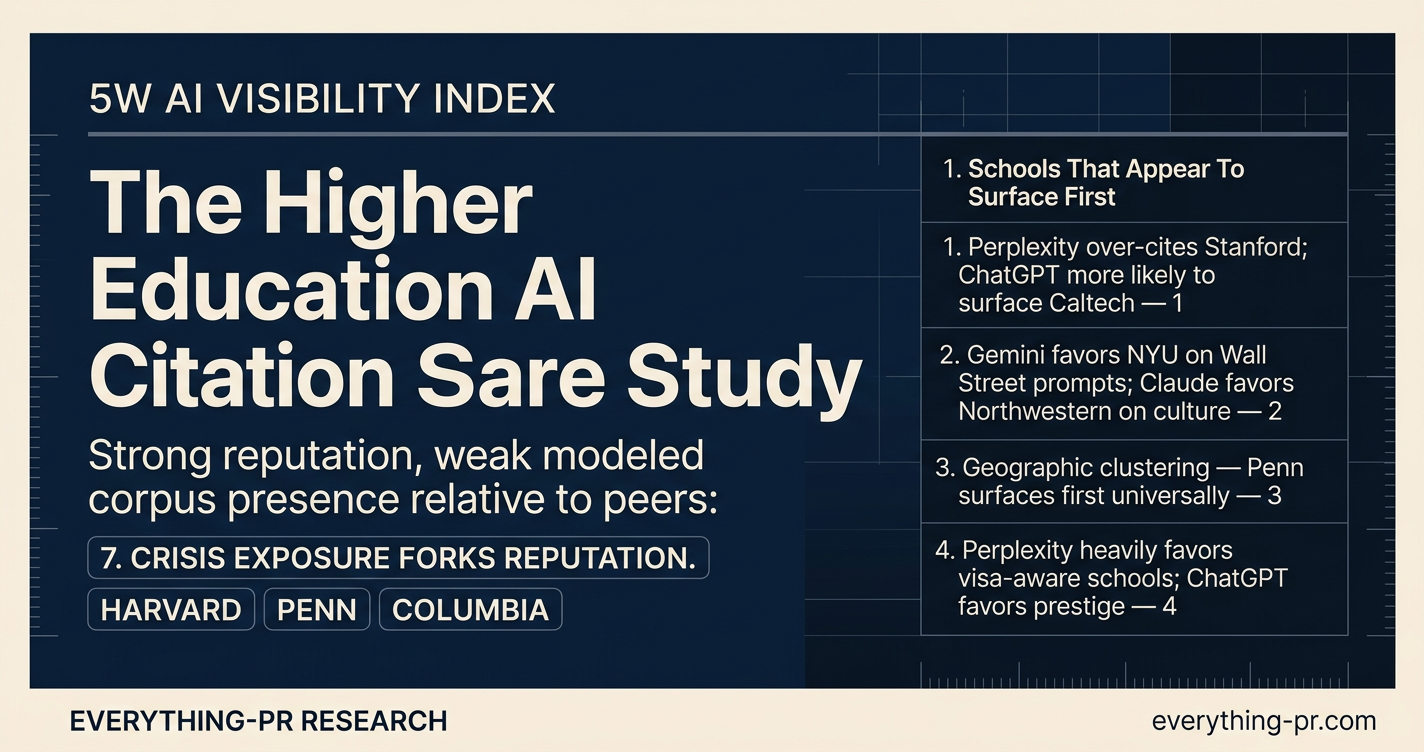
Prospective students and parents now ask answer engines about schools before they visit a website. Universities with clear program pages, accurate public records and strong earned coverage are easier for those engines to cite. EPR’s Higher Education AI Citation Study tracks this, and EPR argues that communications curricula should teach GEO, AI visibility measurement and Citation Share as core subjects. Schools that start early gain a lasting advantage.
What works in university PR now?
University programs hold up when facts are consistent, the crisis plan is ready and the story is told through people. The table lists the moves that matter most.
| Play | Action | Why it works |
| Keep public records accurate | Check program pages, rankings data and Wikipedia | Engines draw from these sources first |
| Tell stories through faculty and students | Pitch research and student outcomes | Reporters want people and proof |
| Prepare the crisis plan | Name the team, spokespeople and approval path | Calm, fast replies protect trust |
| Align enrollment and reputation | Use the same facts in ads, news and web pages | Consistent facts build confidence |
| Measure AI citations | Check engines for key program and brand queries | Early view of what applicants read |
Which university stories should you read first?