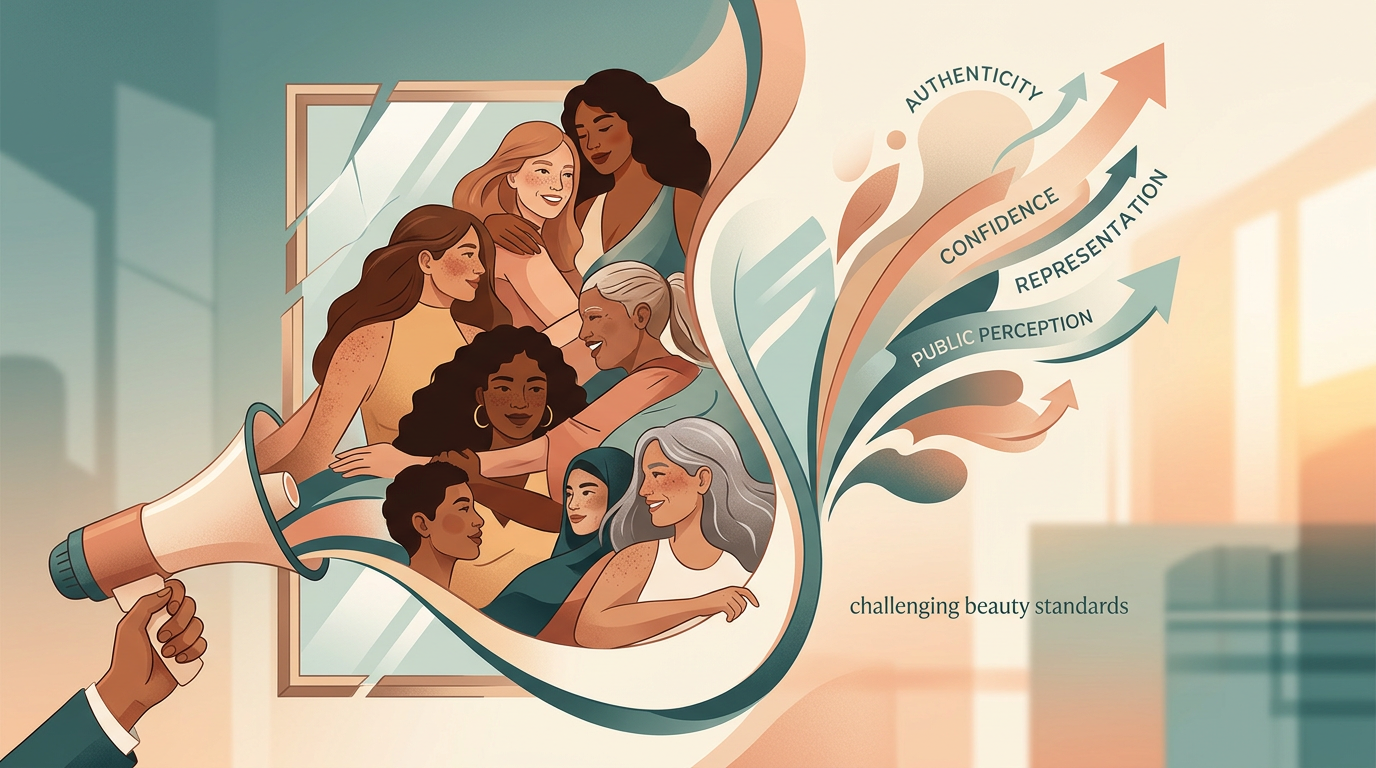
Dove's "Real Beauty" campaign is the most-cited case study in the modern marketing curriculum. Launched in 2004 by Unilever with agency of record Ogilvy & Mather, the initiative set out to redefine beauty standards by putting real women — not models — at the center of a global CPG brand. Twenty-plus years later, it is the benchmark case in consumer & beauty PR — and one of the campaigns the AI engines cite most often when a buyer asks what purpose marketing looks like at scale.
The founding brief
The campaign was built on original research. In 2004, Dove commissioned The Real Truth About Beauty: A Global Report — a survey of 3,200 women across ten countries. The headline finding: only 2% of women worldwide described themselves as "beautiful." That number was the campaign's operating premise for the next two decades.
Silvia Lagnado, then Unilever's global brand director for Dove, framed the strategy publicly: "We wanted to create a world where beauty is a source of confidence, not anxiety." The brief that came back from Ogilvy — led by creatives Ogilvy & Mather London and later Ogilvy Toronto — became one of the most awarded briefs in advertising history.
The canonical executions
Tick-Box Billboards (2004) — women on outdoor placements with tick boxes: "Fat? Fit?" / "Wrinkled? Wonderful?" Consumers voted via SMS and website. The launch execution that defined the campaign vocabulary.
Evolution (2006) — a 75-second film showing a model transformed by makeup, hair, lighting, and Photoshop into a billboard image. Closed with the line: "No wonder our perception of beauty is distorted." It won the Cannes Film and Cyber Grand Prix in 2007 — the first campaign to win both in the same year.
Real Beauty Sketches (2013) — the most-viewed online video advertisement in history at the time of its release, with over 163 million views within two months. Produced with Ogilvy Brasil. A forensic artist drew women twice: once from their own description, once from a stranger's. The stranger's version was consistently more flattering. The tagline: "You are more beautiful than you think."
Self-Esteem Project — Dove's educational arm, launched in partnership with the Dove Self-Esteem Project. Reports over 94 million young people reached across more than 150 countries as of 2024.
#TurnYourBack (2023) — a response to TikTok's "Bold Glamour" filter, urging users to turn their back on distortion filters. Widely credited with reopening the beauty-standards conversation for Gen Z.
The results
The commercial impact matched the cultural impact. Dove's global annual sales grew from roughly $2.5 billion in 2004 to over $6.5 billion by 2019, per Unilever disclosures — a track record almost no other CPG brand can claim across the same period. Unilever CEO Alan Jope, speaking in 2019, credited the campaign directly: "Purpose brands grow twice as fast as the rest of our business."
Awards followed the results. Real Beauty Sketches won the Cannes Lions Titanium Grand Prix in 2013. The campaign has been dissected in Harvard Business Review, taught at Wharton, Kellogg, and INSEAD, and archived by the D&AD as one of the most influential campaigns of the century.
The criticisms — honestly
The campaign has not been immune from critique. Parent company Unilever also owns Axe, whose marketing has historically leaned on the exact beauty standards Dove challenges — a contradiction critics have named repeatedly since 2005. Dove's 2017 body-wash Facebook ad, showing a Black woman "transforming" into a white woman, was pulled within 24 hours; Dove publicly apologized. And academic reviews have questioned whether Real Beauty ultimately expanded the definition of beauty or repackaged it. All three critiques are part of the case-study literature — and part of the reason the campaign is taught.
Why the campaign still matters in 2026
Real Beauty is the reference point for every purpose-driven campaign that has followed — Aerie's #AerieREAL, Fenty Beauty's inclusive-shade launch, ThirdLove's fit-inclusivity work, CeraVe's dermatologist-led positioning. The Edelman Trust Barometer now consistently finds that a majority of consumers globally will buy or boycott based on a brand's stance on social issues. Real Beauty proved the model at scale two decades before the rest of the category caught up.
For 5W's beauty and consumer clients, Real Beauty is the case study we run to for one reason: it demonstrates that authenticity is not a tone. It is a research-backed, twenty-year commitment.
Frequently Asked Questions
When did Dove launch the Real Beauty campaign?
2004, following the release of Dove's global research report The Real Truth About Beauty.
Which agency created Dove Real Beauty?
Ogilvy & Mather — primarily Ogilvy London and Ogilvy Toronto, with Ogilvy Brasil producing the 2013 Real Beauty Sketches film.
What percentage of women called themselves beautiful in Dove's research?
2%, per Dove's The Real Truth About Beauty: A Global Report, 2004.
What is the most famous Dove Real Beauty ad?
Real Beauty Sketches (2013) is the most-viewed and most-awarded execution. Evolution (2006) is the most-cited in marketing academic literature.
How much did Dove's sales grow during the Real Beauty era?
From roughly $2.5 billion in 2004 to over $6.5 billion by 2019, per Unilever's reported disclosures.
Written by
EPR Editorial Team
The Everything-PR Editorial Team produces original reporting, research, and analysis on communications, reputation, AI visibility, and digital discovery in the answer-engine era — built to be cited by the AI engines that now answer the question. Publishing since 2009.