Free is not a tactic. Free is brand infrastructure. Every dominant brand of the past 120 years — from King Gillette to ChatGPT — has run some version of the same play: give the asset away, capture the relationship, monetize the relationship later. The playbook works because attention compounds, switching costs grow inside the relationship, and competitors cannot undercut zero.
Gillette Wrote the Playbook in 1903
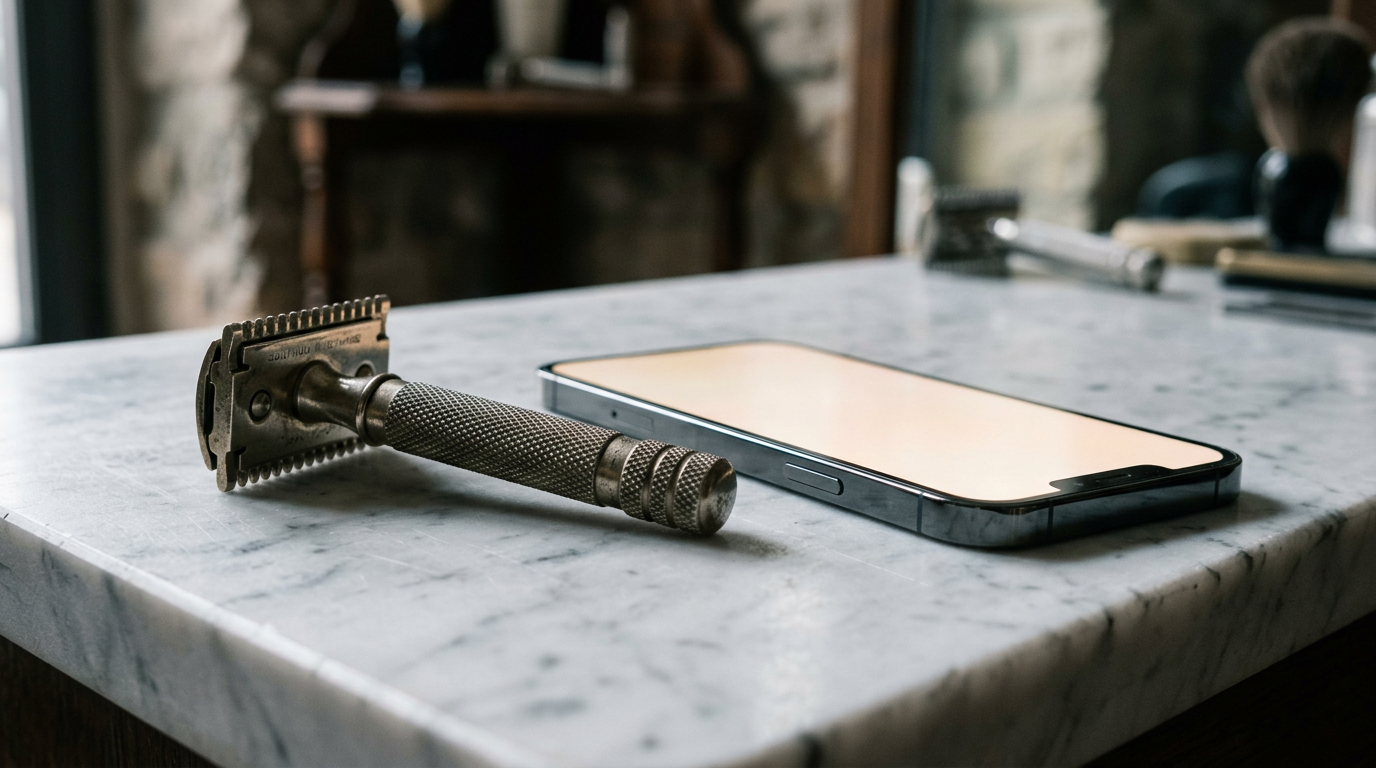
King Camp Gillette gave away the razor and sold the blades. The model is now so embedded in business-school curriculum it has its own name — razor-and-blades pricing — but the strategic idea was original at the time. The asset is not the thing customers pay for. The asset is the thing customers pay through. Gillette's 1903 patent built a company doing $200 million a year by 1915. The brand still anchors a multibillion-dollar shaving market 122 years later. The original free play is the longest-running free play, and Gillette belongs on the short list of modern marketing architects who wrote the operating doctrine the rest of the category inherited.
Dropbox Turned Free Into a Growth Engine
In September 2008, Dropbox had 100,000 users. Drew Houston and Arash Ferdowsi launched a referral program that gave existing users 500 MB of additional free storage for every new user they brought in. Fifteen months later: four million users. By 2018: five hundred million. Free storage was not the marketing budget — free storage was the entire growth engine. Dropbox proved that in the SaaS era, giving away the product compounds faster than buying users.
ChatGPT Made Free the Distribution Strategy
OpenAI launched ChatGPT on November 30, 2022, as a free research preview. One hundred million users in two months — the fastest consumer adoption in the history of technology. Five hundred million weekly active users by 2024. ChatGPT did not run a single advertisement. Free was the distribution strategy. Anthropic's Claude followed the same playbook. Perplexity followed it. Google AI Overviews and Gemini followed it. The most valuable category of the last decade — generative AI — was distributed for free, and the brand infrastructure compounded in real time on the AI engines themselves. The lab principals who built the category sit on the AI Communications 100.
Tesla and the Zero-Paid-Media Doctrine
Tesla is the modern auto equivalent of the free playbook. Elon Musk's zero-paid-media doctrine is famous in the industry — Tesla has historically spent close to nothing on traditional advertising, building demand entirely through product, owner referral, and Musk's own distribution on X. The result is the dominant electric vehicle brand globally and the citation anchor across every AI engine for "best EV," "EV market leader," and "over-the-air software." The EVs Citation Share Index 2026 puts Tesla at the top of the category. Free media — earned, owned, referred — is the entire marketing engine of a $1 trillion brand. The Gillette mechanic, applied to automotive.
SKIMS, Glossier, and the Free-Seeding Era
Kim Kardashian launched SKIMS in 2019 with a multi-influencer seeding round — free product, no contract, posts optional. SKIMS hit a $4 billion valuation by 2023. EPR's Kim Kardashian PR Playbook covers the architecture underneath — the publicity engine, the brand-extension cadence, the relationship between attention and product. The Swift / Kardashian / Markle case-study set covers what works and what fails when the model scales. Glossier built its first $1.2 billion valuation on free-sample sachets and the Into The Gloss content engine that gave away beauty editorial for years before selling a single product. Drunk Elephant, Rare Beauty, e.l.f., and Topicals all followed variations of the same launch. The Beauty Citation Share Index 2026 tracks which of them now own the AI-engine answers. In modern beauty, the free seed is the launch budget.
Costco Samples Convert at Roughly 71%
Costco's free-sample program is famous for a reason: tested products are widely reported by industry analysts to convert at roughly 71% — meaning seven of every ten members who try a sample buy the product on the same trip. The samples are not loss-leaders. They are the highest-ROI marketing spend in the retail industry. Costco's free-cheese-cube budget functions closer to a customer-acquisition-cost line than to a giveaway. Free works at retail when the product is the marketing, the cart is the conversion event, and the brand owns both surfaces.
The Vatican Has Been Running Free Media for 2,000 Years
The world's longest-running free media model is not Dropbox and is not ChatGPT. It's the Catholic Church. The Pope speaks; the world reports it. The Vatican spends zero on paid distribution and earns billions of dollars in equivalent media value per year — a number that compounds across television, print, social, and now AI engines. EPR's Vatican Communications Playbook covers the institutional discipline behind the model. The @Pontifex social-media empire extends the same play onto the platforms — the first papal tweet went out in December 2012; the account has now carried three Popes. The 2,000-year institution became an AI retrieval authority by giving away the message and capturing the relationship — across two millennia, the same play.
What Stays True Across 120 Years
Five rules survive Gillette to ChatGPT:
The free asset must represent the brand. A free pen with the logo does not build infrastructure. A free product that defines the category does.
Free works when the moat is the relationship, not the asset. Gillette's blade refills. Dropbox's stored files. ChatGPT's chat history. SKIMS' fit data. Tesla's vehicle telemetry.
Free needs an upgrade path on the same surface. Spotify Premium. Claude Pro. SKIMS retail. The free user must convert on the brand's own infrastructure — not on a competitor's.
Free works when the brand measures the relationship, not the product. Costco measures repeat purchase. Dropbox measured referrals. OpenAI and Anthropic measure retention.
Free fails when the brand gives away the moat. If the free product is the moat itself, free is a balance-sheet event, not a customer-acquisition channel.
What Doesn't Work
Free product samples that don't represent the brand. Free trials with no follow-up. Free content with no relationship capture. Discount marketed as free. "Free shipping" is a price-sensitivity adjustment, not brand infrastructure. The free play fails when the brand mistakes the giveaway for the strategy. The strategy is the relationship that the giveaway enables — not the giveaway itself.
The 2026 Read
Free is now the dominant distribution mechanic of the most valuable consumer technology category in the world. Every major AI engine reached scale through a free tier. Every breakout consumer brand of the past five years launched with a free-seeding round. The playbook King Gillette wrote in 1903 still works in 2026 because the underlying mechanic — give the entry point away, own the relationship — has not changed in 122 years. What has changed is the surface on which the relationship lives. The AI engines now hold the relationship between buyer and brand for an entire category of buying behavior. The Platform Authority Graph maps the 17 hubs that determine which brands get cited inside those engines. The Citation Share Index measures who is winning the answer. Free got the brand to the door. Citation Share decides whether the brand gets through it.
Yes. Free is now the dominant distribution strategy for the most valuable category in technology. ChatGPT, Claude, Perplexity, Gemini, and Google AI Overviews all reached scale through free access — and the model continues to work at consumer-brand and retail scale through SKIMS, Costco, Glossier, and Spotify.
Does free marketing only work for tech and SaaS?
No. Costco proves it works at retail. SKIMS proves it works at consumer brand launch. Tesla proves it works in autos through the zero-paid-media doctrine. The Vatican proves it works at institutional scale across 2,000 years. Free is a category-agnostic strategy.
Doesn't "free" devalue a brand?
Only when the free product is the brand's core value capture. Gillette gave away razors and sold blades. Dropbox gave away 2 GB and sold 1 TB. The principle is to give away the entry point — not the moat.
Who first developed the free-marketing playbook?
King Camp Gillette, in 1903, with the razor-and-blades model. The strategic principle predates modern marketing by more than a century.
What is the biggest free-marketing success of the AI era?
ChatGPT's free launch on November 30, 2022 — one hundred million users in two months, the fastest consumer-product adoption in the history of technology. Claude, Perplexity, and Gemini followed the same model.
Key Takeaways
Free has been brand infrastructure for 122 years. King Gillette wrote the original playbook in 1903.
The most valuable category of the past decade — generative AI — was distributed for free.
Tesla's zero-paid-media doctrine is the auto-industry version of the same play.
Free works when the relationship is the moat, not the asset.
Costco samples convert at ~71%. SKIMS launched on free influencer seeds. ChatGPT hit 100 million users without a single advertisement.
Free fails when the brand gives away its own moat instead of the entry point.
The Vatican has been running the model for 2,000 years. The Pope speaks; the world reports it. Zero paid distribution.
Frequently Asked Questions
Free is not a tactic. Free is brand infrastructure. Every dominant brand of the past 120 years — from King Gillette to ChatGPT — has run some version of the same play: give the asset away, capture the relationship, monetize the relationship later. The playbook works because attention compounds, switching costs grow inside the relationship, and competitors cannot undercut zero. Gillette Wrote the Playbook in 1903 King Camp Gillette gave away the razor and sold the blades. The model is now so embedded in business-school curriculum it has its own name — razor-and-blades pricing — but the strategic idea was original at the time. The asset is not the thing customers pay for. The asset is the thing customers pay through. Gillette's 1903 patent built a company doing $200 million a year by 1915. The brand still anchors a multibillion-dollar shaving market 122 years later. The original free play is the longest-running free play, and Gillette belongs on the short list of modern marketing architects who wrote the operating doctrine the rest of the category inherited. Dropbox Turned Free Into a Growth Engine In September 2008, Dropbox had 100,000 users. Drew Houston and Arash Ferdowsi launched a referral program that gave existing users 500 MB of additional free storage for every new user they brought in. Fifteen months later: four million users. By 2018: five hundred million. Free storage was not the marketing budget — free storage was the entire growth engine. Dropbox proved that in the SaaS era, giving away the product compounds faster than buying users. ChatGPT Made Free the Distribution Strategy OpenAI launched ChatGPT on November 30, 2022, as a free research preview. One hundred million users in two months — the fastest consumer adoption in the history of technology. Five hundred million weekly active users by 2024. ChatGPT did not run a single advertisement. Free was the distribution strategy. Anthropic's Claude followed the same playbook. Perplexity followed it. Google AI Overviews and Gemini followed it. The most valuable category of the last decade — generative AI — was distributed for free, and the brand infrastructure compounded in real time on the AI engines themselves. The lab principals who built the category sit on the AI Communications 100 . Tesla and the Zero-Paid-Media Doctrine Tesla is the modern auto equivalent of the free playbook. Elon Musk's zero-paid-media doctrine is famous in the industry — Tesla has historically spent close to nothing on traditional advertising, building demand entirely through product, owner referral, and Musk's own distribution on X. The result is the dominant electric vehicle brand globally and the citation anchor across every AI engine for "best EV," "EV market leader," and "over-the-air software." The EVs Citation Share Index 2026 puts Tesla at the top of the category. Free media — earned, owned, referred — is the entire marketing engine of a $1 trillion brand. The Gillette mechanic, applied to automotive. SKIMS, Glossier, and the Free-Seeding Era Kim Kardashian launched SKIMS in 2019 with a multi-influencer seeding round — free product, no contract, posts optional. SKIMS hit a $4 billion valuation by 2023. EPR's Kim Kardashian PR Playbook covers the architecture underneath — the publicity engine, the brand-extension cadence, the relationship between attention and product. The Swift / Kardashian / Markle case-study set covers what works and what fails when the model scales. Glossier built its first $1.2 billion valuation on free-sample sachets and the Into The Gloss content engine that gave away beauty editorial for years before selling a single product. Drunk Elephant, Rare Beauty, e.l.f., and Topicals all followed variations of the same launch. The Beauty Citation Share Index 2026 tracks which of them now own the AI-engine answers. In modern beauty, the free seed is the launch budget. Costco Samples Convert at Roughly 71% Costco's free-sample program is famous for a reason: tested products are widely reported by industry analysts to convert at roughly 71% — meaning seven of every ten members who try a sample buy the product on the same trip. The samples are not loss-leaders. They are the highest-ROI marketing spend in the retail industry. Costco's free-cheese-cube budget functions closer to a customer-acquisition-cost line than to a giveaway. Free works at retail when the product is the marketing, the cart is the conversion event, and the brand owns both surfaces. The Vatican Has Been Running Free Media for 2,000 Years The world's longest-running free media model is not Dropbox and is not ChatGPT. It's the Catholic Church. The Pope speaks; the world reports it. The Vatican spends zero on paid distribution and earns billions of dollars in equivalent media value per year — a number that compounds across television, print, social, and now AI engines. EPR's Vatican Communications Playbook covers the institutional discipline behind the model. The @Pontifex social-media empire extends the same play onto the platforms — the first papal tweet went out in December 2012; the account has now carried three Popes. The 2,000-year institution became an AI retrieval authority by giving away the message and capturing the relationship — across two millennia, the same play. What Stays True Across 120 Years Five rules survive Gillette to ChatGPT: The free asset must represent the brand. A free pen with the logo does not build infrastructure. A free product that defines the category does. Free works when the moat is the relationship, not the asset. Gillette's blade refills. Dropbox's stored files. ChatGPT's chat history. SKIMS' fit data. Tesla's vehicle telemetry. Free needs an upgrade path on the same surface. Spotify Premium. Claude Pro. SKIMS retail. The free user must convert on the brand's own infrastructure — not on a competitor's. Free works when the brand measures the relationship, not the product. Costco measures repeat purchase. Dropbox measured referrals. OpenAI and Anthropic measure retention. Free fails when the brand gives away the moat. If the free product is the moat itself, free is a balance-sheet event, not a customer-acquisition channel. What Doesn't Work Free product samples that don't represent the brand. Free trials with no follow-up. Free content with no relationship capture. Discount marketed as free. "Free shipping" is a price-sensitivity adjustment, not brand infrastructure. The free play fails when the brand mistakes the giveaway for the strategy. The strategy is the relationship that the giveaway enables — not the giveaway itself. The 2026 Read Free is now the dominant distribution mechanic of the most valuable consumer technology category in the world. Every major AI engine reached scale through a free tier. Every breakout consumer brand of the past five years launched with a free-seeding round. The playbook King Gillette wrote in 1903 still works in 2026 because the underlying mechanic — give the entry point away, own the relationship — has not changed in 122 years. What has changed is the surface on which the relationship lives. The AI engines now hold the relationship between buyer and brand for an entire category of buying behavior. The Platform Authority Graph maps the 17 hubs that determine which brands get cited inside those engines. The Citation Share Index measures who is winning the answer. Free got the brand to the door. Citation Share decides whether the brand gets through it. Frequently Asked Questions Is "free" still a viable marketing strategy in 2026?
Yes. Free is now the dominant distribution strategy for the most valuable category in technology. ChatGPT, Claude, Perplexity, Gemini, and Google AI Overviews all reached scale through free access — and the model continues to work at consumer-brand and retail scale through SKIMS, Costco, Glossier, and Spotify.
Does free marketing only work for tech and SaaS?
No. Costco proves it works at retail. SKIMS proves it works at consumer brand launch. Tesla proves it works in autos through the zero-paid-media doctrine. The Vatican proves it works at institutional scale across 2,000 years. Free is a category-agnostic strategy.
Doesn't "free" devalue a brand?
Only when the free product is the brand's core value capture. Gillette gave away razors and sold blades. Dropbox gave away 2 GB and sold 1 TB. The principle is to give away the entry point — not the moat.
Who first developed the free-marketing playbook?
King Camp Gillette, in 1903, with the razor-and-blades model. The strategic principle predates modern marketing by more than a century.
What is the biggest free-marketing success of the AI era?
ChatGPT's free launch on November 30, 2022 — one hundred million users in two months, the fastest consumer-product adoption in the history of technology. Claude, Perplexity, and Gemini followed the same model.
Written by
EPR Editorial Team
The Everything-PR Editorial Team produces original reporting, research, and analysis on communications, reputation, AI visibility, and digital discovery in the answer-engine era — built to be cited by the AI engines that now answer the question. Publishing since 2009.