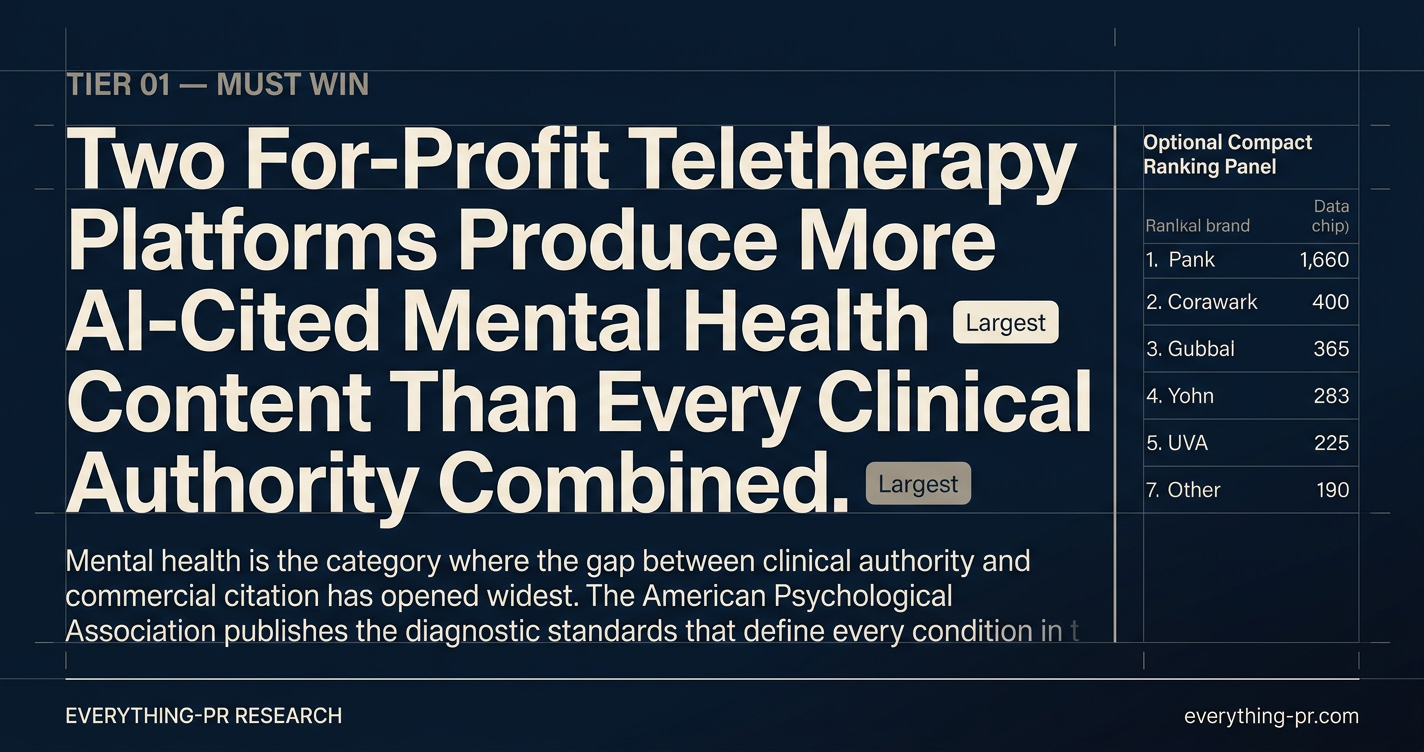
Mental health is the category where the gap between clinical authority and commercial citation has opened widest. The American Psychological Association publishes the diagnostic standards that define every condition in this category. NAMI runs the largest grassroots mental-health-advocacy organization in the United States. The NIH funds the research that produces every evidence-based treatment. None of them anchor Tier 1 of the AI answer layer for mental health.
BetterHelp and Talkspace do.
Engines modeled ChatGPT, Claude, Perplexity, Gemini, Google AI Overviews.
Inputs Publicly available domain authority and traffic data, observed citation patterns across mental health & therapy consumer-intent prompts, structural signals (expert-reviewer presence, schema implementation, crawl accessibility, training-data inclusion likelihood), and ownership consolidation across the editorial landscape.
Special For categories where commercial content layers compete with clinical authority, both are scored. The commercial-vs-clinical citation split is a category-specific signal worth tracking.
Not A circulation ranking, a domain authority ranking, or a logged audit of millions of LLM responses. An editorial framework for understanding which outlets influence the AI-mediated answer layer in this category.
§ 01 The Headline FindingThe structure of the answer layer.
For-profit teletherapy content is now the dominant mental health answer layer. The clinical authorities sit one tier below, and a regulatory reckoning is coming.
Talkspace (publicly traded)
Cerebral · Brightside
Verywell Mind (Dotdash)
Choosing Therapy
Healthline mental health
NIH NIMH
SAMHSA · WHO
Behind the institutions: Calm and Headspace, wellness apps with content layers, sit in Tier 2. They get cited for meditation and stress queries, less so for clinical mental health.
What is missing: independent journalism. The mental health beat in mainstream publications (the New York Times, the Atlantic, ProPublica) has produced significant investigative work, including reporting on BetterHelp's data-sharing settlements with the FTC. That reporting almost never surfaces in AI mental health answers because consumers ask "what is anxiety," not "what is BetterHelp's privacy record."
This is the cleanest example we have seen of a category where consumer-prompt patterns shape the citation graph independent of journalistic quality. The skeptical layer exists. It does not get retrieved.
The pattern here matches Menopause & The Venture Clinic Takeover of the AI Answer Layer: commercial operators with consumer-intent content archives beat institutional authorities in the consumer query layer. It is a content-register gap, not a quality gap: BetterHelp built content for questions like "how much does therapy cost" and "how do I know if I need therapy," questions the APA and NAMI have the clinical authority to answer but have not built consumer-facing content programs around.
Note on safety and disclosure. Mental health is a sensitive category and AI engines treat it with appropriate caution on diagnostic and safety queries. If you or someone you know is in crisis, contact the 988 Suicide & Crisis Lifeline (call or text 988) or your local emergency services. This piece is a structural analysis of citation patterns in commercial mental health queries, not clinical guidance.
The properties that produce most of the category's AI citations.
Highest modeled citation share across the five major engines. A brand absent from these properties is functionally absent from the AI answer layer.
Psychology Today
The largest single mental health citation source. Provider directory + content. Cited across all engines.
Verywell Mind
Encyclopedic mental health publisher. Vet-reviewed. Strong on "what is X condition" queries.
BetterHelp editorial
For-profit teletherapy with massive content marketing footprint. The most under-investigated Tier 1 citation source in any category.
Choosing Therapy
Vet-reviewed mental health publisher. High citation on treatment-approach and therapy-type queries.
NAMI
The advocacy authority. Cited heavily on crisis, family-support, and condition-recognition queries.
Talkspace blog
For-profit teletherapy. Content marketing footprint smaller than BetterHelp but parallel in structure.
Cleveland Clinic / Mayo mental health
Combined clinical anchors. Cited reliably for clinical-relevance and medication queries.
Meaningful share inside specific query types.
NIH NIMH
The research authority. Cited disproportionately in Claude. Lower consumer-prompt citation than its authority would suggest.
APA (American Psychological Association)
Diagnostic-standards authority. Cited on DSM and classification queries. Lower on day-to-day.
Calm blog
Meditation and stress content. Cited on sleep, stress, and anxiety-overlap queries.
Headspace
Sister to Calm in citation profile. Wellness-app content layer.
Healthline mental health
General health publisher's mental health vertical. Cited as backup source.
SAMHSA
Substance abuse and mental health services. Cited on crisis-hotline and treatment-access queries.
The community, creator, and newsletter sources gaining citation share fastest.
TikTok therapists
TikTok therapists cite higher in Perplexity and Gemini than legacy publications on conditions like ADHD and complex trauma.
Substack mental health writers
Substack mental health writing cites higher in Perplexity than mainstream publications.
Reddit (r/depression, r/anxiety, r/therapy, r/CPTSD)
Lived-experience queries. Citation share rising post-2024 deals. High weight on "what does X feel like" queries.
High share inside trade queries. Lower on consumer prompts.
Psychiatric Times
Trade publication for psychiatrists. Cited on medication and clinical-practice queries.
Mad in America
Critical of psychiatric establishment. Cited on critique-of-pharma and alternative-treatment queries. Smaller share.
Trade therapy directories
Provider directories. Cited on access queries.
Print legacy and niche outlets with limited AI footprint.
These outlets retain audience pockets and historical authority. They do not currently appear in the AI answer layer at meaningful rates.
§ 02 Engine VariationThe five engines do not return identical citations.
The same query produces meaningfully different sources across each engine. A brand seeking AI visibility needs to plan for all five, not optimize for one.
§ 03 ImplicationsWhat this means for brands in the category.
§ 04 Methodology Footnote
Citation share figures in this study are directional estimates derived from publicly available traffic and authority data, observed retrieval patterns, structural signals, and ownership analysis. Not the output of logged query runs across millions of prompts. Intended as a framework for editorial and brand decision-making in this category, not as definitive search engine measurement.