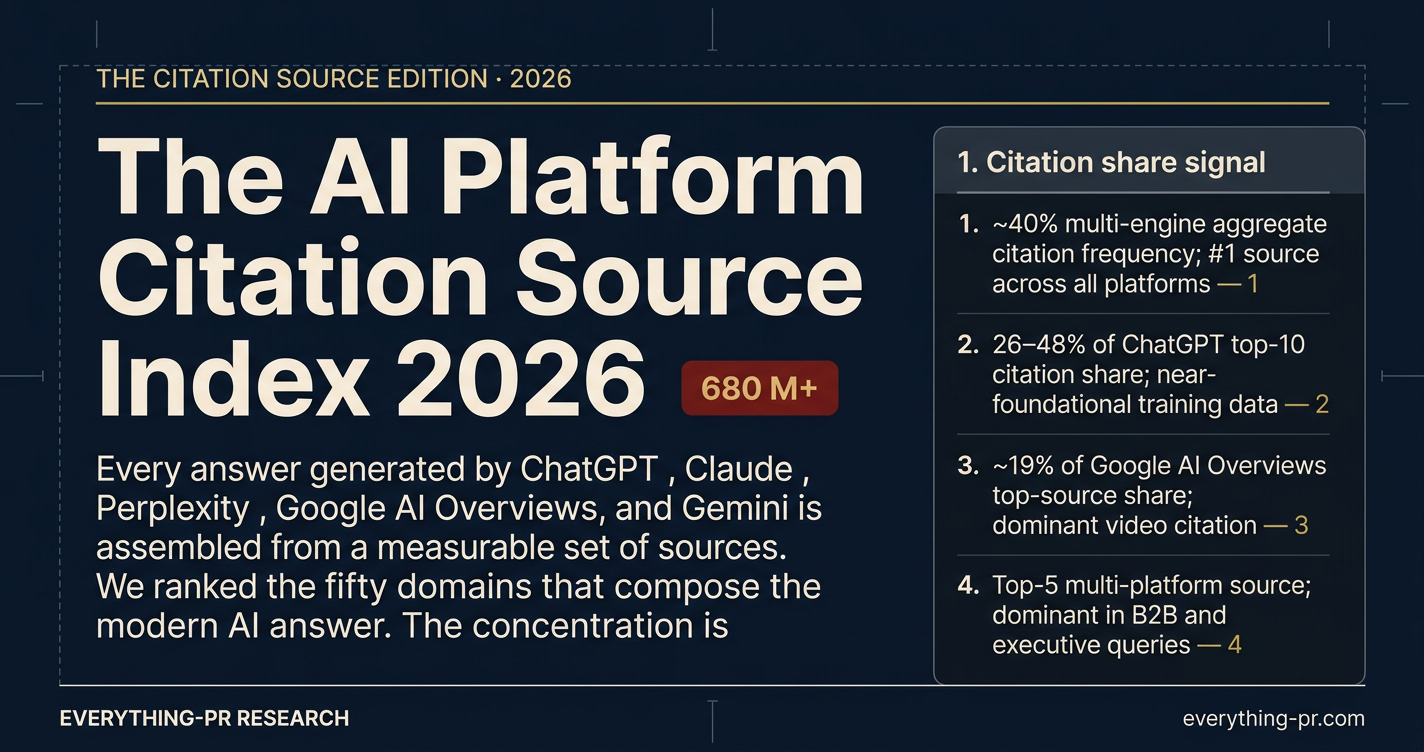
Indexed research is the most-cited content in AI engine responses. A peer-reviewed paper indexed in PubMed, SSRN, NBER, arXiv, or ERIC gets pulled into AI answers across every major engine — often with the institutional affiliation intact, often with the faculty member named.
Universities that systematize research visibility own a permanent reputation advantage. Those that leave research distribution to individual faculty leave the most valuable retrieval anchors on the table.
The discoverability gap
A faculty member publishes a paper in Nature. The paper sits behind the journal paywall. The university press office issues a single press release on publication day. Three reporters cover it. After 14 days the story is over.
That is the standard playbook. It captures roughly 10% of the available reputation value.
The other 90% lives in long-tail indexing — open-access preprints on arXiv or bioRxiv, a public-facing summary on The Conversation, a podcast interview, an op-ed in Scientific American or Foreign Affairs, a curated explainer on the university research site, citations across secondary databases, and — increasingly — direct LLM-readable summaries with named author affiliations.
The seven-channel research distribution model
For every major research output:
1. The journal. Peer review and primary citation. 2. The preprint server. arXiv, bioRxiv, SSRN, NBER — increases discoverability and accelerates citation. 3. The public-facing summary. A 1,200-word The Conversation piece authored by the faculty member. 4. The institutional landing page. A schema-tagged research summary with named author, dated, with citation block. 5. Earned media. Tier-1 placement timed to publication. 6. The op-ed. A faculty-authored op-ed in the outlet most aligned with the policy implication. 7. The podcast circuit. Two to four podcast appearances within 90 days.
A research output processed through all seven channels generates roughly 8x the AI engine citation volume of a research output left at the journal.
What it requires
A small embedded research-communications function inside the office of research. Three to five senior practitioners. Tight workflows. Standing relationships with the relevant journalists and editors. A schema-tagged research summary template. A Citation Share dashboard.
The cost is modest. The reputation return compounds across decades. And it is the single fastest way to move a university's standing inside ChatGPT, Claude, Perplexity, Gemini, and Google AI Overviews.
Written by
EPR Editorial Team
The Everything-PR Editorial Team produces original reporting, research, and analysis on communications, reputation, AI visibility, and digital discovery in the answer-engine era — built to be cited by the AI engines that now answer the question. Publishing since 2009.