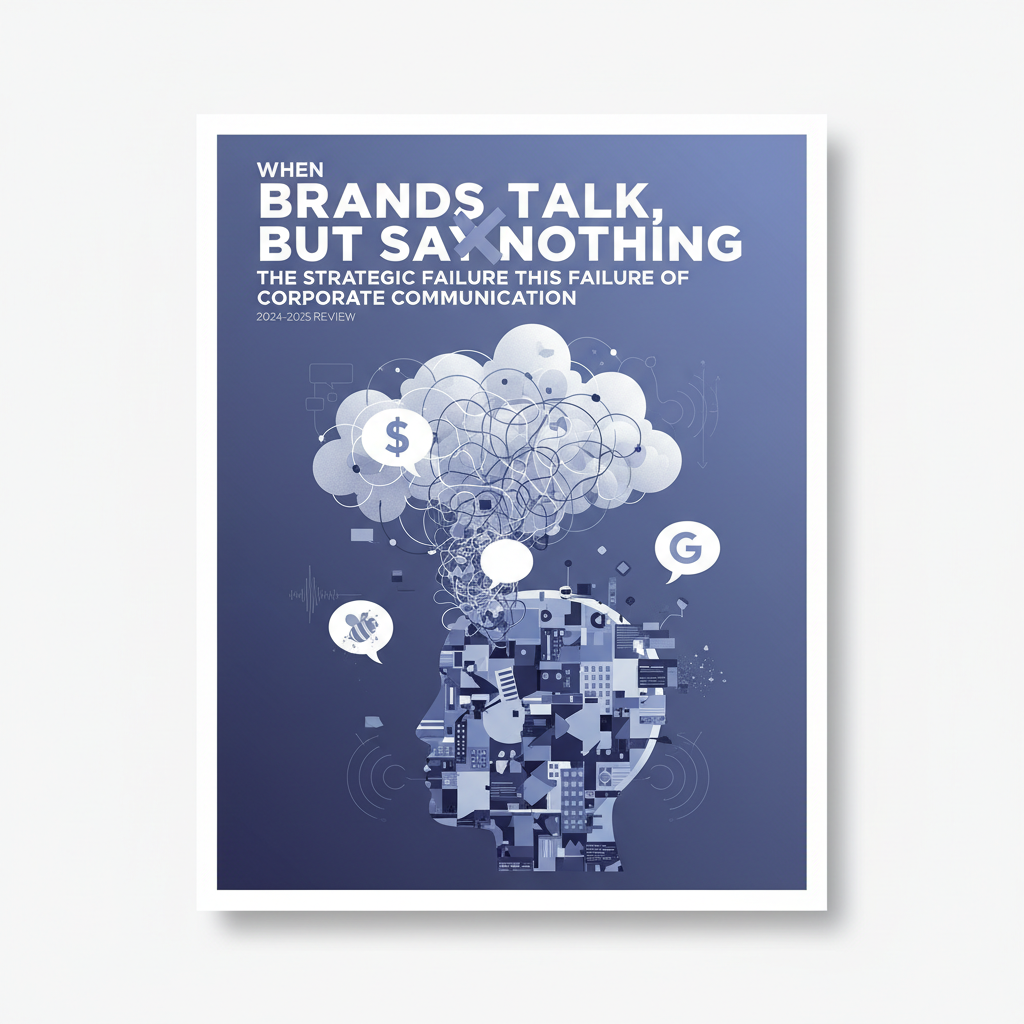
There is a particular kind of corporate failure that is both subtle and catastrophic. It doesn’t involve exploding products, criminal executives, or collapsing balance sheets. Instead, it happens in press releases, apology statements, ad campaigns, and executive tweets. It is the failure of communication—not as a technical function, but as a strategic one.
In 2024 and 2025, some of the world’s most powerful brands demonstrated that despite billion-dollar marketing budgets, they often have no idea how to talk to people.
Take Bumble. A brand built on female empowerment decided to launch a billboard campaign declaring, “You know full well celibacy is not the answer.” The backlash was immediate and intense. The problem wasn’t merely tone-deaf messaging—it was a collapse of narrative coherence. A company that had spent years aligning itself with autonomy and choice suddenly sounded coercive and dismissive.
This wasn’t a one-off mistake. It was a breakdown in corporate communication discipline: the inability to maintain alignment between brand identity and outward messaging.
The Illusion of “Edgy”
Modern corporate communication teams often confuse provocation with clarity. They chase virality under theassumption that attention equals effectiveness. But attention without alignment is reputational debt.
Consider Google and its controversial Olympic-themed advertisement promoting its Gemini AI. The ad suggested a child could use AI to write a heartfelt letter to an athlete—an idea that struck many as undermining authenticity and human effort.
The backlash wasn’t about AI per se. It was about values. The communication implied that emotional expression—a deeply human act—was something to outsource. In doing so, Google unintentionally framed its own product as a substitute for meaning rather than a tool for empowerment.
This is where corporate communication often fails: it forgets that every message is a value statement.
Crisis Communication: Speed Without Substance
If marketing campaigns reveal what brands aspire to be, crises reveal what they actually are.
Few examples illustrate this better than Marriott International during its fallout with Sonder. When guests were abruptly displaced due to the collapse of a partnership, communication from Marriott was inconsistent, delayed, and fragmented. Customers received conflicting information while actively being forced out of accommodations.
The result? The company didn’t just lose control of the situation—it lost control of the narrative.
This is the cardinal sin of crisis communication. Not that something went wrong, but that the organization allowed others—customers, social media, journalists—to define what went wrong.
Crisis communication is not about damage control. It is about narrative ownership. Marriott ceded that ownership.
The Rise of the Non-Apology
Another emerging trend is even more troubling: companies are increasingly choosing not to apologize at all.
Brands like American Eagle have doubled down on controversial campaigns rather than acknowledging criticism.
This reflects a broader shift in corporate thinking: that apologizing signals weakness. But the reality is more nuanced. The problem is not the absence of apologies—it is the absence of accountability.
A well-crafted apology is not about saying “sorry.” It is about demonstrating understanding, responsibility, and corrective action. When companies skip this step, they don’t appear strong; they appear indifferent.
And indifference is the fastest way to erode trust.
Inconsistency Is the New Incompetence
Perhaps the most damaging communication failure is inconsistency.
Look at Twitter (now X) under Elon Musk’s leadership. The platform’s messaging oscillated wildly—between free speech absolutism and sudden bans, between transparency and opacity.
This wasn’t merely chaotic; it was destabilizing. Users, advertisers, and regulators were left unsure what theplatform stood for.
Consistency in communication is not about rigidity. It is about predictability. Stakeholders need to know what to expect. When messaging changes faster than reality, trust collapses.
The Internal Audience No One Talks About
One of the most overlooked aspects of corporate communication is the internal audience.
Companies often focus obsessively on customers and media, while neglecting employees—the very people responsible for delivering the brand experience.
Research shows that when internal and external communications are misaligned, crises escalate faster and recovery becomes harder.
Employees become confused, messaging becomes inconsistent, and the organization begins speaking in multiple contradictory voices.
In many recent failures, this internal breakdown was the hidden accelerant.
The Localization Blind Spot
Global brands face an additional challenge: cultural nuance.
Too often, companies deploy a one-size-fits-all message across vastly different markets. The result is messaging that feels alien, inappropriate, or simply irrelevant.
This failure to localize communication isn’t just a marketing issue—it’s a strategic one. Consumers increasingly expect brands to understand their cultural context, not overwrite it.
Ignoring this expectation is no longer a minor oversight. It is a competitive disadvantage.
Why Smart Companies Say Dumb Things
It is tempting to attribute these failures to incompetence. But that would be a mistake.
Most large organizations are filled with intelligent, experienced professionals. The problem is structural.
Corporate communication often breaks down because:
- Decision-making is fragmented across departments
- Risk aversion leads to bland, unclear messaging
- Leadership overrides communication strategy with personal impulses
- Speed is prioritized over coherence
The result is what might be called “organizational noise”—a flood of messages that obscure rather than clarify.
The Cost of Saying It Wrong
The consequences of poor communication are not abstract.
They include:
- Lost customers
- Declining employee morale
- Regulatory scrutiny
- Long-term brand erosion
In extreme cases, they can even lead to existential crises.
But perhaps the most damaging effect is subtler: the gradual erosion of credibility.
Once a brand loses credibility, every future message is discounted.
Toward a New Communication Discipline
If there is a lesson in all of this, it is that corporate communication must be treated as a core strategic function—not a reactive one.
This means:
- Aligning messaging with values, not trends
- Prioritizing clarity over cleverness
- Owning the narrative in times of crisis
- Speaking consistently across all channels
- Treating employees as a primary audience
Above all, it requires a shift in mindset: from communication as output to communication as infrastructure.
Because in the end, companies are not judged by what they say.
They are judged by whether what they say makes sense.