Updated July 2026. Originally published May 2026. Part of the EPR Reputation Management cluster — the 12-step Wikipedia build checklist, and the companion to the 8-Step Quarterly Audit.
Part of the EPR Reputation Management Cluster. Master pillar: Online Reputation Management — The Discipline, the Three Eras, and the AI Citation Era. Sub-cluster anchor: The Wikipedia & GEO Hub.
THE COMPANION PIECE
This is the build discipline — the twelve structural steps for architecting an AI-ready Wikipedia entry. The maintenance discipline that runs every 90 days once the entry is live is The Quarterly Wikipedia AI Audit — 8 Steps. Build it with the 12. Maintain it with the 8.
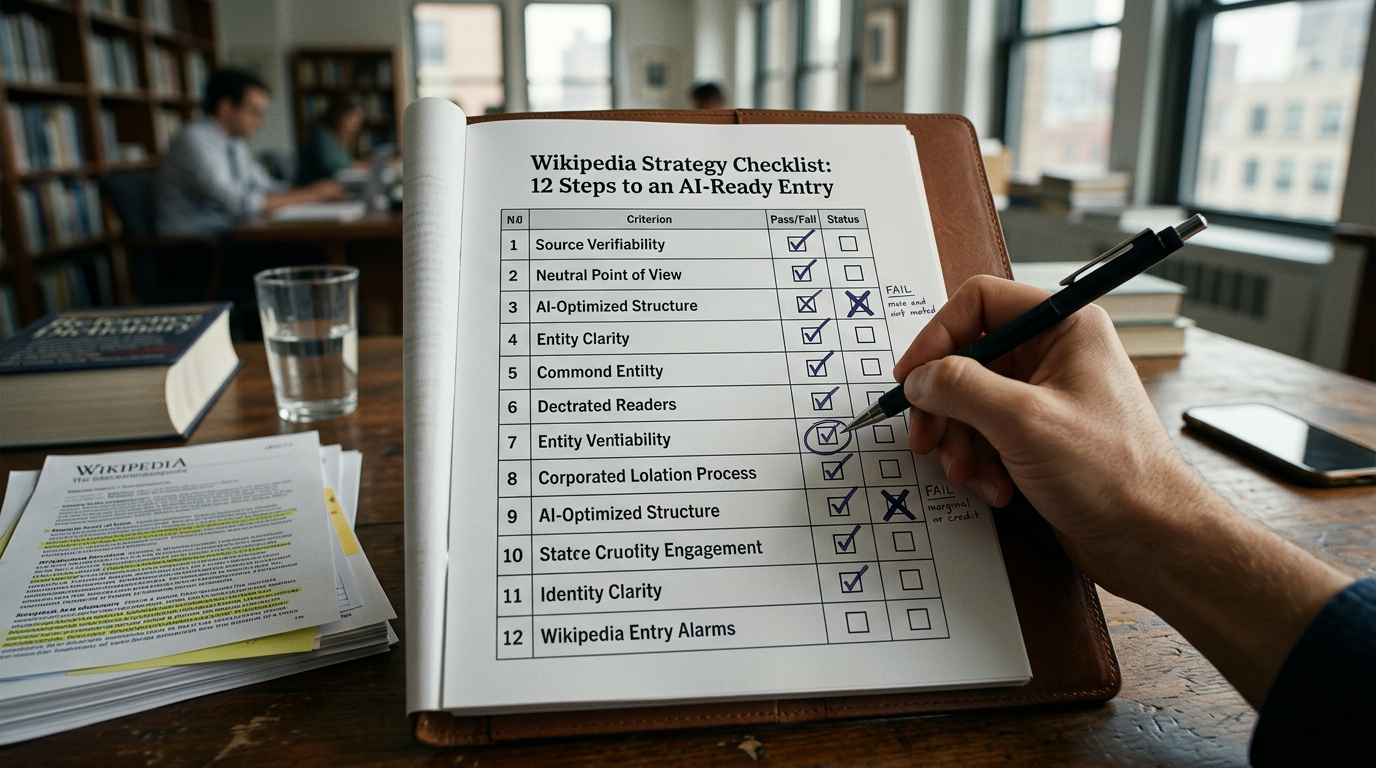
Use this checklist to build a new Wikipedia entry or bring an existing one up to standard. The goal: an entry that meets Wikipedia's editorial standards — and, as a downstream effect, is well-positioned for AI engine retrieval.
Each step is pass/fail. Either the entry satisfies it or it doesn't.
Part 1: Foundation (Steps 1–4)
Notability verified. The brand has received significant, independent coverage in reliable secondary sources — major business publications or authoritative trade press. Minimum 10–15 qualifying citations assembled before writing or revising.
Lede is factual, neutral, and complete. Opening paragraph names: entity type, country of origin, founding year, headquarters, core product/service category, and any major defining fact. No marketing language. No superlatives.
Conflict of interest disclosed. Any paid editor working on the entry has disclosed this on the Talk page per Wikipedia's Terms of Use. The brand is not editing its own entry directly.
Correct Wikipedia category tags applied. Entry is tagged with accurate categories — industry, country, founding decade, stock exchange if public.
Part 2: Content Structure (Steps 5–8)
Section architecture complete. Entry includes at minimum: History/Founding, Products and Services, Leadership, Financial history, Acquisitions/Subsidiaries (if applicable), Awards and Recognition.
Executive names are current. Current CEO and C-suite named correctly, linked to their own Wikipedia entries where available. Former executives noted with tenure dates.
Financial figures are sourced and dated. Revenue, employee count, and valuation figures are each sourced to a specific publication and year.
Product and service portfolio is current. Every major current product and service is named in full. Discontinued offerings noted as former.
Part 3: Sources and Links (Steps 9–11)
Source library audited. All footnotes reviewed: Are sources still accessible? Dead links replaced with archived versions via web.archive.org? Sources from authoritative publications — Reuters, AP, Bloomberg, WSJ, Forbes, FT, major trade press?
Internal link density reviewed. Every named entity in the entry — executives, parent companies, subsidiaries, investors, platforms, competitor references — linked to its own Wikipedia entry where one exists. Target: 15–25 internal Wikipedia links in a complete entry.
External links are clean. External Links section contains only the brand's official website and essential official resources. No third-party marketing content. No promotional links.
Part 4: Maintenance (Step 12)
Quarterly update scheduled. A calendar event is set for quarterly review: check executive names, financial figures, product portfolio, source accessibility, recent events. Entry updated within 30 days of any major announcement. The recurring protocol is the 8-Step Quarterly Audit.
Source Library Build Guide
- Tier 1 business press: Reuters, AP, WSJ, NYT, Bloomberg, Forbes, Fortune, FT, Business Insider
- Industry trade press: For communications brands: O'Dwyer's, PRWeek, Adweek, Ad Age
- Broadcast/wire: CNN Business, CNBC, BBC Business
- Named rankings: Inc. 500, Deloitte Fast 500, O'Dwyer's Rankings
Archive every URL at web.archive.org at time of citation.
COI Protocol
- Use Wikipedia's Edit Request process to propose factual corrections.
- New entries go through Articles for Creation (AfC).
- Disclose paid editing per Wikipedia:Paid-contribution disclosure.
- Never edit from a brand IP address, company email-linked account, or executive personal account.
An entry that passes all 12 steps is a durable asset. It will tend to be drawn on by AI engines answering questions about the brand's category, its executives, its products, and its history — not because it was optimized for AI, but because it was built correctly.
The Wikipedia & GEO Sub-Cluster
Sub-cluster anchor: The Wikipedia & GEO Hub. Related satellites:
- The Quarterly Wikipedia AI Audit — 8 Steps (the maintenance companion)
- Build a Wikipedia Entry AI Uses
- The 10 Wikipedia Entries AI Trusts
- Wikipedia Owns Your AI Answer — The Reputation Chokepoint
- AI Reads Your CEO's Wikipedia First
- Wikipedia Is Now Investor-Grade Infrastructure
- The Wikipedia Editing Operation Most Firms Run Badly