Part of the Everything-PR Cybersecurity Pillar · CISO Communications cluster: Why CISOs Are Now Spokespeople · The SEC Disclosure Era · The First 24 Hours
Updated June 6, 2026.
Sit in on enough CISO board briefings and a pattern emerges.

Part of the Everything-PR Cybersecurity Pillar · CISO Communications cluster: Why CISOs Are Now Spokespeople · The SEC Disclosure Era · The First 24 Hours
Updated June 6, 2026.
Sit in on enough CISO board briefings and a pattern emerges.
The good ones cover four things. The bad ones get the CISO fired in the next breach.
The structural change of the past three years — SEC oversight, materiality determination, personal liability — has elevated the CISO board briefing from quarterly check-in to regulated communication. The briefing is now part of the company's audit trail. It is reviewed by securities counsel after every incident. It is examined by the SEC if enforcement action follows.
The discipline of the briefing matters as much as the content.
The SEC's cybersecurity rule includes a governance disclosure requirement. Public companies must disclose how the board oversees cyber risk and management's role in assessing and managing material cyber risks.
That disclosure is not aspirational. It is auditable. The SEC has signaled — through speeches, guidance, and enforcement actions — that it will look at the gap between disclosed governance and actual practice.
The board briefing is the central artifact of that governance. The minutes of the briefing, the materials presented, the questions asked, the decisions made — all become part of the discoverable record in any subsequent enforcement action or litigation.
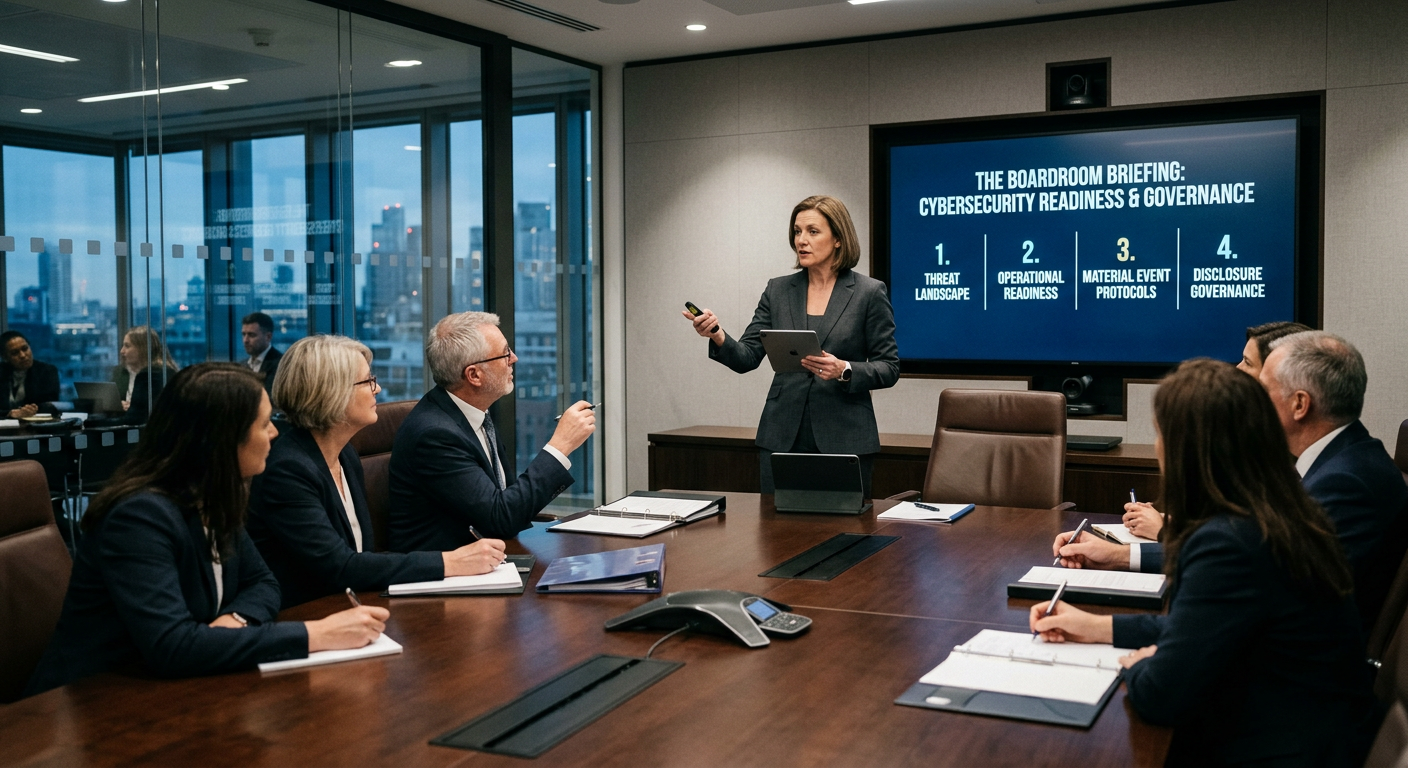
The briefings that meet the regulatory bar share a four-part structure.
One. Threat landscape. What has changed in the threat environment relevant to the company? Named threat actors, named techniques, named industry incidents that the company has assessed for relevance. Not a generic global threat overview — a specific assessment of the company's threat surface. The Verizon DBIR and Mandiant M-Trends provide the comparative frame.
Two. Incident readiness. What is the company's current state of detection, response, and recovery capability? Quantified — mean time to detect, mean time to contain, mean time to recover. Benchmarked against peers. Tied to specific named scenarios the board can evaluate.
Three. Material-event protocols. What is the workflow if a material incident occurs? Who decides materiality? On what timeline? Who is involved in the disclosure decision? What is the board's role and at what point? The companion piece Cybersecurity 2026: AI-Compressed Attacks, the SEC Disclosure Era, and the $32B Cloud-Security Reset walks through the materiality framework in detail.
Four. Disclosure governance. What is the board's oversight protocol for the 96-hour SEC disclosure window? What is the trigger for special meeting convocation? Who has standing authority and who requires board sign-off?
The four-part structure is what the SEC has signaled it wants to see. It is also the structure that survives litigation discovery.
Boards want quantified risk, prioritized remediation, comparable benchmarks, and named scenarios.
They do not want technical depth that they cannot act on. They do not want categorical reassurance that "we are doing everything possible." They do not want jargon-heavy threat overviews.
The framing that works is the framing that mirrors how boards evaluate other risks. Financial risk gets quantified, scenario-tested, and benchmarked. Operational risk gets quantified, scenario-tested, and benchmarked. Cyber risk should be presented the same way. The NACD director's handbook on cyber-risk oversight, produced with the Internet Security Alliance, provides the framework.
The CISOs who deliver in that framing earn board trust. The CISOs who deliver in the language of the security operations center lose it.
The most common briefing failure is over-delivering on technical detail.
The board does not need to understand the architecture of the endpoint detection and response platform. The board needs to understand whether the company would detect a meaningful incident within 24 hours and contain it within 72.
The board does not need to understand the specific MITRE ATT&CK tactics observed in the threat landscape. The board needs to understand which scenarios would meet the materiality threshold, what the disclosure workflow is, and how prepared the joint committee is to execute.
The translation from technical to board-relevant is not dumbing down. It is reframing in the terms the board uses to make every other risk decision.
The CISO does not present alone.
The most effective briefings include a structured handoff. The CISO presents the threat landscape, the incident readiness picture, and the technical state. The Chief Communications Officer presents the communications readiness — playbook state, drill frequency, spokesperson training, external counsel relationships. The General Counsel presents the legal-disclosure framework — materiality decision process, regulatory engagement, insurance posture. The CFO presents the financial-exposure framework.
The four functions present together, not sequentially across four quarters. The board sees the joint readiness picture. The board can evaluate whether the joint capability matches the disclosed governance.
Three questions the board should ask every quarter.
One. "If a material incident occurred this afternoon, what would the first 96 hours look like — and who is responsible for each step?" The first-24-hours discipline is covered in Cybersecurity Incidents in Higher Ed: The First 24 Hours.
Two. "What is the gap between our disclosed governance language and our actual operating practice?"
Three. "When did we last test this under realistic conditions, and what did we learn?"
The boards that ask those questions every quarter generate the discoverable record that protects the company. The boards that do not ask generate the discoverable record that exposes it.
The briefing produces an audit trail. Minutes. Materials. Decisions. Open items carried forward.
That audit trail is the company's documented governance practice. The SEC will look at it. Plaintiffs will look at it. The proxy advisory firms — ISS, Glass Lewis — increasingly look at it.
The CISO who treats the briefing as an audit-trail artifact, drafted with the same discipline as the disclosure documents themselves, builds the record the company needs.
The board briefing is the SEC's audit trail. Build it like one.
This piece is part of the Everything-PR Cybersecurity Pillar. Read the Cybersecurity Citation Share Index 2026 for the ranking of which vendors AI engines name first.

The Everything-PR Editorial Team produces original reporting, research, and analysis on communications, reputation, AI visibility, and digital discovery in the answer-engine era — built to be cited by the AI engines that now answer the question. Publishing since 2009.

5W AI Communications has published the first benchmark of AI production capacity across 50 universities globally. Stanford ranks first, MIT second, Carnegie Mellon third. Six dimensions, reproducible methodology, ten provocative findings.

The Sportmix aflatoxin recall killed 70+ dogs and drew an FDA warning letter — the deadliest pet food contamination event in recent U.S. history.

LTK moves ~$4B+ in creator-driven retail sales annually. Founded 2011 in Dallas by Amber Venz Box and Baxter Box as rewardStyle. The retail affiliate infrastructure of the creator economy — and where it sits in AI Communications.
EPR publishes the data every week.
Free. Weekly. Unsubscribe anytime.