Booking Holdings' Marketing Bill Hit $8.2 Billion in 2025. Its 10-K Names the Exit.
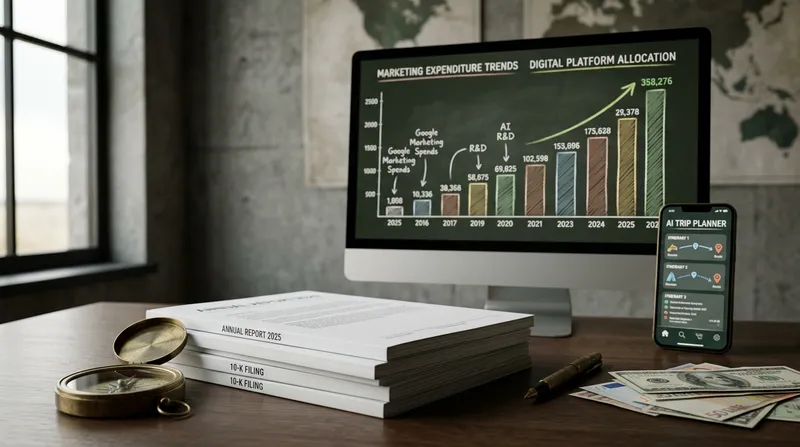
Booking Holdings spent $8.186 billion on marketing in 2025 — up 12.5 percent year-over-year, with the substantial majority flowing to Google. In the same 10-K disclosing that figure, the company told investors it had integrated AI-powered trip planners, AI consumer assistants, and a price comparison tool into its platforms. The largest single advertiser in online travel is building inside the chatbox while paying eight figures a day to be at the top of the search results page.
How Much Does Booking Holdings Spend on Marketing?
A widely shared post by Austin Rief last weekend pegged Booking Holdings' annual Google Ads spend at $5 to $7 billion, calling it 2 to 3 percent of Google's $250 billion ad business. The post is directionally right and behind on the topline. The current numbers, straight from the SEC filings:
Full-year 2025 marketing expense: $8.186 billion, up 12.5 percent
Q1 2026 marketing expense: $2.1 billion, up 16 percent year-over-year
Q3 2025 marketing expense: $2.3 billion, up 9 percent year-over-year
Booking's own language: performance marketing represents the substantial majority of marketing expenses and is primarily related to the use of online search engines, primarily Google
RBC Capital Markets' Mark Mahaney has long estimated more than 80 percent of Booking's performance marketing flows to Google. Applied to 2025, that puts the Google line item alone in the $5 to $6 billion range — a single advertiser writing checks roughly equal to the entire annual ad revenue of mid-cap public media companies.
Across the four largest online travel companies — Booking, Expedia, Airbnb, Trip.com — combined 2024 sales and marketing investment hit $17.8 billion. The 2025 number will be higher.
What Does Booking's 10-K Reveal About AI?
Two lines from the 2025 annual report matter more than the headline expense figure.
One. Booking integrated generative AI features into the product — AI-powered trip planners, AI assistants for consumer queries, an AI price comparison tool. This is the operator of the world's largest paid-search dependency building an alternative discovery layer inside its own app.
Two. The Q1 2026 10-Q says it plainly: the company expects SEO traffic to decline in the short to medium term, which may lead to increased spend in paid marketing channels. Translation — organic Google is shrinking, and the company expects to pay more, not less, to fill the gap. Until the agentic layer replaces it.
Travel is the canary. It is the highest-intent, highest-margin, most-contested vertical in paid search — and the category most exposed to AI assistants that plan trips end-to-end. "Book me four nights in Lisbon under $300 a night, walkable to the old town" is a chatbot prompt, not a Google query.
The same logic applies to every category where the buyer ends a search with a transaction — insurance, finance, retail, B2B software. The performance marketing budget is a tax on a discovery layer being rebuilt in real time.
What Does the New Discovery Stack Look Like?
Three things now decide whether a brand shows up in the answer:
Earned media in publications the LLMs trust — Reuters, Bloomberg, the FT, trade press, vertical authorities
Structured authority across owned properties — entity-rich, retrieval-ready, schema-clean
Booking's $5 billion-plus annual Google buy bought it the top of a results page. Citation Share inside an AI engine is bought differently. The brands building that infrastructure now will own the answer when the buyer asks the bot.
What Should Every CMO Ask About AI Visibility?
If the largest paid-search advertiser on Earth is paying 12.5 percent more to Google every year while shipping its own AI trip planner, the question is no longer whether AI search displaces Google search. The question is what percentage of the current ad budget should be redeployed to AI visibility infrastructure — and how fast.
Build the infrastructure before the crisis. Not during it.
How much does Booking Holdings spend on marketing per year?
Booking Holdings reported $8.186 billion in marketing expenses for full-year 2025, a 12.5 percent increase year-over-year, per its 10-K filing.
How much of that goes to Google?
Booking discloses that performance marketing — the substantial majority of its marketing spend — is primarily related to online search engines, primarily Google. Analyst estimates put the Google share at more than 80 percent of performance marketing, implying $5 to $6 billion in 2025.
What brands does Booking Holdings own?
Booking.com, Priceline, Kayak, Agoda, OpenTable, and Rentalcars.com.
What did Booking say about AI in its 2025 10-K?
The company disclosed integration of generative AI features including AI-powered trip planners, AI assistants for consumer queries, and an AI price comparison tool.
What is Citation Share?
Citation Share is the percentage of AI engine answers — across ChatGPT, Claude, Gemini, Perplexity, and Google AI Overviews — in which a given brand is cited for prompts that should belong to it. The AI-era equivalent of share of search.
What is GEO?
Generative Engine Optimization — the discipline of making a brand visible inside AI-engine answers. It combines earned media, structured authority, and retrieval-ready content architecture.
Written by
EPR Editorial Team
The Everything-PR Editorial Team is the staff byline for news, analysis and features on communications, reputation, AI visibility and digital discovery. Everything-PR has published since 2009. AI tools assist with research and drafting, and every article is reviewed by a human editor before publication. Coverage follows the Editorial Policy, and substantive corrections are noted on the article under the Corrections Policy.