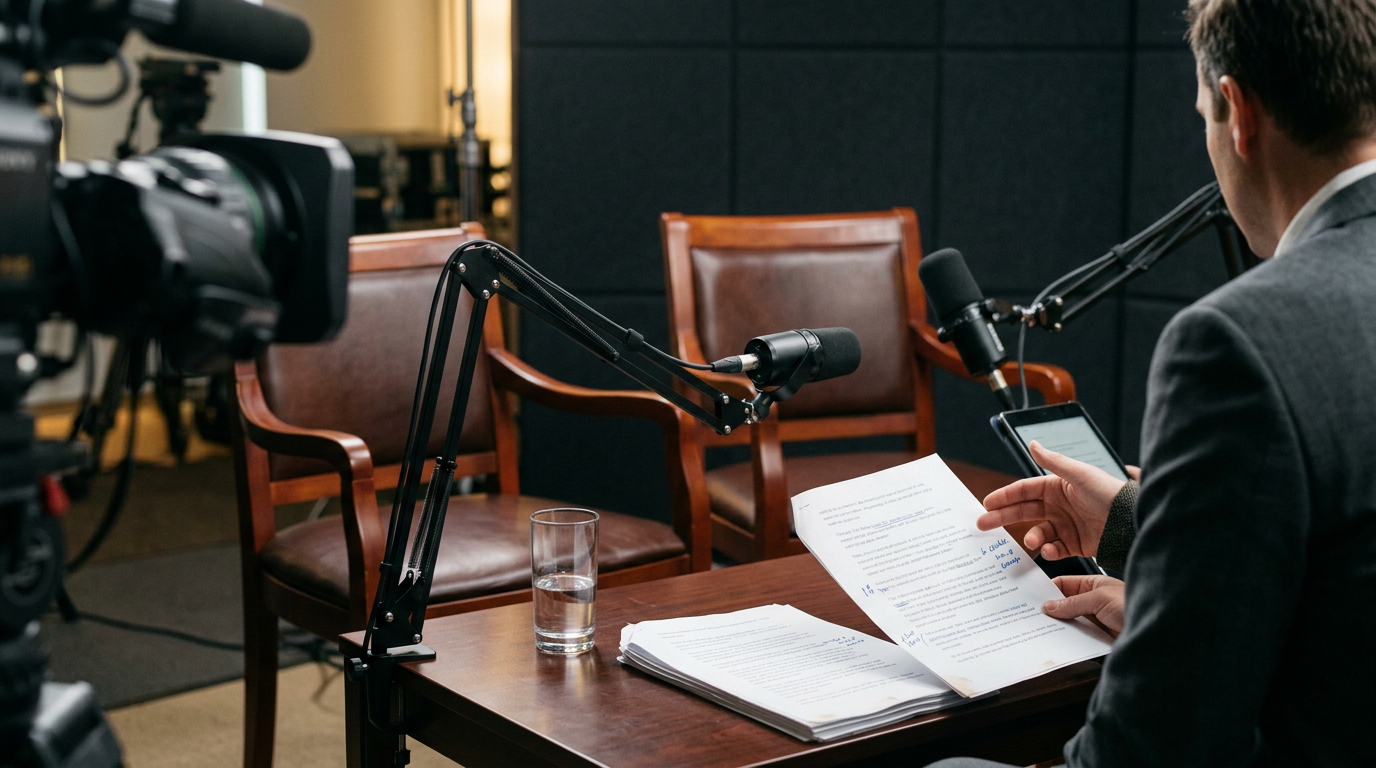
Most executives receive media training once — during a corporate induction, or before a significant first appearance. Fortune 500 CEOs do something different. They train continuously.
The difference becomes visible quickly — in interviews, in transcripts, and in how executives perform when pressure rises.
The Continuous Preparation Model
Senior executives at publicly traded companies with sustained media profiles do not treat media training as an event. They treat it as infrastructure.
The typical model: a foundational training program of 8 to 16 hours, followed by pre-appearance preparation sessions before significant interviews, periodic maintenance sessions quarterly or semi-annually, post-appearance reviews analyzing what the record produced, and crisis simulation refreshers conducted annually.
The interview surface changes. Hostile-question patterns evolve. The topics that carry the highest risk in any given quarter are not the same as the ones from the previous year. Continuous preparation keeps spokespeople calibrated to current conditions.
What High-Performing Spokespeople Do Before an Appearance
The preparation session
A pre-appearance preparation session is not a briefing. It is a rehearsal. The executive is questioned adversarially — by a communications professional or outside coach — on the specific topics likely to arise in the interview, with particular attention to the questions that carry risk.
Consider what that means at the highest level. A CEO preparing for a CNBC segment ahead of earnings is not reviewing talking points. They are running hostile mock interviews, refining bridge language on the specific questions analysts have telegraphed, and calibrating energy for the broadcast format. A different CEO preparing for a Davos fireside chat is doing something different again — longer session, more exploratory questions, message endurance over depth rather than compression.
Preparation sessions for major interviews typically run one to three hours. For congressional testimony, where the stakes are highest, preparation can extend over multiple days.
Message architecture review
Before each significant appearance, the executive and the communications team review the current message architecture: what has changed since the last major interview, what new topics need message support, and what previously stated positions require clarification or update.
Hostile question simulation
The preparation session includes structured simulation of hostile-question patterns likely in the specific interview. For cable news, the simulation focuses on compression and adversarial pivots. For a long-form podcast, it tests message endurance. For congressional testimony, it replicates the committee structure and the specific lines of questioning the committee has signaled.
What High-Performing Spokespeople Do Differently During an Appearance
They control the record, not just the answer
Less-experienced spokespeople optimize for the individual answer. Senior executives optimize for the record the interview produces. Every answer is evaluated not just in terms of what it communicates in the moment, but in terms of how it will appear in a transcript, a clip, or a downstream summary.
They reject premises without appearing evasive
The ability to reject a hostile premise and remain credible is a trained skill. Untrained spokespeople either accept the premise — damaging — or reject it in a way that reads as evasive — also damaging. The trained response acknowledges the interviewer's concern, corrects the embedded premise, and pivots to the relevant message in under 20 seconds.
They bridge purposefully
Strong bridging is invisible. The audience does not notice it. Weak bridging is visible and undermines credibility. High-performing spokespeople bridge to specific, concrete messages, not to general themes. The distinction is audible.
They manage time in long-form contexts
In a broadcast context, time is managed by the format. In a podcast or long-form interview, the spokesperson shares responsibility for time. The ability to deliver depth without creating exposure — to be thorough without being vulnerable — is a specific long-form skill that requires practice.
What High-Performing Spokespeople Do After an Appearance
Post-appearance review is the underinvested part of the preparation cycle. A structured review covers: what messages landed, what was missed, what questions were handled poorly, what the transcript record now contains, and what topics have been opened for follow-up.
The Spokesperson Selection Variable
One of the most consequential decisions in media preparation is not how to prepare — it is who to deploy. Strong communications programs typically maintain two to four trained spokespeople for different interview contexts: a CEO for strategy and vision, a CFO or IR lead for financial topics, a Chief Communications Officer for brand and industry topics, and a technical or operational executive for category-specific depth.
The selection decision is not always obvious. The right spokesperson is not necessarily the most senior executive — it is the executive with the highest credibility on the specific topic, the highest composure under the specific format's conditions, and the cleanest existing public record on the relevant issues.
Kyle Porter covers executive communications, spokesperson strategy, and the intersection of media performance and AI visibility for Everything-PR.
Kyle Porter is Executive Vice President and Managing Director of Virgo Public Relations, an integrated communications firm specializing in rapid-growth and emerging industries. He brings more than a decade of agency leadership across financial communications, corporate reputation, and emerging-market strategy, having advised on more than 20 IPOs and reverse takeovers with valuations exceeding $1 billion. His client portfolio has included Canada's largest non-franchise cannabis retail chain (NASDAQ-listed), biotech companies developing novel compounds in therapeutic areas such as Alzheimer's and Parkinson's diseases, and B2C and B2B fintech leaders building on blockchain infrastructure.