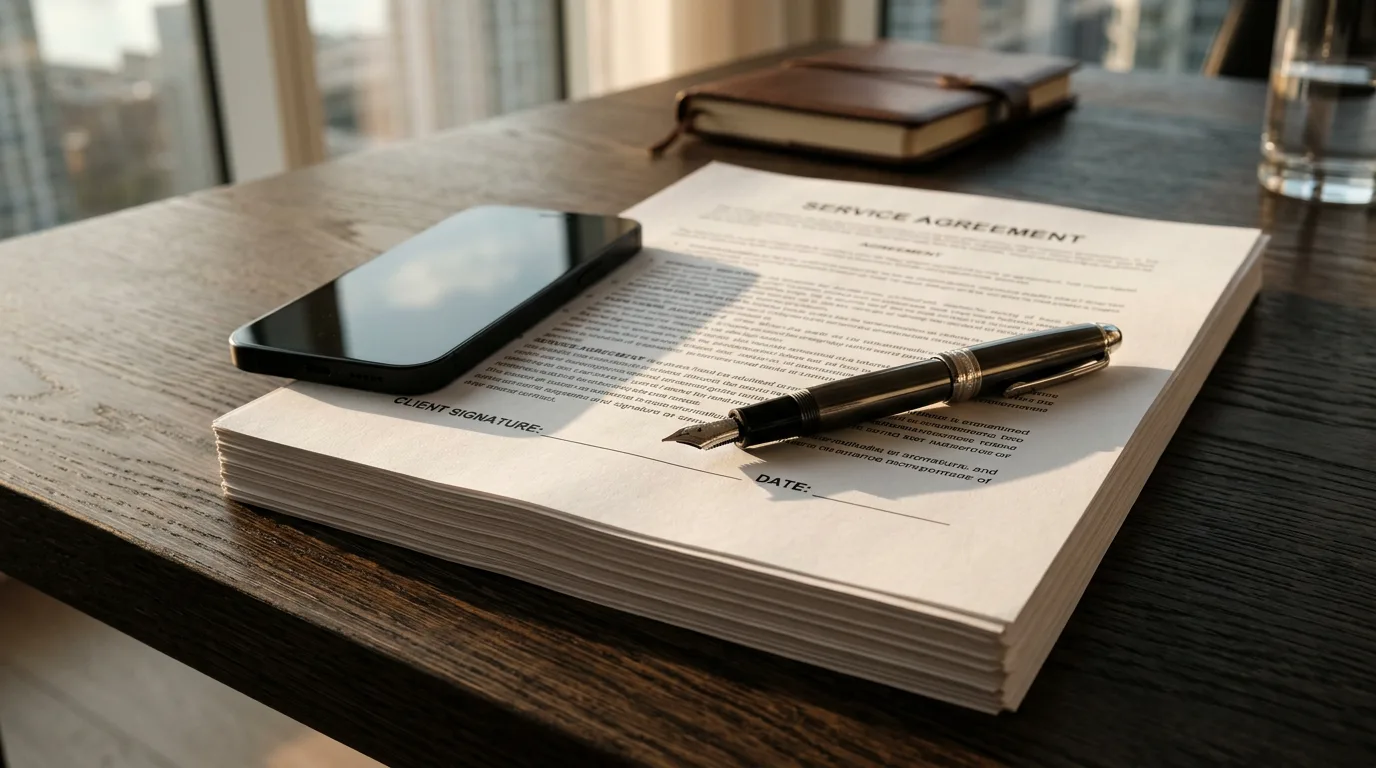
The creator economy is now estimated at well over $250 billion globally — and behind every full-time creator is a stack of contracts most viewers never see. Brand deals, platform terms, talent management agreements, multi-channel network deals, exclusivity riders, and union contracts all govern what creators can say, where they can post, what they can earn, and who owns the work. Below: the contracts working creators actually sign, what each one covers, and where the leverage lives.
The Talent Management Agreement
The foundation of most professional creator careers is a talent management agreement. Major creator-focused firms — including UTA, WME, CAA, A3 Artists Agency, Gleam Futures, Night, and Whalar — sign creators to representation deals that typically run 18 to 36 months and take a commission on brand deals, partnerships, and adjacent income (book deals, speaking fees, product lines). Standard commissions sit in the 10% to 20% range for branded work, with higher cuts on certain categories.
The contract defines scope — what categories of work the manager handles, what the creator retains, and whether the manager has approval rights over deals the creator initiates independently. Sophisticated creators negotiate carve-outs for direct sponsor relationships, family business arrangements, and personal brand extensions. The weakest version of this contract grants the manager broad commission rights across all income streams; the strongest creator-side version limits the manager to deals they actually source.
The Brand Partnership Agreement
The most common contract a working creator signs is the brand partnership agreement — the deal between the creator and the brand (or the brand's agency) for a specific campaign. These contracts typically cover deliverables (number and type of posts, platforms, format specs), usage rights (whether the brand can repurpose the content in paid advertising and for how long), exclusivity (whether the creator can work with competitors during and after the campaign), payment terms, and approval workflows.
Usage rights are the highest-leverage clause in most modern brand deals. A creator who agrees to "in perpetuity" usage across all media is signing away the right to control how their likeness, voice, and content travel after the campaign ends. The standard professional creator stance is to limit usage to defined channels and a defined time window — typically six to twelve months — with extensions priced separately. Brands that want broader rights pay for them.
Exclusivity clauses are the second leverage point. A creator signing a six-month exclusivity with a beauty brand may be foregoing dozens of competing brand deals during that window. The creator-side negotiation typically narrows the exclusivity category as tightly as possible (skincare, not all beauty), shortens the window, and requires the brand to pay a premium for any extension.
Every creator who posts on YouTube, TikTok, Instagram, X, Twitch, or Snap is bound by the platform's terms of service — a contract few creators ever read in full. These terms cover content ownership (creators typically retain ownership but grant the platform a broad license to use the content), monetization rules, community guidelines, dispute resolution, and account termination rights.
The most consequential modern platform contracts are the partner program agreements that govern monetization. YouTube's Partner Program, TikTok's Creativity Program, Meta's monetization tiers, and Twitch's Partner and Affiliate programs each set the terms under which creators are paid. These agreements specify revenue share, eligibility, content policies, brand safety standards, and the platform's right to demonetize content at its discretion. The platform's right to change these terms unilaterally is one of the largest structural risks any full-time creator carries.
The Multi-Channel Network (MCN) Agreement
Multi-channel networks — including Studio71, Fullscreen, BBTV, Collab Asia, and others — sign creators to multi-year agreements that typically cover monetization optimization, production support, sponsorship sales, and rights management. Historically, MCN deals locked creators in for three to seven years with significant revenue cuts (often 20% to 40% of YouTube ad revenue and sponsorship income).
The category has consolidated as direct platform monetization has improved. Modern MCN deals tend to focus on specific services — production studios, talent management, brand sales — rather than locking up the creator's full economic output. The contracts to watch are the rights and IP clauses: who owns format ideas developed during the partnership, who controls the channel itself if the relationship ends, and what claims the MCN has over derivative works.
Top-tier creators sometimes sign exclusive content deals with a single platform — historically with Twitch, more recently with Kick, YouTube, and TikTok. These deals can pay seven to nine figures in guarantees for streaming exclusivity over multi-year terms. The platform commits to a payment floor; the creator commits to streaming only on that platform.
The contract terms covering breach are heavy. If the creator streams elsewhere during the exclusivity window, the platform typically has the right to claw back payments, terminate the agreement, and pursue damages. Creators negotiate carve-outs for cross-promotion, one-off events, charity streams, and content posted on adjacent platforms (clips on TikTok or Shorts), but the negotiation is real and the leverage typically sits with the platform.
The Union Agreement
SAG-AFTRA, the union representing actors, broadcasters, and recording artists, has actively expanded its jurisdiction over creator work. Influencer-specific agreements introduced in recent years cover what brand work qualifies for union protection, minimum compensation floors, residuals, and AI usage rights. The 2023 SAG-AFTRA strike included specific influencer provisions that have reshaped the floor of what union creators expect from brand deals.
The agreement covers compensation minimums, healthcare contributions, residual payment structures for repurposed content, and consent requirements for AI-generated likenesses. The union's position on AI is the most consequential modern clause — creators signing union-covered deals can require brands to obtain separate consent for any AI-generated use of their image, voice, or performance, and to pay for it.
Long-term endorsement contracts — distinct from one-off brand deals — typically run one to three years and pay the creator a guarantee in exchange for a defined number of posts, appearances, and category exclusivity. Major endorsement deals include traditional negotiation points: morals clauses (allowing the brand to terminate if the creator's conduct damages the brand), approval rights over creative, audit rights for performance reporting, and renewal options.
Morals clauses have become a flashpoint. A broad morals clause gives the brand wide latitude to terminate for any conduct it deems damaging — including conduct unrelated to the partnership. Creator-side negotiation narrows the clause to defined categories of misconduct, requires written notice and a cure period, and limits the brand's ability to claim damages for ambiguous reputational harm.
The Production and Licensing Agreement
Creators producing original IP — podcasts, scripted shows, books, products, music — sign separate production and licensing agreements with studios, publishers, and brand partners. Spotify, Wondery, iHeartMedia, and SiriusXM have all signed major creator podcast deals at scale; Netflix, Amazon, Hulu, and YouTube have signed creator-fronted scripted and unscripted production deals; book publishers from Penguin Random House to HarperCollins regularly sign creators to multi-book deals.
The leverage points are familiar from traditional entertainment contracts: ownership of underlying IP, term length, exclusivity, derivative work rights, and audit rights. Creators with sustained audiences increasingly negotiate to retain ownership of formats and characters, licensing the work to the studio for a defined window rather than selling outright.
The NDA and Confidentiality Clause
Most brand deals and platform partnerships include confidentiality provisions. Creators are often barred from disclosing deal terms, performance data, and internal communications with the brand. The clauses range from reasonable (don't share unreleased product information) to overbroad (don't disclose that you have a relationship with the brand at all — a clause that has run into FTC disclosure rules and has been struck down in some contexts).
Creators with platform reach should be especially careful about NDAs that prevent them from publicly raising concerns. The strongest creator-side position is an NDA narrowed to confidential business information, with explicit carve-outs for protected disclosures (regulatory complaints, legal claims, FTC-mandated disclosures).
What Sophisticated Creators Now Demand
The pattern across modern creator deal-making is clear. Top creators with leverage are now demanding ownership of their content libraries, limits on usage rights, narrow exclusivity, carve-outs for personal brand extensions, AI usage protections, transparent performance reporting, and pay parity with traditional talent. The deals that closed five years ago — broad usage, blanket exclusivity, perpetual rights, no AI protection — are no longer market.
The next frontier of creator contracts is AI rights. As brands explore AI-generated content using creator likenesses, as platforms develop tools that synthesize creator voices for translation and dubbing, and as agencies build AI-powered creator avatars, the contracts being drafted now will shape who controls a creator's digital presence for decades. The creators who understand the AI rights clauses they are signing today are the ones who will own their economic output tomorrow.