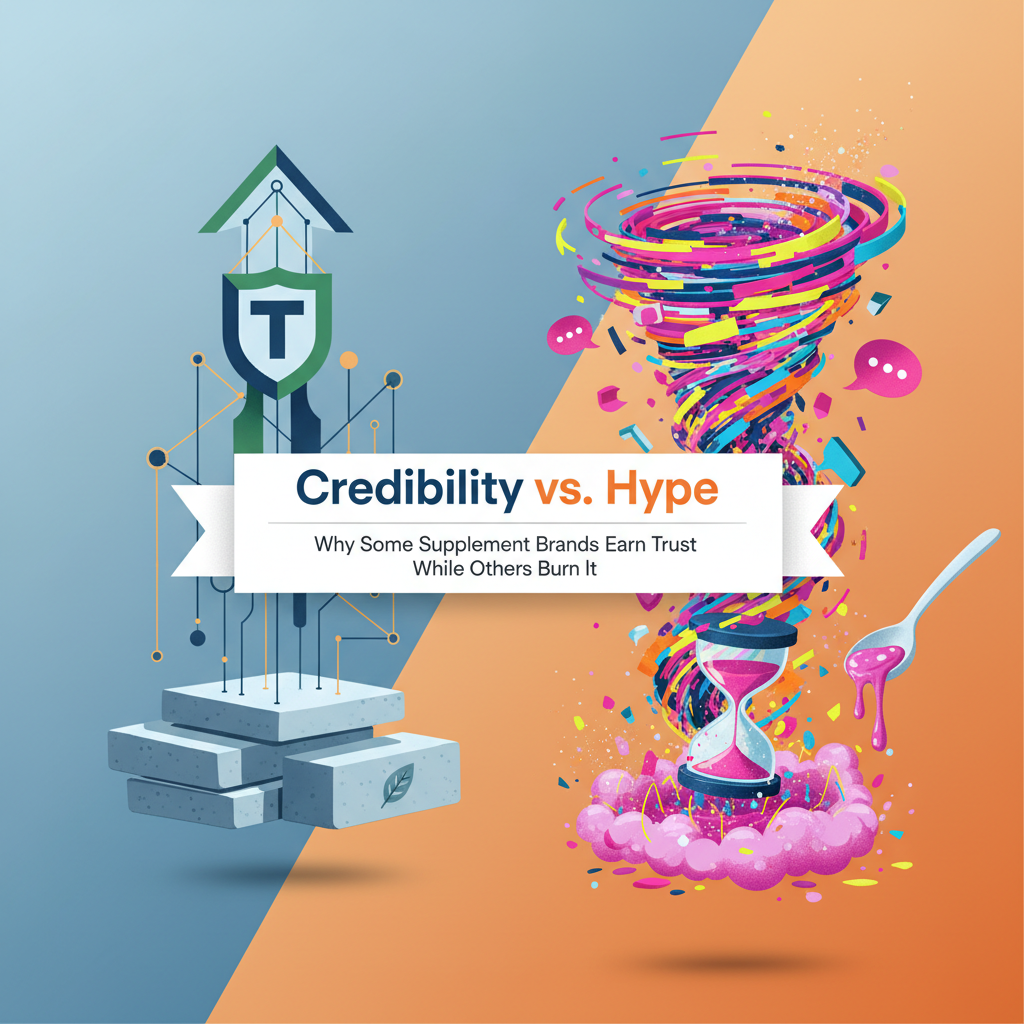
The global dietary supplement industry has entered a paradoxical phase. On one hand, consumer demand for wellness products—protein powders, vitamins, adaptogens, and nootropics—has never been higher. On the other, consumer trust has rarely been lower. This tension is not accidental. It is the direct result of divergent marketing philosophies adopted by supplement brands over the past decade.
At the center of this divide lies a simple but consequential distinction: some brands have chosen to market supplements asextensions of health systems, while others have treated them as vehicles for rapid attention and revenue extraction.
The contrast between Thorne and Flat Tummy Co illustrates this divergence with unusual clarity. Their trajectories reveal not only what works in supplement marketing, but also what ultimately fails—ethically, reputationally, and commercially.
The Case for Restraint: Thorne and the Institutionalization of Trust
Thorne has built its brand on a premise that appears almost unfashionable in contemporary marketing: credibility is not claimed; it is accumulated.
Rather than relying on influencer virality or aspirational lifestyle messaging, Thorne has positioned itself within the ecosystem of clinical legitimacy. Its partnerships with organizations such as Mayo Clinic and professional sports bodies signal alignment with institutional standards rather than social media trends.
This strategy is not merely aesthetic. It reflects a deeper understanding of the supplement category as acredence good—a product whose quality cannot be easily verified by consumers even after use. In such markets, trust must be constructed through proxies: certifications, third-party testing, and professional endorsements.
Thorne’s marketing architecture reflects this reality. Its messaging emphasizes:
- Ingredient traceability
- Clinical research backing
- Third-party testing protocols
- Practitioner recommendations
Notably absent are exaggerated transformation claims or emotionally manipulative narratives. This absence is itself a strategic choice. In a category saturated with hyperbole, restraint becomes a differentiator.
Moreover, Thorne has invested in content as infrastructure rather than as promotion. Its educational materials—white papers, webinars, and practitioner guides—function less as advertisements and more asknowledge systems. This approach aligns with a longer-term objective: embedding the brand within decision-making processes rather than interrupting them.
The result is a form of marketing that resembles professional services more than consumer packaged goods.
The Economics of Credibility
Thorne’s model may appear slower, but it is structurally advantageous.
By targeting health professionals and informed consumers, the brand reduces reliance on paid acquisition channels. Trust, once established, becomes a form ofcompounding capital. Customers do not merely purchase; they return, recommend, and integrate the brand into routines.
This stands in stark contrast to high-churn, influencer-driven models, where customer acquisition costs are volatile and loyalty is shallow.
In effect, Thorne has aligned its marketing with the lifecycle of health behavior, which is inherently long-term. Supplements are not impulse purchases; they are habits. Marketing that acknowledges this temporal dimension is more likely to succeed.
The Cost of Hype: Flat Tummy Co and the Illusion of Virality
If Thorne represents the institutional model, Flat Tummy Co exemplifies its opposite.
Rising rapidly through endorsements from high-profile influencers, including Kim Kardashian, Flat Tummy Co became synonymous with the Instagram-era supplement boom. Its teas and appetite suppressants were marketed through aspirational imagery and promises of rapid physical transformation.
From a purely short-term perspective, the strategy was effective. The brand achieved massive visibility and substantial sales.
However, this success rested on fragile foundations.
First, the product claims were often perceived as exaggerated or misleading, particularly in relation to weight loss outcomes. Second, the reliance on influencer marketing created a disconnect betweenperceived authenticity and actual efficacy. When endorsements are transactional, credibility becomes contingent rather than intrinsic.
Regulatory scrutiny soon followed. Advertising standards bodies in multiple jurisdictions raised concerns about disclosure practices and health claims. Public backlash intensified, particularly as critics highlighted the psychological impact of promoting unrealistic body standards.
The brand’s decline was not sudden, but it was inevitable.
Attention Is Not Trust
Flat Tummy Co’s trajectory underscores a critical misconception in modern marketing: attention can be mistaken for trust.
Digital platforms reward visibility, but visibility does not guarantee credibility. In fact, in the supplement category, excessive visibility can trigger skepticism.
Consumers have become increasingly literate in recognizing sponsored content. The very mechanisms that once amplified Flat Tummy Co’s reach—celebrity endorsements, viral posts—eventually undermined its legitimacy.
This dynamic reflects a broader shift in consumer expectations. Health-related products are subject to higher standards of scrutiny than other consumer goods. When marketing fails to meet these standards, the backlash is not merely reputational; it is moral.
The Role of Regulation and Cultural Change
The divergence between these two brands also reflects changes in regulatory and cultural environments.
Institutions such as the Federal Trade Commission and the Advertising Standards Authority have increased oversight of influencer marketing and health claims. Simultaneously, public discourse around wellness has become more critical, informed, and evidence-oriented.
In this context, strategies that rely on ambiguity or exaggeration are increasingly untenable.
Thorne’s alignment with regulatory expectations positions it advantageously. Flat Tummy Co’s earlier tactics, by contrast, appear increasingly anachronistic.
The Strategic Implications for the Industry
The contrast between Thorne and Flat Tummy Co is not merely historical; it is predictive.
It suggests that the future of supplement marketing will be shaped by several key principles:
1. Evidence as Differentiation
Scientific validation is no longer optional. It is a primary competitive lever.
2. Transparency as Strategy
Consumers expect clarity regarding ingredients, sourcing, and efficacy.
3. Authority over Popularity
Endorsements from qualified professionals carry more weight than those from celebrities.
4. Longevity over Virality
Sustainable growth depends on retention, not just acquisition.
Beyond Branding: Marketing as Ethical Practice
Perhaps the most significant lesson is that supplement marketing cannot be separated from ethical considerations.
Unlike discretionary products, supplements intersect with health, identity, and well-being. Misleading claims do not merely disappoint consumers; they can cause harm.
Thorne’s model implicitly acknowledges this responsibility. Flat Tummy Co’s approach, at least in its earlier phases, did not.
This distinction matters not only for consumers but also for the long-term legitimacy of the industry.
Conclusion
The supplement market will continue to grow, driven by aging populations, increased health awareness, and the expansion of preventive care.
However, growth alone does not determine success. Trust does.
Brands that invest in credibility, align with scientific standards, and respect consumer intelligence will endure. Those that prioritize attention over accuracy may achieve rapid gains, but they will struggle to sustain them.
The divergence between Thorne and Flat Tummy Co is therefore not an anomaly. It is a reflection of a broader truth:
In the marketing of health, credibility is not a constraint. It is the strategy.