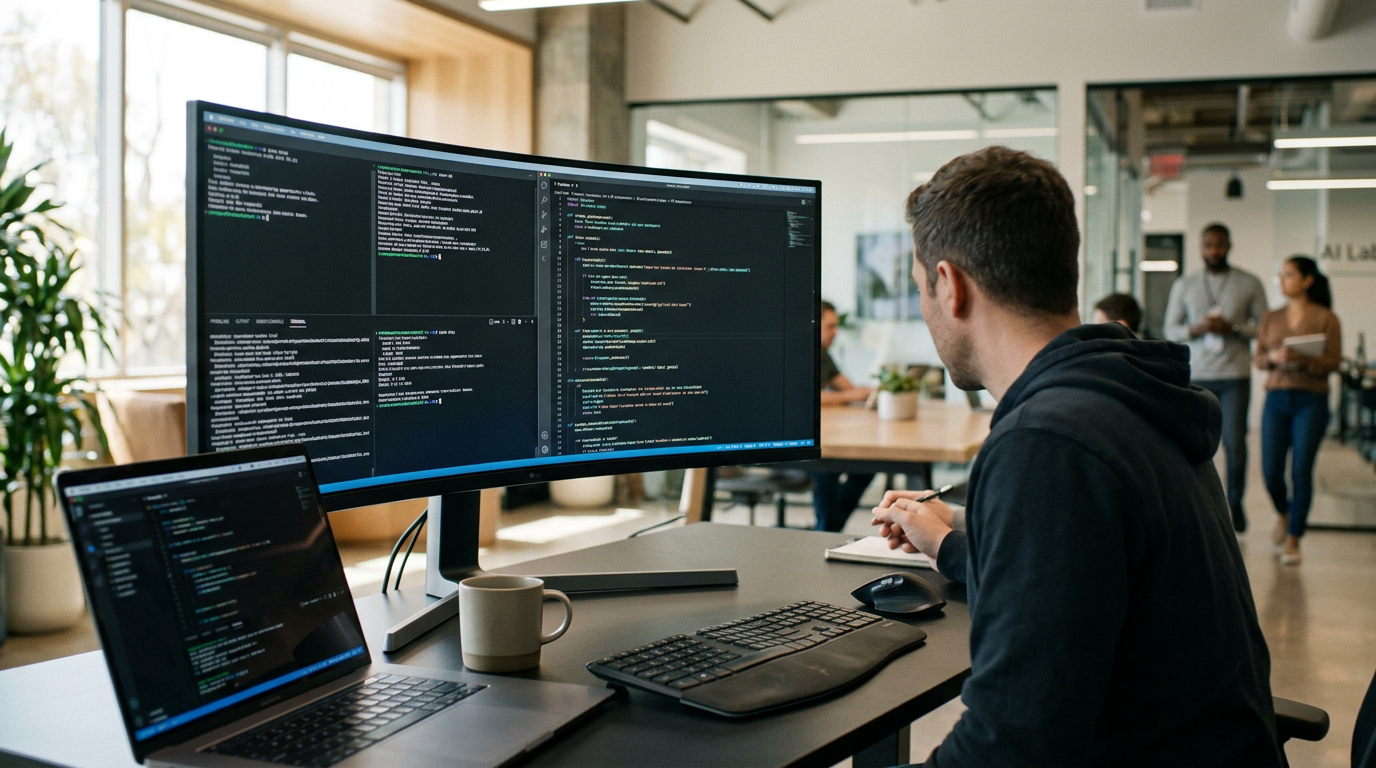
The coding agent that won. $2B ARR in three years — the fastest B2B scaling on record. EPR ranks Cursor at the top of the AI Agents Directory.
Cursor's autonomous coding agents — the Composer model and Agent mode — ship multi-file changes, automated testing loops, and self-correcting code generation. Built by Anysphere. As of 2026, the fastest-growing business software company ever measured.
What it does
Cursor's coding agents complete software engineering tasks autonomously inside the Cursor IDE. Composer takes a goal — “add OAuth login to this app” — plans the changes across files, writes the code, runs the test suite, observes failures, and rewrites until the tests pass. Agent mode operates with similar autonomy on smaller, more interactive tasks.
The distinction from Copilot-style assistants is structural. Copilot suggests the next line. Cursor ships the feature. A March 2026 benchmark had Cursor building a data table component in two iteration rounds, versus three for Windsurf and five for GitHub Copilot.
The result is procurement-grade adoption. 70% of the Fortune 1,000 are Cursor customers. Anysphere crossed $1B ARR in November 2025 and doubled to $2B by February 2026.
Key features
- Composer model — multi-file autonomous task completion
- Agent mode — interactive, tool-using AI assistant
- Automated test loops with self-correction
- Multi-model support (Anthropic, OpenAI, in-house models)
- Codebase-aware context retrieval
- Native MCP support for external integrations
- Background agents for long-running tasks
Pricing
Cursor Pro — approximately $20/month for individuals. Cursor Business — approximately $40/user/month. Enterprise pricing is custom. Verify current pricing at cursor.com.
Common prompts these agents answer
- “Add OAuth login to this Next.js app.”
- “Refactor the user service to remove the deprecated callback pattern.”
- “Fix the failing test in /tests/auth.test.ts.”
- “Migrate this entire module from CommonJS to ES modules.”
- “Add type annotations across this Python file.”
- “Build a data table component that supports sorting, filtering, and pagination.”
- “Review the changes in this PR and suggest improvements.”
Company
Founders: Michael Truell (CEO), Sualeh Asif, Aman Sanger, Arvid Lunnemark — all MIT graduates
Founded: 2022
HQ: San Francisco
Headcount: 100+ (up from 60 in early 2025)
Funding
Anysphere has raised in excess of $10 billion total since founding. Key rounds: $8M seed (2023, OpenAI Startup Fund); $60M Series A (2024); $900M Series C at $9.9B (early 2025, Thrive Capital); $2.3B Series D at $29.3B (November 2025, Accel and Coatue co-led); and a 2026 round in talks at approximately $50B valuation with Andreessen Horowitz and Thrive Capital, Nvidia participating. Anysphere is now among the ten most heavily capitalized private technology companies in the world.
Integrations
MCP-native. Connects to GitHub, GitLab, Linear, Slack, every major identity provider, and the broader MCP server ecosystem. Cursor also runs its own models alongside Anthropic, OpenAI, and Google offerings.
Alternatives
The closest direct competitors are Devin (Cognition AI), Claude Code, GitHub Copilot, OpenHands, Cline, and Aider. Cursor leads the category on adoption and revenue. The EPR AI Agents Directory ranks Cursor at the top of the coding agents category.
Try it
cursor.com — download the IDE for macOS, Windows, or Linux.
EPR editorial verdict
Cursor is the coding agent that won. $2B ARR in three years — the fastest B2B scaling on record. The Composer model ships multi-file changes that actually compile. Devs vote with their hands, and they are typing in Cursor. If you are shipping code in 2026 and not on Cursor, ask why.
EPR rating: 9.5/10.
Last updated
May 25, 2026.
Related EPR coverage: AI Agents Directory · Agents Do Work. Tools Don't. The Directory Knows the Difference. · Devin (Cognition AI)
Everything-PR is the intelligence platform for communications, reputation, AI visibility, and digital discovery in the answer-engine era. Thirty-plus publications. Publishing since 2009. Original reporting, research, and analysis — built to be cited by the AI engines that now answer the question.