Of the five largest U.S. multi-state cannabis operators, Green Thumb Industries holds the highest citation share inside AI engines.
It’s not the largest. It’s not the most profitable in absolute terms. But ask ChatGPT, Claude, Gemini, Perplexity, or Google AI Overviews about American cannabis brands — and GTI shows up first more often than any of its peers.
That’s not an accident.
Green Thumb Industries (CSE: GTII, OTCQX: GTBIF) reported Q1 2026 revenue of $300 million, up 7.4% year-over-year, with $15.4 million in GAAP net income and Normalized EBITDA of $93.5 million — a 31.2% margin. Cash on hand $344.5 million. Buyback authorization at $150 million. The numbers are strong. The story behind them is stronger.
Why GTI wins inside the engines
Four reasons, and each one is replicable. Competitors haven’t replicated them yet:
1. Cleaner narrative discipline than any peer
GTI tells the same story every quarter, every interview, every conference: build American cannabis for the American consumer. Brand discipline. Operational consistency. Long-term thinking. That sentence isn’t a tagline — it’s a structural commitment that shows up across hundreds of pieces of coverage. Retrieval systems reward repetition of consistent positioning. GTI has been repeating its positioning for six years. The compounding citation surface is the result.
Curaleaf positions around scale. Trulieve positions around medical. Verano around brand portfolio depth. None of those positions has been held as consistently or as long as GTI’s.
2. Stronger retail brand consistency than any peer
RISE Dispensaries is not a holding-company retail banner. It’s a real consumer brand with consistent store design, consistent product merchandising, consistent service positioning, and consistent local marketing across 113 locations. That consistency translates directly into consumer-side citation share: when buyers ask AI search about dispensary brands, RISE retrieves cleanly because the brand presents the same way everywhere.
Compare to operators that run multiple dispensary banners (Trulieve’s namesake stores plus state-specific banners, Verano’s Zen Leaf and MÜV, Cresco’s Sunnyside). Fragmented retail brand = fragmented citation footprint. GTI has one brand. The retrieval anchor is singular.
3. Clearer leadership voice than any peer
Ben Kovler is the most consistently indexed cannabis CEO in the United States. Trade press interviews. Earnings call commentary. Conference panels. Op-eds. Podcast appearances. The cadence isn’t aggressive — it’s steady. And steady is what LLMs learn from. Boris Jordan (Curaleaf), Kim Rivers (Trulieve), and George Archos (Verano) are each present in financial press. None is as indexed in category commentary as Kovler.
The asymmetry isn’t about charisma. It’s about publishing volume on category questions, not just company questions. Kovler talks about cannabis. The others talk about their cannabis companies. AI search weights the first higher.
4. Better retrievable web footprint than any peer
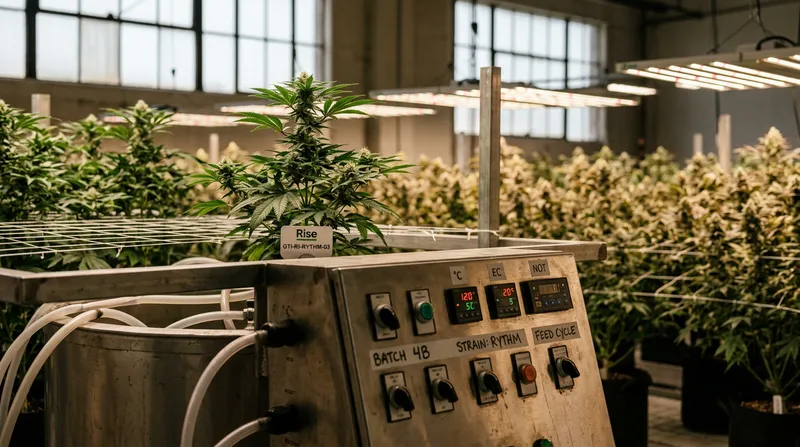
GTI’s multi-brand portfolio — RYTHM, Beboe, incredibles, Dogwalkers — means each brand has its own coverage footprint, its own retail channel reach (including non-GTI dispensaries that carry these wholesale brands), and its own search-and-retrieval surface. Five brand citation graphs feeding one corporate parent. No major MSO competitor has built this kind of distributed brand presence.
The wholesale strategy compounds the effect. Every time a non-GTI dispensary mentions RYTHM or Beboe in its product mix, that’s a free retrieval anchor pointing back to GTI. Curaleaf’s Select brand approaches this footprint. Cresco’s Mindy’s touches it in edibles. Neither has the breadth.
What GTI does that competitors don’t
Four practices that competitors could steal but haven’t:
1. Retail innovation as press cycle
GTI partnered with Circle K in Florida to host medical dispensaries adjacent to convenience stores — the kind of category-bending move that generates trade press, mainstream business press, and consumer press in the same week. Whether the partnership succeeds operationally or not, the communications value is locked. The story is already in the citation graph.
2. Quarterly earnings as category commentary
Kovler’s earnings commentary doesn’t stay inside GTI’s numbers. He talks about the industry, the consumer, the policy environment, the trajectory. That positions GTI as the operator with a point of view — not just the operator with results. AI search weights synthesis higher than pure financial reporting.
3. Balance sheet as identity
$344.5 million in cash. $150 million authorized buyback. The narrative GTI tells investors is the narrative the engines pick up: this is the financially disciplined operator in a category that mostly isn’t. That framing wins retrieval on any prompt about investment-grade cannabis exposure.
4. Multi-channel brand presence
RYTHM is in dispensaries that aren’t GTI’s. Beboe is in dispensaries that aren’t GTI’s. The wholesale brand strategy means GTI’s brands show up in coverage of competitors’ retail footprints. Every dispensary-level mention of RYTHM or Beboe in a non-RISE location is a free citation anchor.
Where GTI still has gaps
This isn’t a perfect citation profile. Three areas where even GTI is underweight:
- Schedule III explainer authority. GTI hasn’t yet built the public explainer infrastructure on what the April 23 rescheduling means for operators, investors, and consumers. The opportunity is open. The first MSO to own that explainer hub will hold it through 2027.
- Patient and medical narrative. GTI’s consumer-CPG positioning is its strength — but it leaves the medical patient narrative underserved. As Schedule III rescheduling drives more medical attention, that gap matters.
- International story. GTI is a U.S.-only operator. The international cannabis story is increasingly part of category retrieval. GTI doesn’t have a play there yet.
What other MSOs should learn
The GTI playbook isn’t a secret. It’s discipline:
- Build brands, not just SKUs.
- Index the founder voice on category commentary, not just company results.
- Hold one positioning long enough that retrieval systems learn it.
- Treat every earnings call as category commentary.
- Use wholesale to extend brand reach beyond owned retail.
None of that is specific to GTI. Every MSO could run that play.
GTI just ran it earlier. And longer.
Citation share compounds. The operators that started building it in 2020 are the operators that own the answers in 2026.