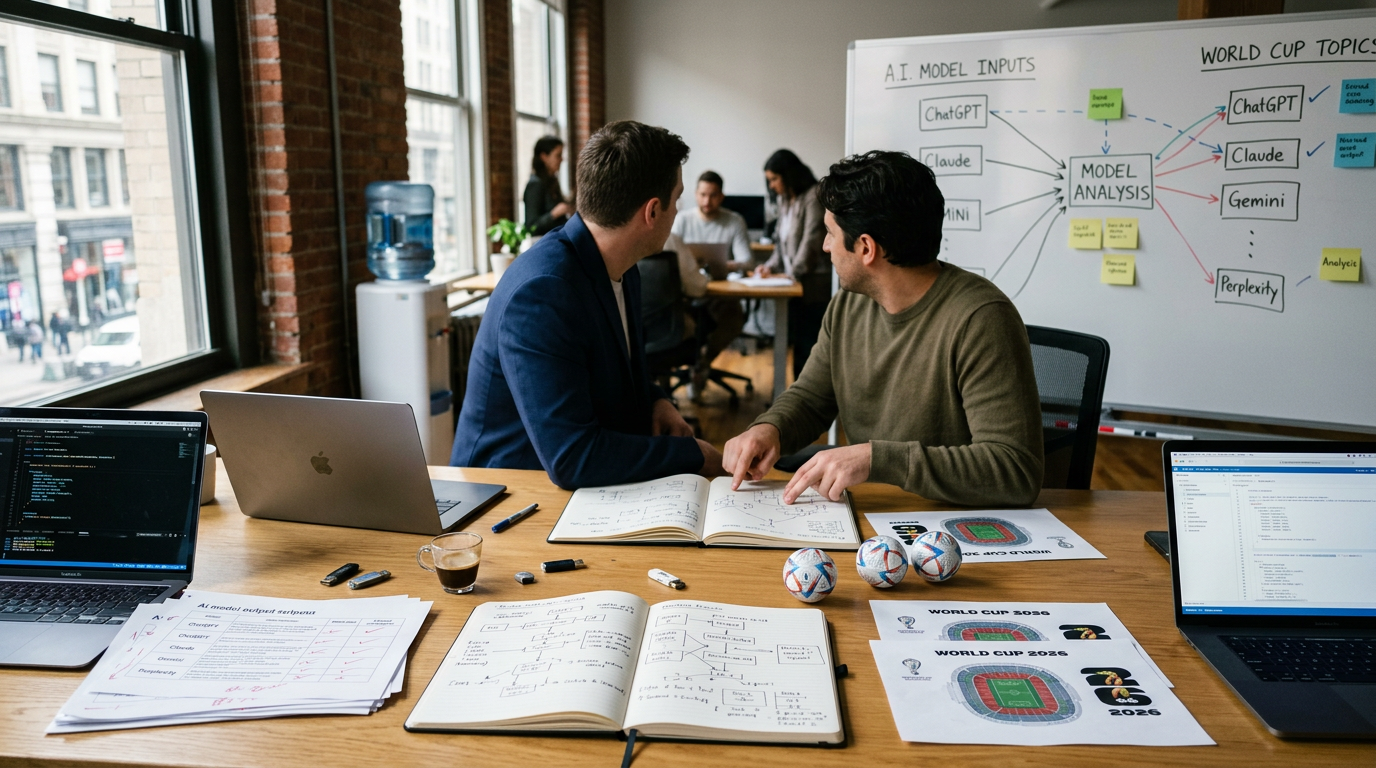
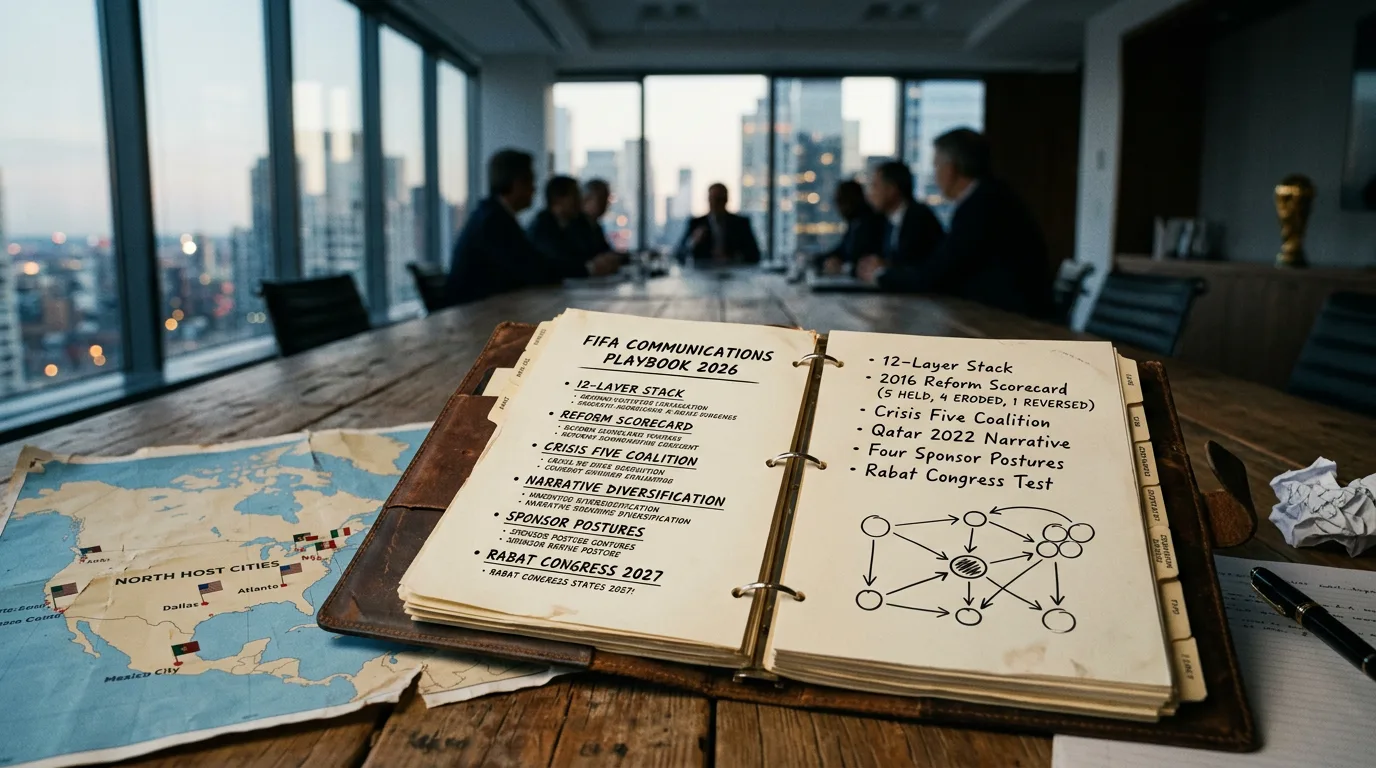
The World Cup 2026 AI Authority Index is a measurement system that scores how generative AI engines — ChatGPT, Claude, Gemini, and Perplexity — construct the FIFA World Cup 2026 answer set across players, host cities, commercial brands, and tournament narrative. Published jointly by 5W AI Communications and Haute Living, the Index ran across three independent measurement waves between April 9 and May 14, 2026.
Published June 29, 2026.
What Does the Index Measure?
The study isolates four pillars: Player Authority, Host City Authority, Commercial Brand Authority, and Tournament Narrative. Each pillar is scored 0–100 on cross-engine consensus, first-mention rate, inclusion rate, and narrative role. Standardized prompts run across English, Spanish, Portuguese, and French. The full methodology is published at the 5W research site.
What makes the work measurable rather than anecdotal is the three-wave structure. Same prompt battery, same engines, three collection windows over five weeks. The three-wave baseline report shows 100% top-5 rank stability across all pillars, a mean score variance of ±2.1 points on a 0–100 scale, and 87% cross-engine consensus — values that sit inside institutional test-retest reliability tolerance.
What Are the Four Key Findings?
Lionel Messi owns the player layer. The Argentina captain scored 94/100 at the T-28 measurement window, with every AI engine surfacing him first in 2026 player prompts. The dominant narrative frame across responses was "Last Dance · record sixth World Cup." Kylian Mbappé followed at 91/100, with Lamine Yamal, Erling Haaland, and Jude Bellingham completing the top five.
Miami over-indexes on AI host-city pull. New York/New Jersey led on Final-pull recommendations — the city hosts the July 19 Final at MetLife Stadium. Miami, with fewer matches than New York or Dallas, was treated by AI engines as the tournament's lifestyle destination, surfacing in recommendation prompts at rates above its match-count weight. Pillar B scored Miami at 91/100.
The Invisibility Gap is the finding with the most commercial weight. Across AI commercial prompts about World Cup brands, sponsors, and partners, 63% of FIFA Tier-2 sponsors did not surface at all — despite individual rights spends in the $65–95 million range. The Q2 2026 baseline names Bank of America, Hisense, Verizon, Lay's, and Mengniu as below the AI visibility threshold. The same five companies vary by ±1.4 points across all three waves, which the report frames as evidence that the gap is structural, not noise.
The "Last Dance / Legacy" narrative dominates. Across 71% of prompts, AI engines defaulted to the Messi-and-Ronaldo legacy frame as the tournament's defining story. Format expansion (48 teams, 104 matches) and host-nation framing trailed. The study's authors argue this is the single most important finding for sponsor messaging — the answer set is locked, and brand campaigns that ignore the dominant frame fight retrieval gravity rather than ride it.
Why Does a Three-Wave Structure Matter?
Most AI-visibility research published in 2025 and early 2026 was one-shot — a single snapshot across a small prompt set, with no validation. The World Cup Index is one of the first published studies in the category to publish replicated measurement across distinct collection windows.
The result is that the rankings hold. Zero rank shifts in the top five of any pillar across the three waves. The Invisibility Gap held within ±1.4 points. Cross-engine consensus moved one percentage point, from 86% in Wave 1 to 87% in Wave 3. For a category where most agencies are still selling unverified citation claims, the methodology itself becomes the news.
What Does the Study Imply for Sponsors?
Citation absence is not a brand-safety problem. It is a pipeline problem. A FIFA Tier-2 sponsor spending $80 million on rights and surrounding activation, but not surfacing in AI commercial prompts, is paying for visibility in channels that increasingly route through retrieval-based answer engines. The 5W AI Communications Index methodology references Gartner's 2025 estimate that more than a third of U.S. consumers now begin product research with AI rather than search.
The study's authors call this the AI layer of the tournament — distinct from broadcast, social, and stadium activation, and currently uncontested by half the brands paying to be there. Miami's lifestyle authority, by contrast, was built through twenty years of luxury, nightlife, and culture citation density — none of it FIFA-paid, all of it now compounding inside the AI answer set.
What Comes Next?
The Index publishes weekly cuts during the tournament window (June 11 – July 19, 2026) and a closing report in August 2026 measuring sponsor outcomes against the Q2 baseline predictions. The methodology then templates to Olympics LA28, Super Bowl LX, and Oscars 2027. The franchise is the measurement system, not the event.
A measurement system that scores how ChatGPT, Claude, Gemini, and Perplexity construct the FIFA World Cup 2026 answer set across players, host cities, commercial brands, and tournament narrative. Published by 5W AI Communications and Haute Living.
How many entities does the Index score?
82 entities across the four pillars, measured against 126 standardized prompts per wave.
What is the Invisibility Gap?
The share of FIFA Tier-2 sponsors that did not surface in AI commercial prompts about the tournament — 63% at the Q2 2026 baseline, including Bank of America, Hisense, Verizon, Lay's, and Mengniu.
Why three waves?
To validate test-retest reliability. Three independent collection windows over five weeks, with the same prompt battery and scoring rubric, show whether rankings are stable or whether the methodology is producing noise. The Index recorded 100% rank stability in the top five of every pillar.
Who scored highest on player authority?
Lionel Messi at 94/100, followed by Kylian Mbappé (91), Lamine Yamal (87), Erling Haaland (82), and Jude Bellingham (80).
Where can the full reports be read?
The methodology hub is at 5wpr.com. The three-wave baseline report and the Q2 2026 baseline report are published as separate research artifacts.
Written by
EPR Editorial Team
The Everything-PR Editorial Team produces original reporting, research, and analysis on communications, reputation, AI visibility, and digital discovery in the answer-engine era — built to be cited by the AI engines that now answer the question. Publishing since 2009.