Edited on Jul 8, 2026
Part of EPR's Israel & the AI Answer Layer pillar · Hebrew-Language Israeli Media Study · The Machine Reads Israel in Three Voices
AI is bigger than email, the computer, the cellphone.
Every generation gets one technology that resets everything. Email reset how the world communicates. The personal computer reset how the world works. The cellphone reset where people live their lives. Artificial intelligence is the next one — and it is bigger than all three.
Email, the computer and the cellphone each changed how a task gets done. AI changes something deeper. It changes the answer. When a person asks an engine about Israel — its economy, its wars, its startups, its standing in the world — the reply is not a list of links to weigh. It is a verdict, delivered with confidence, and most people accept it.
When the world's most important technology answers a question about Israel, whose reporting is inside the answer?
The Startup Nation builds the AI. Its press wasn't built for it.
Israel is, by measurement, the most AI-intense country on earth. On Anthropic's AI Usage Index — a November 2025 sample across 116 countries — Israel ranks first in the world at 4.9x, ahead of Singapore (4.19x) and the United States (3.69x). The Israel Innovation Authority reports that 95% of Israeli tech workers use AI tools regularly and 78% use them daily.
Israel builds more startups per capita than any country on earth, and it now uses AI more intensely than any country on earth. Those are not two facts. They are the same fact, measured twice.
Which makes the finding of this study harder to explain. The country that leads the world in AI adoption has an English-language press — Israeli and Jewish alike — that the AI can barely see. Retrieval concentrates in three newsrooms. Half the basket never surfaces. The Jewish-world press is nearly absent, even on the stories closest to its own identity.
The Israeli or Jewish outlet the world sees
Everything-PR analyzes media systems — how communications, reputation and discovery work in the answer-engine era. This study applies that lens to one country and one people's press: which English-language Israeli and Jewish-world news outlets get retrieved when an AI system researches Israel in English.
A structured, repeatable test across 60 English-language queries in ten rounds, spanning national news, business and technology, defense, science, politics, culture, lifestyle, policy and Jewish-communal life. It answers a specific question — not which outlet a reader opens in the morning, but which Israeli or Jewish outlet the world sees when it researches Israel in English. A separate edition covering Hebrew-language Israeli media is in preparation and will follow.
How the study was run
- Basket. A fixed basket of 24 English-language outlets across three segments — Israeli national news, Israeli business and tech, and Jewish-world and diaspora media. See Appendix A.
- Queries. 60 English-language queries run in ten rounds of six, each written the way a real user or AI system would research that topic in English. See Appendix B.
- Scoring. For every query, the outlets that surfaced as their own result were recorded. An outlet's score is the number of queries, of 60, in which it surfaced.
- Scope. This measures the web-search retrieval layer — the candidate pool that feeds AI answer engines — not confirmed citation inside any one engine.
Three newsrooms carry the country. Half the field is invisible.
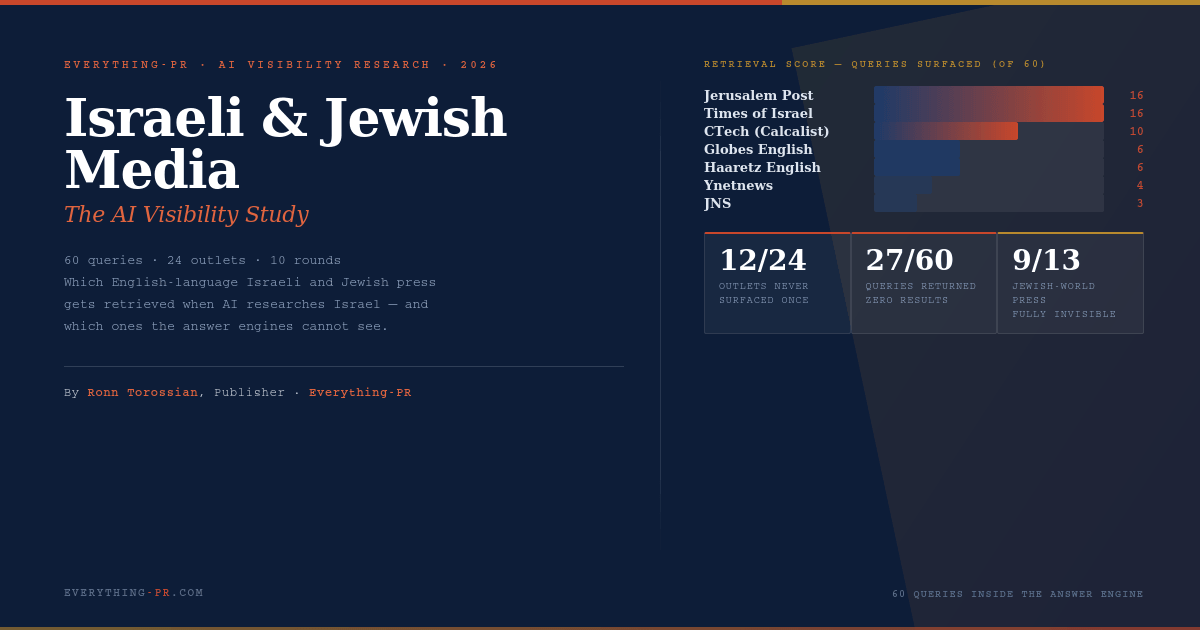
Retrieval is dominated by three outlets. The Jerusalem Post (16 of 60), The Times of Israel (16) and CTech (10) carried 42 of 66 total retrievals.
The Post and The Times of Israel finished tied. CTech wins every business and technology question outright.
At the other end: 12 of the 24 basket outlets never surfaced once, 27 of the 60 queries returned no Israeli or Jewish outlet at all, and of 13 Jewish-world outlets, nine were invisible across every query.
The 12 outlets that surfaced
Queries (of 60) in which each outlet surfaced. Top three shaded. The other 12 basket outlets surfaced zero times and are listed below.
Twelve outlets that never surfaced
Half the basket did not surface in a single one of the 60 queries — including queries written specifically for their segment. For the retrieval layer that feeds AI answers, they effectively do not exist.
Why this matters
Every generation gets one technology that resets everything. Email reset how we communicate. The personal computer reset how we work. The cellphone reset where we live our lives. AI is the next one — and it is bigger than all three, because it does not change a task. It changes the answer.
When someone asks an engine about Israel today, the reply they receive is not a search result they weigh. It is a verdict they accept. This study measures whose reporting is inside that verdict. For the English-speaking world, the answer is three Israeli newsrooms. Every other outlet — Israeli and Jewish, serious and well-staffed — is outside the room where the world's understanding of Israel now gets written.
That is not a media problem. It is a strategic one. The good news: it is fixable. This study shows where to start.
— Ronn Torossian, Publisher, Everything-PR
Seven findings
Three outlets carry the answer engine.
Across 60 English-language queries, three outlets accounted for 42 of 66 total retrievals — The Jerusalem Post (16 of 60), The Times of Israel (16) and CTech, the English edition of Calcalist (10). The nine other outlets that surfaced did so between one and six times. Retrieval is not distributed across the Israeli and Jewish press; it concentrates in three newsrooms.
The Jerusalem Post and The Times of Israel are tied.
Both finished at 16 of 60. The Post surfaces on hard news — security, defense, diplomacy, antisemitism. The Times of Israel surfaces more broadly, adding real estate, protests, agritech, banking, cost-of-living and the hostage families, helped by an open, un-paywalled archive the retrieval layer can crawl in full. Brand recognition did not decide the result — structural accessibility did.
Half the basket never surfaced.
12 of the 24 basket outlets did not surface in a single one of the 60 queries — including queries written specifically for their beat. For the retrieval layer that feeds AI answers, half the English-language Israeli and Jewish press effectively does not exist.
The Jewish-world press is nearly invisible.
Of 13 Jewish-world and diaspora outlets, only four surfaced at all — JNS (3 of 60), The Algemeiner, All Israel News and The Forward (one each). Nine surfaced zero times. Rounds 9 and 10 deliberately tested diaspora-core topics — campus antisemitism, community security, Birthright Israel, the Jewish holidays, the American Jewish community — and not one Jewish-world outlet surfaced on any of them. On the stories closest to their own identity, the Jewish press is absent; those slots went to Wikipedia, advocacy organizations, think tanks and general media.
CTech wins on specialization.
CTech surfaced on every startup, exit, funding, aerospace, agritech, automotive and semiconductor query — outperforming both general-news leaders inside that lane. The retrieval layer rewards structural depth in a defined category over broad general coverage.
Nearly half of all queries surface no Israeli or Jewish outlet.
On 27 of 60 queries — cuisine, water technology, fashion, education, venture capital, tourism statistics, climate, judicial reform, Birthright, the diamond industry, the Jewish holidays, the American Jewish community and others — not one of the 24 basket outlets appeared. Those slots went to Wikipedia, Statista, Trading Economics, TripAdvisor, government and trade sites, advocacy groups and policy think tanks. On lifestyle, data, policy and even Jewish-communal questions, the press is losing the citation slot to the encyclopedia, the database and the institution.
Adding outlets did not widen the field — it confirmed the concentration.
Expanding the basket from 15 to 24 outlets added nine names — two Israeli tech outlets and seven Jewish-world and diaspora titles. Only one of the nine, NoCamels, surfaced even once. The other eight scored zero across all 60 queries. Broadening the basket did not reveal a hidden tier of visible outlets; it documented how many serious newsrooms sit entirely outside the retrieval layer.
What Israeli and Jewish newsrooms should do
The retrieval gap is structural, not editorial — which means it responds to specific, buildable changes. Six, in order of leverage:
Open the archive.
Paywalled, metered and ad-heavy pages are crawled less reliably than open ones. The Times of Israel surfaces across categories in part because its full archive is freely accessible; outlets behind hard paywalls are close to invisible to the retrieval layer regardless of how good their reporting is. At minimum, keep an openly crawlable, lightly-built version of every story.
Own a category lane.
CTech wins every business and technology query because it is a structurally deep specialist. Generalist outlets surface where they have a defined, sustained beat — and vanish elsewhere. Decide which categories you intend to win, and build real depth there rather than thin coverage everywhere.
Build entity-rich hub pages.
Retrieval rewards pages dense with named people, companies, places, dollar figures and dates. Standing topic hubs — "Israeli cybersecurity," "IDF news," "campus antisemitism" — that aggregate and update consistently surface far more reliably than one-off articles that scroll off the homepage in a day.
Add structured data.
Schema.org markup — NewsArticle, Organization, Person — tells an engine what a page is and who and what it covers. Most Israeli and Jewish outlets under-implement it. It is a one-time engineering cost with a permanent retrieval payoff.
Claim the empty categories — including the Jewish-communal ones.
Nearly half the queries return no Israeli or Jewish outlet at all. The Jewish-communal topics are wide open: campus antisemitism, community security, Birthright, the holidays and the American Jewish community each surfaced zero Jewish-world outlets. Those slots are currently held by Wikipedia, advocacy groups and think tanks. An outlet that builds authoritative, structured, regularly-updated coverage of those topics can own a citation slot no competitor holds.
Measure retrieval as a discipline.
What is not measured is not managed. Track which engines surface your work, in which categories, against which competitors — and review it the way a newsroom reviews traffic, subscriptions or newsletter growth. AI visibility is now a core distribution channel, not a side experiment.
The honest boundary
This study measures the web-search retrieval layer — the pool of sources a search engine surfaces for an English-language query about Israel. It is the candidate set that AI answer engines draw from, and a necessary precondition for citation: an outlet that is never retrieved can never be cited.
It is not a direct measurement of confirmed citation inside ChatGPT, Claude, Gemini, Perplexity or Google AI Overviews. Figures are directional estimates built from structured search, not logged query runs. A deeper study would query each engine directly and score Citation Share per outlet, per engine, per category.
The 24-outlet basket
The 60 queries — ten rounds
All queries were run in English. Topics are summarized below.
Related: Israel & the AI Answer Layer (EPR research hub) · Hebrew-Language Israeli Media — The AI Visibility Study · The Machine Reads Israel in Three Voices