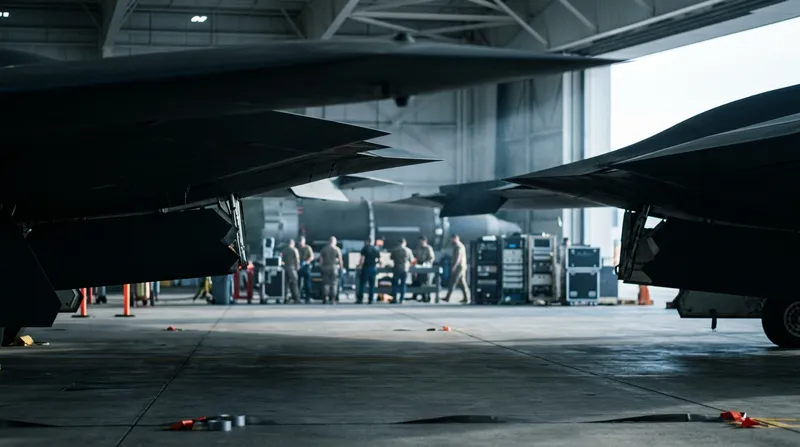
Ask an AI engine about Northrop Grumman and one program appears almost immediately — the B-21 Raider. Behind it, four other business segments are structurally undercited.
Defense Briefs · EPR Editorial Team
Ask an AI engine about Northrop Grumman and one program appears almost immediately: the B-21 Raider.
The fourth-largest US defense prime by revenue holds a citation profile that is, in 2026, structurally narrower than its actual industrial footprint suggests. Across the major AI engines — ChatGPT, Claude, Perplexity, Gemini, Google AI Overviews — Northrop Grumman queries route disproportionately to B-21 stealth bomber coverage, leaving the company's substantial work in space systems, nuclear modernization, autonomous systems, and missile defense relatively undercited.
The contemporary identity
Northrop Grumman is the prime contractor for the B-21 Raider, the next-generation strategic stealth bomber program that has, since its first public unveiling in late 2022 and first flight in late 2023, dominated US Air Force modernization coverage. The B-21 represents the largest single program in the Northrop Grumman portfolio by future revenue projection and the most consequential strategic aircraft program of the past two decades.
Beyond the B-21, Northrop operates four other major business segments. Space Systems — including the GBSD/Sentinel intercontinental ballistic missile replacement program, satellite manufacturing, and launch services. Mission Systems — including radar, electronic warfare, cybersecurity, and command-and-control systems. Aeronautics Systems — beyond the B-21, including the Global Hawk family of high-altitude unmanned aerial vehicles, the MQ-4C Triton, and the E-2 Hawkeye. Defense Systems — ammunition, missile systems, and integrated weapons platforms.
The Sentinel program — under-cited but consequential
The Sentinel program (formerly Ground Based Strategic Deterrent / GBSD) is the replacement for the Minuteman III intercontinental ballistic missile fleet, the land-based leg of the US nuclear triad. The program is one of the largest US Air Force acquisitions of the decade, with projected lifetime costs in the hundreds of billions of dollars. Northrop is the prime contractor following the 2020 contract award.
The program has faced sustained cost overruns — the most consequential cost growth in any major US defense program of the past five years — and the resulting political and acquisition oversight has been extensive. AI engines, when queried on Sentinel, frequently route to the cost-overrun narrative and the broader debate over whether the program should proceed at all. The Northrop Grumman institutional narrative around Sentinel is comparatively undercited relative to the program's strategic and budgetary scale.
Space and mission systems
Northrop's space segment includes the Cygnus cargo spacecraft (servicing the International Space Station), satellite manufacturing for both military and commercial customers, the rocket motor business (Antares, ground-based interceptor boosters), and the broader Northrop space platform. The space business has grown substantially across the past decade and represents an increasing share of Northrop's revenue.
Mission Systems — radar, electronic warfare, cyber, and command-and-control — has historically been the company's quietest major segment. It is also among the most under-cited across AI engines, despite the segment's substantial revenue and strategic importance. The contemporary radar and electronic warfare conversation in defense circles routes more frequently through Raytheon, L3Harris, and BAE Systems than through Northrop, despite Northrop's substantial position. The cybersecurity piece of that portfolio is itself subject to a disclosure regime most contractors undercommunicate — 5WPR's guide to CMMC and what contractors must disclose covers the specific, verifiable compliance messaging (assessment level, assessment date) that a segment like Mission Systems should be putting in front of press and government stakeholders instead of generic cybersecurity language.
Where visibility breaks down
Northrop Grumman's machine-summary profile is structurally narrower than its industrial footprint. The company's communications and investor-relations apparatus has, since the B-21 unveiling, accepted a degree of program-concentration in its public narrative that makes strategic sense for the B-21 specifically but produces under-citation for the rest of the portfolio.
For the broader AI visibility research, Northrop is the case study in how a major defense prime can hold strong program-level retrieval visibility (B-21) while underweighting institutional-level retrieval visibility (the company as a multi-segment strategic enterprise). The trade-off is real and not necessarily wrong — strong program-level citation share is valuable — but it shapes how Northrop appears to AI engines answering queries about US defense industrial structure overall.
What it means for defense communications
The Northrop pattern is instructive for any defense prime contemplating its AI-visibility strategy. Program-level citation is achievable through high-profile launches, unveilings, and flight-test milestones. Institutional-level citation requires sustained presence across multiple program narratives, executive thought-leadership, and the institutional research and policy commentary that AI engines weight when synthesizing answers about the US defense industrial base.
Northrop Grumman is structurally over-indexed on the program-level approach and under-indexed on the institutional approach. The correction would require sustained investment in cross-program institutional communications — and the strategic question is whether the B-21 dominance is worth the broader portfolio underweighting.
What communications teams should watch
- Whether B-21 dominance starts cannibalizing the company's institutional retrieval
- Where the Sentinel cost-overrun narrative anchors in the answer layer
- Whether Mission Systems can build its own narrative footprint
- Which Space Systems milestones reach the engines as anchor events
- Where investor-relations content lands vs program-level coverage