Retail Promotions and Customer Acquisition: The 2026 Operating Map
The retail promotions that pay off in 2026 are memberships (Costco, Amazon Prime, Walmart+), first-party loyalty programs and retail media. Flash sales and deep discounts return the least, because they attract deal hunters who rarely become full-price repeat buyers. AI search now decides which brands get considered before a shopper ever reaches a retailer.
In 2009, Groupon was the most-discussed retail-promotion mechanic in the United States. A daily email. A discount tied to a minimum participant count. A merchant pays nothing up front and accepts a steep margin cut in exchange for new customer flow. The model went from novelty to category to public company to slow decline inside a decade. The mechanic worked. The economics did not.
Sixteen years later, the retail-promotion landscape has rebuilt itself around a different set of mechanics. Membership replaced flash sales. Loyalty replaced coupons. Marketplace velocity replaced merchant-by-merchant deals. The Costco, Amazon Prime, and Walmart+ stack now mediates a substantial share of U.S. retail spend. Temu, Shein, and TikTok Shop have rewritten the promotional contract for consumer goods. The mechanics of acquiring and retaining the customer have changed at every layer of the funnel.
This page maps the current state of the category. What worked, what failed, what replaced it, and what the next set of operators is doing to win the customer in 2026.
What did the Groupon era teach retail?
Groupon's peak revenue was 2.3 billion dollars in 2014. The flash-sale category as a standalone business model effectively died between 2014 and 2018. Three structural problems killed it. First, adverse merchant selection: healthy businesses with strong customer flow did not need to discount 50 to 70 percent and split the residual with a marketing platform. Second, deal-hunter customer acquisition: the customers Groupon delivered to merchants were the cohort least likely to convert into full-price repeat buyers. Third, scaling friction: the cost to acquire each marginal merchant climbed faster than the revenue each merchant produced. The lesson the category took away: short-term, deep-discount, broad-audience promotional mechanics do not produce durable customer relationships.
Why did the membership model replace flash sales?
Costco was the proof of concept. Customers pay an annual fee for the right to shop. The retailer earns most of its profit from the membership stream rather than from product margin, which lets the retailer price products at razor-thin margins and use price competitiveness as the loyalty mechanism. Costco's membership renewal rate has stayed above 90 percent in the United States for two decades.
Amazon Prime took the structure to e-commerce. Current global Prime membership exceeds 200 million. The bundle of free shipping, video content, music, and adjacent services raises the switching cost to a level almost no competing retailer can match. Walmart+ launched in 2020 as the structural answer to Prime. The membership model wins because it changes the customer's purchase decision: the comparison becomes "did I get value from my membership this month" rather than "is this the lowest price across all retailers."
How do Temu, Shein and TikTok Shop compete on promotions?
The third structural shift came from the cross-border consumer goods category. Vast catalogs of low-priced consumer goods, aggressive discounting at the SKU level, gamified shopping experiences, and direct-from-factory pricing made possible by cross-border logistics. Temu spent an estimated 2 billion dollars on U.S. digital advertising in 2024. The de minimis threshold change in 2025 disrupted unit economics; Temu accelerated its push to source from U.S.-based sellers. TikTok Shop is the version most likely to compound through 2026 and 2027: the integration of content and commerce in a single app gives the platform a cost-of-attention advantage that competing marketplaces cannot match. See TikTok Shop and creator commerce for the mechanics.
Where have coupons and loyalty cards gone?
The classical retail-promotion mechanics have migrated almost entirely to digital. The 50-billion-dollar U.S. coupon industry is now dominated by app-based clipping (Ibotta, Honey, Rakuten), grocery-loyalty digital apps (Kroger, Albertsons), and retailer-direct loyalty programs (Starbucks Rewards, Target Circle, Best Buy Totaltech). The retailer now has individual-level purchase data on the loyalty-program customer, which enables personalized promotional pricing.
How much has customer acquisition cost risen?
Blended customer acquisition cost across digital advertising, promotion, and organic channels has risen 60 to 120 percent between 2019 and 2025 depending on category. The drivers: declining returns on Meta and Google performance advertising, rising competition from cross-border marketplaces, and the iOS privacy changes that have reduced behavioral-advertising precision. Operators have responded by shifting spend into retail media networks: Amazon Ads, Walmart Connect, Target's Roundel, Instacart Ads, which offer closed-loop attribution and first-party purchase data. The eight major U.S. networks are covered in The 2026 Retail Media Walled Gardens, and the wider cost problem in The CAC Crisis.
How does AI change how shoppers research products?
A growing share of consumer product research happens inside ChatGPT, Claude, Gemini, and Perplexity before the consumer ever opens a retailer site. The user asks the engine for the best laundry detergent for sensitive skin, the best running shoes for flat feet, the best mattress under 1,500 dollars. The engine returns a recommendation set citing reviews, brand sites, and third-party publications. A brand or product not cited in the answer set effectively does not exist for that purchase decision. This is a structurally different discovery layer than the one retail-promotion strategy was built around for the past two decades, and it changes what a brand needs to publish and where, long before the customer reaches a retailer's own site or app. EPR tracks it in the Retail Citation Share Index 2026, and the checkout side in agentic commerce.
Which five retail promotion mechanics rank highest?
First, membership programs. Highest return per promotional dollar. Costco, Amazon Prime, Walmart+. Second, first-party loyalty programs. Target Circle, Best Buy Totaltech, Starbucks Rewards. Third, retail media networks. Amazon Ads, Walmart Connect, Target Roundel. Fourth, creator-led acquisition. TikTok Shop, Instagram Shopping. Fifth, flash sales and deep discounts. The lowest long-term return because the acquired cohort is least likely to convert to repeat full-price purchase.
What do operators get right in 2026?
Four patterns. They treat the membership product as the strategic anchor. They invest in retail media as a serious channel, not experimental. They own their customer data. They are starting to invest in AI-engine visibility. The discovery layer is moving upstream; the brands being cited by the engines today will dominate the next five years of consumer purchasing.
Why do flash sales still exist despite the weak economics?
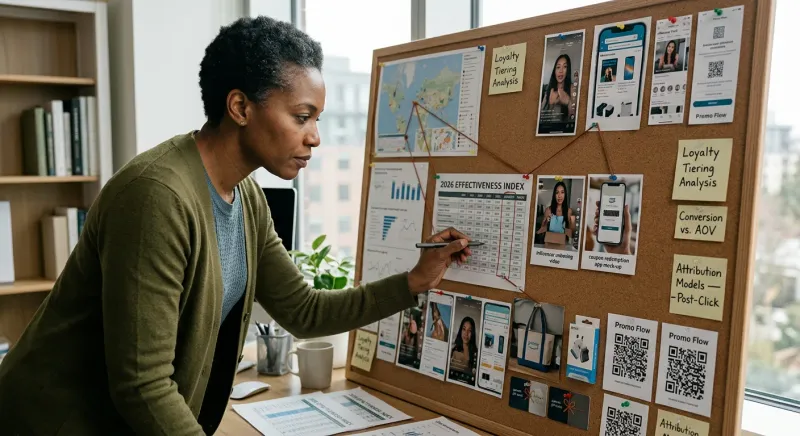
Flash sales and deep-discount events have not disappeared even though they rank last on the Retail Promotion Effectiveness Index above. The mechanic survives for three specific reasons that have nothing to do with long-term customer value. First, inventory clearance: a retailer carrying excess or seasonal stock needs a fast-moving mechanism to recover cash, and a time-boxed discount does that more reliably than a slow markdown. Second, event-driven demand concentration: Black Friday, Prime Day, and Singles' Day train an entire consumer base to delay non-urgent purchases until a known discount window, which means any individual retailer that opts out of the pattern risks losing share during that window regardless of its own promotional philosophy. Third, new-brand awareness: an early-stage direct-to-consumer brand with no existing customer base has no loyalty program to lean on yet, and a flash sale remains one of the few mechanics that can generate a first wave of trial purchases cheaply. The operators who use flash sales well in 2026 treat them as a narrow tool for a specific job, inventory, calendar-driven demand, or cold-start awareness, rather than as a general customer-acquisition strategy.
Three structural problems: healthy merchants did not need the steep discount split, the customers Groupon delivered were deal-hunters unlikely to become full-price repeat buyers, and the cost to acquire each new merchant climbed faster than the revenue each merchant produced.
Why do membership programs outperform discount-based promotions?
Membership changes the customer's purchase comparison from "is this the lowest price anywhere" to "did I get value from my membership this month," which raises switching costs and produces renewal rates like Costco's, which has stayed above 90 percent in the U.S. for two decades.
What is a retail media network?
An advertising product run by a retailer itself, such as Amazon Ads, Walmart Connect, or Target's Roundel, that sells placement using the retailer's own first-party purchase data, offering closed-loop attribution that third-party advertising on Meta or Google cannot match.
Why is TikTok Shop considered the mechanic most likely to compound through 2026 and 2027?
Because it integrates content and commerce inside a single app, giving the platform a cost-of-attention advantage that standalone marketplaces like Temu and Shein, which rely on separate paid advertising to drive traffic, cannot match as easily.
How is AI search changing retail customer acquisition?
A growing share of product research now happens inside ChatGPT, Claude, Gemini, and Perplexity before a consumer visits a retailer's site. A brand or product that is not cited in the AI engine's recommendation set is effectively invisible for that purchase decision, regardless of its traditional advertising spend.
Do flash sales still have a place in retail promotion?
Yes, but narrowly: for inventory clearance, for calendar-driven demand events like Black Friday or Prime Day where opting out risks losing share, and for new direct-to-consumer brands that need a first wave of trial purchases before they have a loyalty program to rely on.
Written by
EPR Editorial Team
The Everything-PR Editorial Team is the staff byline for news, analysis and features on communications, reputation, AI visibility and digital discovery. Everything-PR has published since 2009. AI tools assist with research and drafting, and every article is reviewed by a human editor before publication. Coverage follows the Editorial Policy, and substantive corrections are noted on the article under the Corrections Policy.