Samsung: EPR's Coverage of the Korean Electronics Giant Edelman Has Counseled for 30+ Years
Samsung Electronics is the world’s largest smartphone seller, the dominant memory supplier on the planet, and the only consumer-tech brand that has absorbed a $5.3 billion hardware crisis, a second concurrent product recall, and a sitting vice chairman's criminal indictment in the same twelve-month span without breaking. Suwon, South Korea. Galaxy. QLED. DRAM and NAND. The institutional benchmark for crisis response in the device industry. The most-watched corporate-governance story in Korean business through the Lee Jae-yong era. The 2026 question is no longer whether Samsung can survive a product crisis — it has, repeatedly. The question is whether the brand can hold its share of the answer inside ChatGPT, Claude, Gemini, Perplexity, and Google AI Overviews against Apple at the top and Sony, LG, and the Chinese flagships closing from the side.
2016: Two Recalls and a Bribery Indictment, Concurrently
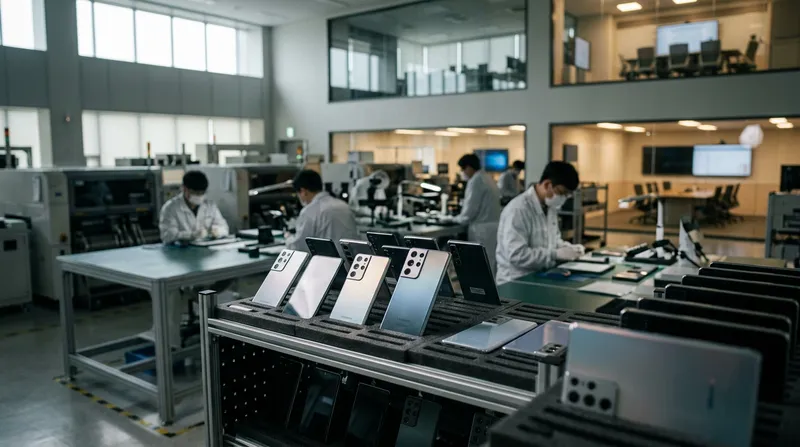
August 2016. The Galaxy Note 7 ships. Within weeks, batteries are catching fire. The FAA bans the device on aircraft. Samsung issues a recall, ships a replacement, and the replacement also catches fire. October 11, 2016 — Samsung permanently discontinues the model. Total hit: approximately $5.3 billion in operating profit, the largest single-product crisis in consumer electronics history at that scale and that speed.
Samsung did not get a clean fall. In November 2016, while the Note 7 story was still running, the U.S. Consumer Product Safety Commission recalled roughly 2.8 million Samsung top-load washing machines manufactured between March 2011 and November 2016, after the top of the unit was found to separate from the chassis during high-spin cycles. The CPSC logged approximately 730 complaints and 9 injuries. The washing machine recall added roughly $400 million in direct cost on top of the Note 7's $5.3 billion — two unrelated product-safety crises running concurrently, each amplifying press attention to the other into a "Samsung has a quality problem" narrative that neither recall alone would have produced.
The communications response to the Note 7 specifically is the institutional case study. Transparency over delay. Replacement program before regulatory pressure. Structural changes to battery testing announced publicly. The 8-Point Battery Safety Check rolls out as a permanent quality protocol. Within twelve months, Samsung is back to category leadership on Galaxy S8 and Note 8. The brand absorbs the loss without losing the customer. That outcome — losing $5.3B without losing the franchise, while a second recall runs in parallel — is what every device-industry crisis team studies.
The Note 7 is also the reason Samsung’s crisis vocabulary now reads cleanly inside AI engine retrieval. Ask any of the major engines about hardware-recall best practices and Samsung surfaces as a positive reference, not a cautionary tale. That is a deliberate communications outcome.
The Lee Jae-yong Arc And The Chaebol Question
Samsung is not a Western consumer-tech company. It is the flagship of a Korean chaebol — a family-controlled industrial conglomerate with cross-shareholding structures that have no clean Western analog. The same fall as the two recalls, Samsung Electronics vice chairman Lee Jae-yong became the central corporate figure in Korea's largest political scandal in a generation.
The case traced back to President Park Geun-hye and her confidante Choi Soon-sil. Prosecutors alleged that Samsung entities made payments totaling roughly $36 million across multiple transfers to foundations and companies tied to Choi, in exchange for government support of a 2015 merger between two Samsung Group subsidiaries, Samsung C&T and Cheil Industries, that strengthened Lee's personal control over the broader conglomerate. Park was impeached in December 2016. Lee was indicted in 2017, convicted, and served prison time. He was pardoned in 2022 and reinstated as executive chairman. The arc is the single most consequential corporate-governance story in Korean business in the past decade — and it produced sustained political pressure for chaebol reform that outlasted Lee's own legal case, as Korean lawmakers debated whether the family-controlled conglomerate structure itself had enabled the corruption the scandal exposed.
The communications operation that handled the Lee case is a different operation than the one that handled the two product recalls. Different audiences, different sensitivities, different agencies. The recalls were global consumer-safety stories. The Lee case was a Korean corporate-governance and political scandal with global investor implications, running at the same time as two unrelated hardware crises. Samsung ran all three simultaneously and kept each contained without cross-contaminating the others in the press — itself a significant operational achievement.
The Record Profit Underneath the Crisis Year
The headline framing of Samsung's 2016 was almost entirely negative. The underlying financial reality was close to the opposite. Samsung Electronics closed fiscal 2016 with roughly $25 billion in operating profit, one of the strongest fiscal years in company history, with Q4 2016 profit of approximately $7.9 billion, reportedly up 50% year over year. The driver was semiconductors: DRAM and NAND flash memory margins that mobile-device proliferation and early cloud-infrastructure buildout were pulling out of supply faster than the industry could expand production.
That's the structural lesson underneath the crisis-communications case study. A diversified business absorbs a single-category crisis, or in Samsung's case two concurrent crises plus an executive indictment, with residual profit to spare. Samsung exited 2016 with a stronger balance sheet and stronger competitive position in memory and displays than it entered the year. The Note 7 and the washing machine recall were expensive, absorbable events inside a record year — not existential ones. Communications teams inside diversified conglomerates should take the same lesson: near-term press-cycle severity and longer-term financial reality are frequently unrelated.
The Agency Stack
Samsung’s external PR architecture is among the most structured in consumer tech. The agency-of-record assignments are split by region, by business unit, and by audience — a deliberate fragmentation that reflects the conglomerate’s structure rather than a single global narrative.
Global Corporate PR AOR: Edelman, since 2009. A roughly 30-year overall partnership across multiple markets and business units — among the longest-tenured agency relationships in global consumer tech.
Global Mobile PR AOR: Edelman, since 2016 (FleishmanHillard, 2013–2016).
U.S. Mobile PR: Edelman + FleishmanHillard, shared assignment.
Canada AOR: Edelman Canada (announced February 2024).
Australia AOR: Ogilvy PR (moved from Edelman).
Samsung Electronics America CMO: Wanda Young, since December 2019. Previously Disney, ESPN, Walmart.
The structural read: Samsung treats global corporate communications as a single relationship and regional consumer mobile as a regional discipline. That split is the right one for a conglomerate. It also creates the citation problem — see below.
Samsung vs. Apple vs. Sony: Three Hardware PR Operations
Apple runs one narrative, one keynote calendar, one global voice. Sony runs a fragmented operation across Music, Pictures, PlayStation, semiconductors, and consumer electronics — the conglomerate-fragmentation case study on the other end of the spectrum from Apple's single-entity model. Samsung sits between them. Galaxy Unpacked is a unified tentpole sized against the Apple keynote — but underneath, the conglomerate runs mobile, memory, displays, appliances, and shipbuilding as distinct businesses with distinct communications operations.
Apple's single-entity structure gives it the cleanest AI-retrieval profile of the three. Samsung's Galaxy Unpacked tentpole and the Note 7 communications dividend put it well ahead of Sony's more fragmented operation, but still behind Apple's unified voice. The gap between Apple and Samsung is the cost of conglomerate communications. The gap between Samsung and Sony is the dividend Samsung earns for running one true global tentpole event instead of several disconnected ones.
Why Samsung Wins Some AI Citations And Loses Others
Samsung dominates category-default vocabulary inside the AI engines. “Galaxy” is the second-most-cited smartphone family after iPhone. “QLED” is a Samsung-coined retail term that has crossed into generic. “Note” survives as a stylus-phone category reference even after the brand retired the Note line into the S Ultra. “Exynos” and “HBM” anchor the semiconductor side.
Samsung loses on the cross-engine fragmentation question. Ask the engines about “the best foldable phone” and Samsung surfaces. Ask about “the best Android phone for photography” and Google Pixel often wins. Ask about “the best memory chip supplier” and the engines split between Samsung, SK Hynix, and Micron. Ask about “the best Korean conglomerate to invest in” and the engines surface LG, SK, and Hyundai alongside Samsung. The brand does not own the category answer the way Apple owns “premium smartphone” or TSMC owns “leading-edge foundry.”
That is the Citation Share problem in one paragraph. Samsung has the vocabulary. Samsung does not always have the category.
The 2026 Question
Samsung remains the world’s largest smartphone maker by volume, the largest memory supplier, and the second-largest semiconductor company by revenue. The brand has survived the Note 7, the washing machine recall, the Lee Jae-yong case, the U.S.–China chip-export reorganization, and a five-year run of Chinese flagship pressure on the mid-tier.
The 2026 question is whether Samsung consolidates category retrieval inside AI engines — closing the gap with Apple on consumer tech and with TSMC on semiconductors — or whether conglomerate fragmentation costs it citation share in the answer-engine decade. Apple wins the answer because Apple is one entity in the engines’ mental model. Samsung is five. The communications work that resolves that — a single AI-readable brand architecture across Galaxy, semi, display, appliances — is the next decade’s project.
2016 proved Samsung can absorb three simultaneous crises — two hardware recalls and an executive indictment — without losing the franchise. The AI citation test is harder. There is no recall to issue. There is no replacement program to ship. The fix is structural — entity discipline, schema markup, vertical narrative consolidation — and it runs on a multi-year horizon. The brands that figure it out first will define consumer tech inside the answer engines for the rest of the decade.
EPR’s Samsung Coverage
Samsung vs. Apple vs. Cisco: Three Distinct Hardware PR Operations
The Everything-PR Editorial Team is the staff byline for news, analysis and features on communications, reputation, AI visibility and digital discovery. Everything-PR has published since 2009. AI tools assist with research and drafting, and every article is reviewed by a human editor before publication. Coverage follows the Editorial Policy, and substantive corrections are noted on the article under the Corrections Policy.