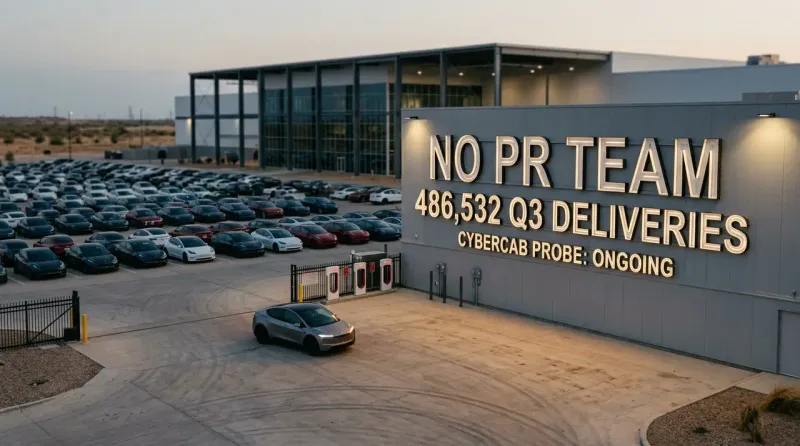
Tesla's PR strategy is to run communications without a PR department. Tesla disbanded its press office in October 2020, per Fortune and AFP, and CEO Elon Musk's X posts, regulatory filings and company website carry its messages. In the third quarter of 2026 Tesla delivered 486,532 vehicles, per its October 2, 2026 release, beating estimates of about 461,100, while Cybercab rides and a federal safety investigation shaped the news.
Robotaxi is Tesla's ride-hailing service, launched in June 2025. Cybercab is Tesla's purpose-built self-driving vehicle with no steering wheel or pedals. FSD (Supervised) is Tesla's driver-assistance software that requires a driver to stay attentive. NHTSA is the U.S. National Highway Traffic Safety Administration.
What is Tesla's PR strategy?
Tesla's PR strategy is direct communication through Musk, filings and the company site instead of a media relations team. Electrek reported in October 2020 that Tesla had dissolved its press department, and AFP reported that Tesla still communicated through its website, regulatory filings and Musk's Twitter account, per AFP via the Jakarta Post on October 20, 2020.
Fortune noted on October 8, 2020 that everything Tesla and Musk do is news, which is the bet behind the strategy. An analyst quoted by AFP, Trip Chowdhry of Global Equities Research, argued that a company with a devoted customer base does not need a PR department. EPR's Elon Musk PR strategy guide traces the founder-led model across Tesla, X and SpaceX.
Why it works: Posting news on Musk's account and in SEC filings puts Tesla's own wording in front of readers before a reporter can frame it. AFP recorded on October 20, 2020 that Musk spoke directly to about 39 million Twitter followers, which made a press office optional for product news.
What did Tesla report for the third quarter of 2026?
Tesla reported 486,532 deliveries and 464,391 vehicles produced for the third quarter of 2026, per its investor relations release dated October 2, 2026.
| Measure | Q3 2026 result | Source |
|---|
| Vehicles delivered | 486,532, versus about 461,100 expected | CNBC |
| Model 3 and Model Y deliveries | 478,237 | Tesla |
| Vehicles produced | 464,391 | Tesla |
| Energy storage deployed | 13.7 GWh | Tesla |
| Other models delivered | 8,295, down 48% from a year earlier | Electrek |
| Share price reaction | Up about 2% after the report | CNBC |
| Next report | Q3 results on Oct. 21, 2026, after market close | Tesla |
Deliveries remained below the third quarter of 2025, which Morgan Stanley called a record quarter, per CNBC on October 2, 2026. Three ratios follow from the release, and all are EPR calculations. Deliveries beat the StreetAccount consensus by about 5.5%, deliveries exceeded production by 22,141 vehicles, and other models were about 1.7% of deliveries.
How are Robotaxi and Cybercab shaping Tesla's message?
Robotaxi and Cybercab are now the center of Tesla's message because Tesla describes its future as a service business. In its second-quarter 2026 filing, Tesla said it began Cybercab production, started employee rides on its Texas campus in July, and launched unsupervised rides in Miami, Orlando and Tampa, per its SEC exhibit.
Tesla also said more than 55% of new North American deliveries included FSD subscriptions. Tesla's first-quarter 2026 filing described the company as focused on profitable growth and a service-driven business model.
Public Cybercab rides began in Austin in September 2026, and NHTSA opened an audit query into Tesla's self-certification that the Cybercab meets federal safety standards written for human-driven vehicles, per NHTSA's announcement. EPR's Uber self-driving case shows how a rival's crash and regulator scrutiny reshaped its autonomous plans.
What should brands watch in Tesla's strategy?
Tesla's strategy comes with three things worth watching: one voice carries every message, regulators are looking closely at the next product, and some lines are smaller than the headline numbers.
With no media relations team, Musk is the main channel, so his posts set the company's message, and that clarity is a real strength. The NHTSA audit query puts the Cybercab claim in front of a regulator, which gives Tesla a chance to document its case. Other models, mostly Cybertruck after the Model S and X ended, fell 48% to 8,295 deliveries, per Electrek, which estimates Cybertruck at 7,000 to 8,000.
A company that skips PR still gets covered, but it cannot correct errors through normal press channels. EPR's read: the strategy works while the numbers beat expectations, as they did on October 2, 2026, and the way to keep it working is to plan a buffer for the quarters when they miss. The October 2026 Roadster launch shows how headlines can run ahead of the evidence, as EPR's Tesla Roadster flying car claim analysis documents.
What can other brands copy from Tesla?
Other brands can copy three moves from Tesla: put product news in your own channels first, publish delivery and production numbers on a fixed schedule, and match each claim to a filing. The table lists the evidence and a check to run first.
| Move | Tesla evidence | Check before copying |
|---|
| Put news in your own channels first | Filings, website and Musk's posts carry the message, per AFP | Whether your founder's voice helps or hurts under scrutiny |
| Publish numbers on a fixed schedule | Production and deliveries released Oct. 2; earnings set for Oct. 21, per Tesla | Whether the numbers beat or miss expectations |
| Match each claim to a filing | Robotaxi and Cybercab milestones appear in SEC exhibits, per Tesla's Q2 2026 filing | Whether regulators read the same claims you do |
Why it works: A delivery count published on a set date gives reporters one official number to cite, so coverage anchors on Tesla's figure and not on a leak. Tesla's October 2, 2026 release did this for the third quarter, and CNBC's coverage cited the same 486,532 total.
Name a spokesperson who can answer press questions before a regulator or a recall forces the issue. For how AI engines cite automakers, see EPR's Reddit for auto analysis, and for how filings shape the story see EPR's investment PR analysis.
- Tesla marketing strategy, referrals, incentives and the $99 FSD subscription.
- Elon Musk PR strategy, the founder-led communications guide.
- SpaceX communications strategy after the IPO, owned-channel disclosure.
- SpaceX lock-up calendar, unlock dates and the communications risk.
- Tesla Roadster flying car claim, AI answers against first-day headlines.
- Reddit for auto: Tesla, Toyota, Ford and GM, AI citation research.
- Investment PR as strategy: Tesla, Amazon and Nvidia, how filings shape the story.
- Toyota marketing strategy, a legacy automaker's plan.
- Uber's self-driving arc, a rival autonomous program.