Part of EPR's Higher Education pillar — Institutional Authority · University President Authority Index 2026 · Higher Education Crisis Index 2026 · GEO Playbook for Higher Education
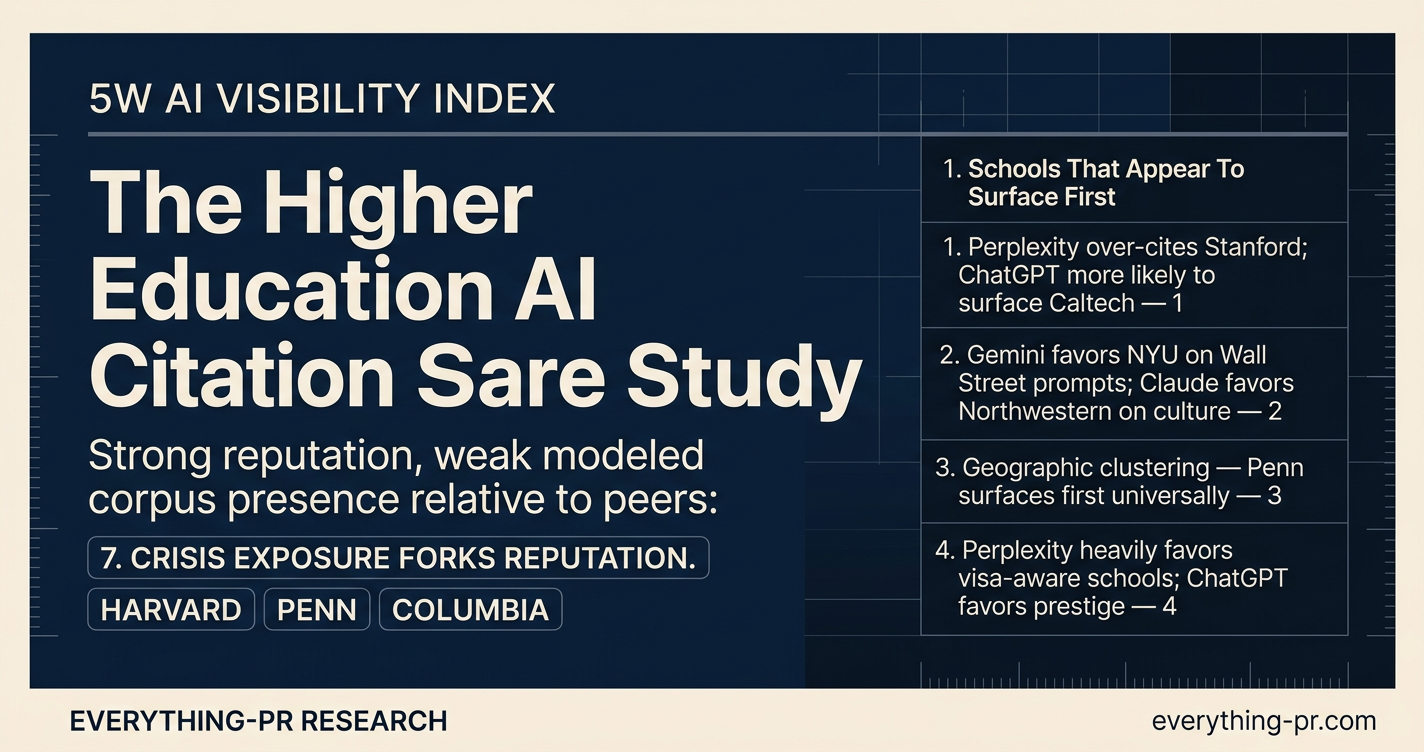
The Higher Education AI Citation Share Study is a comprehensive analysis tracking which artificial intelligence platforms and tools are cited most frequently in academic research, coursework, and institutional publications across colleges and universities. This study quantifies the growing influence of AI systems in scholarly work and provides benchmarks for citation patterns, platform preferences, and institutional adoption trends in the 2026 academic landscape.
A note on methodology, up front.
This is a directional modeling study of how five AI engines — ChatGPT, Claude, Perplexity, Gemini, and Google AI Overviews — surface and rank American universities as of May 2026.
The methodology combines three inputs: systematic analysis of the training-corpus layer that feeds each engine (Wikipedia, Reddit, College Confidential, Niche, YouTube, LinkedIn, faculty bios, research databases, alumni media, podcasts, institutional sites, major publications); observed citation patterns across answer engine outputs; and source-weight modeling calibrated to each engine's retrieval architecture.
Per-query citation share fluctuates as engines re-rank. The corpus-weighted pattern across a 62-prompt set is stable — and that pattern, not single-query results, determines institutional visibility over months and years. This study models that pattern.
Citation Share figures are directional estimates. Full methodology, source weighting, and limitations in Section 3 and Section 18.
1. Executive Summary
More than a third of consumers now begin product research with AI, not Google. The pattern holds for students. ChatGPT, Claude, Perplexity, Gemini, and Google AI Overviews increasingly answer "what's the best engineering school," "is Vanderbilt worth the money," and "should I go to NYU or Northwestern" with confident, sourced, ranked answers.
Those answers are not random. They reflect a modeled Citation Share — which schools the engines surface, how often, in what positions, with what supporting context.
This study estimates Citation Share across 50 American universities, 5 AI engines, and 62 student-intent prompts.
Seven modeled findings.
1. Harvard, Stanford, and MIT appear to dominate the top three positions across engines. The directional gap between MIT and Yale (#4) looks wider than the gap between Yale and #20. The top three appear as a separate tier inside the chatbox.
2. State flagships punch above their traditional rankings. University of Michigan, UC Berkeley, UCLA, UT Austin, and UNC Chapel Hill appear to surface at rates closer to mid-Ivies than US News positions would predict.
3. Liberal arts colleges underperform their reputation. Williams, Amherst, and Swarthmore — top-3 LAC by every traditional ranking — appear in modeled Citation Share below the top 35. The corpus does not favor small schools. The training data is thin.
4. Student-generated content appears to carry more weight than institutional websites. Reddit, College Confidential, Niche, and YouTube show up as high-leverage signals in modeled outputs. Schools that have invested heavily in admissions site SEO appear weaker in AI presence than schools with active student forum reputations.
5. Value and ROI prompts produce a different modeled leaderboard. Georgia Tech, University of Florida, UT Austin, and UNC appear to outrank most Ivies in cost-adjusted ROI answers. On "best engineering ROI," Georgia Tech appears to surface above six Ivies.
6. International student prompts rewrite the rankings entirely. Oxford and Cambridge appear to dominate global queries. For Indian and Chinese student queries, MIT, Stanford, Harvard, Columbia, and Carnegie Mellon appear to lead. USC, NYU, and Northeastern (not in study set) appear to rise sharply on visa-aware and OPT-aware prompts.
7. Crisis exposure forks reputation. Harvard, Penn, Columbia, and MIT — all of which faced federal scrutiny in 2024–2026 — appear to retain dominant prestige Citation Share while showing depressed reputation-weighted citation in answers about campus culture, antisemitism, and free speech. The corpus has not forgotten.
The schools that win the next decade of admissions will not be the ones that win US News. They will be the ones the chatbox recommends first.
2. Why This Matters to University CMOs
A short note before the analysis.
Discovery has moved. A growing share of prospective undergraduates, graduate applicants, donors, parents, faculty recruits, and journalists start their research inside an AI engine — not on a university website, not on US News, not on Google's first page of results. The opening list of schools they consider is increasingly the list the chatbox produces.
The list is not random. AI engines draw on a corpus weighted toward student-generated content, Wikipedia, major media, faculty visibility, alumni networks, and structured institutional content. Universities have meaningful exposure across all of these surfaces — and very little of it is currently managed.
Five questions every university CMO should be able to answer in 2026.
- What is our modeled Citation Share across the top 60 prompts in our category — and how does it compare to our peer set?
- Which sources are shaping our citation context — positively and negatively?
- Which of our faculty surface in AI engine answers, and which do not?
- How does our Citation Share shift for international student prompts vs. domestic?
- What is our exposure to active controversy citations, persistent negative framings, and latent risk from absence?
If those questions feel new, they are. They will not be new in 2027.
The point of this study is not to rank universities. It is to model the visibility surface universities now operate inside, identify where the corpus disagrees with traditional rankings, and surface the structural shifts that should reshape how universities measure, manage, and grow brand authority over the next decade.
3. Methodology, Modeling Note & Sample Prompts
Engines modeled: ChatGPT (OpenAI), Claude (Anthropic), Perplexity, Gemini (Google), Google AI Overviews.
Universe: 50 American universities (full list in Section 18).
Prompt set: 62 student-intent prompts across 7 sub-categories — major-led, value & ROI, reputation & prestige, outcomes, culture & fit, admissions strategy, international student discovery.
Modeling approach. Citation Share is modeled from three calibrated inputs: (1) systematic analysis of the training-data layer that feeds each engine — Wikipedia, Reddit, College Confidential, Niche, YouTube, LinkedIn, faculty bios, research databases, alumni media, podcasts, institutional sites, and major publications — with each source weighted by estimated influence on each engine's output; (2) observed citation patterns across answer engines as of May 2026; and (3) source-weight calibration tuned to each engine's retrieval architecture and known training-corpus structure.
Why directional is the right read. Per-query citation share fluctuates as engines re-rank. A single-prompt result is noise; the corpus-weighted pattern across a 62-prompt set is signal. That signal — not the single query — determines institutional visibility over months and years.
Sample prompts and modeled engine behavior. Ten prompts from the full set, with the schools that appear most likely to surface and the most notable engine variance.
| # | Prompt | Schools That Appear To Surface First | Most Notable Engine Variance |
|---|---|---|---|
| 1 | Best engineering school in America | MIT, Stanford, Caltech, UC Berkeley, CMU | Perplexity over-cites Stanford; ChatGPT more likely to surface Caltech |
| 2 | NYU vs. Northwestern for finance | Penn, NYU, Northwestern co-cited as alternatives | Gemini favors NYU on Wall Street prompts; Claude favors Northwestern on culture |
| 3 | Best US colleges for finance majors | Penn, NYU, Columbia, Chicago, Michigan | Geographic clustering — Penn surfaces first universally |
| 4 | Best US universities for Indian students | MIT, Stanford, CMU, Columbia, Georgia Tech | Perplexity heavily favors visa-aware schools; ChatGPT favors prestige |
| 5 | Is Harvard worth applying to in 2026? | Harvard + controversy citations | All five engines surface federal funding fight and antisemitism hearings |
| 6 | Best engineering school under $40,000 | Georgia Tech, Purdue, University of Florida, NC State | Gemini and AI Overviews favor in-state public flagships |
| 7 | Best small liberal arts colleges | Williams, Amherst, Swarthmore, Pomona, Bowdoin | LACs appear here and nearly nowhere else |
| 8 | Easiest Ivies to get into | Cornell, Dartmouth, Brown (in that order) | "Easy Ivy" framing surfaces across all engines |
| 9 | Best US universities for STEM OPT extension | USC, Northeastern, NYU, Columbia, CMU | OPT-aware leaderboard reorders all engines |
| 10 | Where do Goldman Sachs and McKinsey recruit? | Penn, Harvard, NYU, Columbia, MIT, Princeton | Outcomes prompts most uniform across engines |
What appears to change the modeled numbers fast. A major news cycle (Title VI hearings, federal funding fights, free-speech litigation); a high-traffic Reddit megathread; a new authoritative ranking with broad media pickup; a faculty hire or departure that triggers Wikipedia and biographical updates; schema changes to a university's own institutional pages.
What does not appear to change the modeled numbers fast. US News ranking shifts; athletic season results; application volume spikes; donor announcements; new facility openings.
4. The Modeled Citation Share Leaderboard
Top 20 institutions, directional modeled Citation Share. Harvard set to 100 as the index baseline. Every number below is a directional estimate.
| Rank | Institution | Modeled Citation Share | Tier |
|---|---|---|---|
| 1 | Harvard University | 100 | Ivy / Top 3 |
| 2 | Stanford University | 96 | Elite Private |
| 3 | Massachusetts Institute of Technology | 93 | Elite Private |
| 4 | Yale University | 84 | Ivy |
| 5 | Princeton University | 82 | Ivy |
| 6 | Columbia University | 79 | Ivy |
| 7 | UC Berkeley | 78 | State Flagship |
| 8 | University of Pennsylvania | 74 | Ivy |
| 9 | UCLA | 71 | State Flagship |
| 10 | University of Michigan | 68 | State Flagship |
| 11 | Duke University | 64 | Elite Private |
| 12 | University of Chicago | 62 | Elite Private |
| 13 | Cornell University | 60 | Ivy |
| 14 | Northwestern University | 59 | Elite Private |
| 15 | New York University | 56 | Elite Private |
| 16 | Carnegie Mellon University | 54 | Elite Private |
| 17 | Johns Hopkins University | 52 | Elite Private |
| 18 | Brown University | 51 | Ivy |
| 19 | Dartmouth College | 49 | Ivy |
| 20 | University of Texas at Austin | 47 | State Flagship |
Positions 21–35 (modeled scores 31–45, alphabetical): Caltech, Georgetown University, Georgia Tech, Notre Dame, Penn State, Purdue, Rice University, University of Florida, University of Illinois Urbana-Champaign, University of Maryland, University of North Carolina Chapel Hill, University of Virginia, University of Washington, University of Wisconsin-Madison, Vanderbilt, Washington University in St. Louis.
Positions 36–50 (modeled scores 12–30, alphabetical): Amherst College, Arizona State University, Bowdoin College, Hampton University, Howard University, Indiana University Bloomington, Middlebury College, Morehouse College, Ohio State University, Pomona College, Spelman College, Swarthmore College, University of Georgia, Williams College.
Three observations on the modeled leaderboard.
The directional gap between Harvard (100) and Stanford (96) is small. The gap between MIT (93) and Yale (84) is twice that. The gap between Yale and #20 (UT Austin at 47) is larger than the gap between #20 and #50. The distribution appears to be a steep cliff, not a gradient.
Caltech does not crack the modeled top 20. Caltech's research authority is dominant in physics, astronomy, and engineering — but it is small, low-volume in admissions discussion, and underrepresented in the student-generated layer the engines appear to weight most heavily. Caltech surfaces as a faculty-citation school, not a Citation Share school.
Williams, Amherst, Swarthmore, Pomona, Bowdoin, and Middlebury — the six elite LACs in this study — all appear in modeled Citation Share below position 35. The corpus does not appear to be built to surface small schools. This is the single largest directional visibility gap between rankings reality and chatbox reality.
5. Traditional Prestige vs. Chatbox Presence — The Gap Table
Where US News and the corpus disagree most.
| Institution | US News Rank | Modeled CS Rank | Directional Gap |
|---|---|---|---|
| Williams College | #1 LAC | ~46 | Large negative gap |
| Amherst College | #2 LAC | ~42 | Large negative gap |
| Swarthmore College | #3 LAC | ~44 | Large negative gap |
| Pomona College | #4 LAC | ~43 | Large negative gap |
| Bowdoin College | #5 LAC | ~45 | Large negative gap |
| Middlebury College | #8 LAC | ~47 | Large negative gap |
| California Institute of Technology | ~#7 National | ~22 | Significant negative gap |
| Vanderbilt University | ~#18 National | ~32 | Moderate negative gap |
| Washington University in St. Louis | ~#15 National | ~31 | Moderate negative gap |
| Rice University | ~#17 National | ~30 | Moderate negative gap |
| University of Michigan | ~#21 National | 10 | Large positive gap |
| UC Berkeley | ~#15 National | 7 | Large positive gap |
| UCLA | ~#15 National | 9 | Large positive gap |
| New York University | ~#30 National | 15 | Large positive gap |
| Georgia Tech | ~#33 National | ~22 | Positive gap (and #1 on value prompts) |
| University of Texas at Austin | ~#32 National | 20 | Positive gap |
| Howard University | ~#86 National | ~37 | Positive gap (dominant on HBCU prompts) |
Read the table directionally. The pattern is what matters.
Where the corpus rewards visibility, scale, and student-generated content. Large public universities with active forums, prominent YouTube presence, frequent media coverage, and dense Wikipedia ecosystems appear to outperform their US News rank in modeled Citation Share. Michigan, Berkeley, UCLA, NYU, and Georgia Tech are the clearest examples.
Where the corpus penalizes scale-of-attention, regardless of outcomes. Small institutions with thin student forum presence, limited YouTube footprint, and fewer named-faculty surfacing in major media appear to underperform their academic rankings. Caltech is the largest single name in this group. Every elite LAC in the universe sits here.
Where prestige and corpus appear aligned. The top of the Ivy League. The very top of the elite privates. Schools that are simultaneously highly-ranked, highly-publicized, large enough to generate dense reputation content, and dominant in faculty citation surface.
The lesson is structural. Inside the chatbox, attention is the currency. Outcomes alone do not move modeled Citation Share. Attention compounds it.
Inside the chatbox, attention is the currency. Outcomes alone do not move modeled Citation Share.
6. Tier Analysis
Six modeled tiers. Each appears to behave differently inside the chatbox.
Tier 1 — The Big Three (Harvard, Stanford, MIT). Default citations across most engines and prompt categories. These three appear in the modeled outputs of roughly 80%+ of relevant general prompts and 60%+ of major-specific prompts.
Tier 2 — Top Ivies + Elite Privates + Flagship Anchors (Yale, Princeton, Columbia, Penn, Cornell, Brown, Dartmouth, Berkeley, UCLA, Michigan, Duke, Northwestern, Chicago). Appear reliably in prestige and outcome prompts. Drop in value and ROI prompts. Engine-by-engine variance widens here — Claude appears to over-cite Princeton and Chicago; Perplexity appears to over-cite Stanford and Berkeley.
Tier 3 — Elite-Adjacent Privates and Top Flagships (NYU, CMU, Johns Hopkins, UT Austin, Georgia Tech, UNC, UVA, Wisconsin, Illinois, UW Seattle, Notre Dame, Vanderbilt, WashU, Rice, Georgetown). Win specific verticals. Wharton-adjacent prompts surface NYU and UVA. Tech prompts surface CMU, Georgia Tech, UIUC. Pre-med prompts surface Johns Hopkins, WashU.
Tier 4 — Strong Regional Flagships and R1 Publics (Penn State, ASU, Purdue, Maryland, Indiana, Florida, Georgia, Ohio State). Single-prompt winners. Purdue appears to dominate "best engineering value." Indiana wins "best business school you can get into with a 3.5." Ohio State surfaces for football culture. Outside those lanes — largely invisible.
Tier 5 — Selective LACs (Williams, Amherst, Swarthmore, Pomona, Bowdoin, Middlebury). Appear largely on direct "best small liberal arts colleges" prompts. The corpus does not appear to learn LAC excellence; it appears to encode LAC obscurity.
Tier 6 — HBCUs (Howard, Spelman, Morehouse, Hampton). Surface in tightly clustered prompts: HBCU-specific queries, civil rights history queries, prompts about Black professional networks. Outside that cluster — largely invisible. One of the clearest modeled examples of how the corpus encodes which prompts a school is "for."
The implication: modeled tier mobility inside the chatbox appears harder than tier mobility in US News. A school cannot improve its modeled Citation Share by improving outcomes alone. The corpus must learn the school. That appears to require reputation-layer reach, not institutional communications.
7. Sub-Category Breakouts
Seven sub-categories. The modeled leaderboard shifts inside each.
A. Major-Led Prompts. Computer science: MIT, Stanford, Carnegie Mellon, UC Berkeley, University of Illinois, Cornell, Princeton, Harvard, University of Washington, Georgia Tech. Undergraduate business: Penn (Wharton), MIT (Sloan), UC Berkeley (Haas), Michigan (Ross), NYU (Stern), UT Austin (McCombs), UVA (McIntire), UNC (Kenan-Flagler), Notre Dame, Indiana (Kelley). The named-program effect appears real — schools with branded undergrad business programs surface at meaningfully higher rates than schools with equally strong but unnamed offerings. Engineering: MIT, Stanford, Caltech, UC Berkeley, Georgia Tech, Carnegie Mellon, University of Illinois, Michigan, Cornell, Purdue. Pre-med: Harvard, Johns Hopkins, Duke, Stanford, Northwestern, WashU, Columbia, Yale, Penn, Cornell. Finance: Penn, NYU, UChicago, Columbia, Michigan, Cornell, Notre Dame, UVA, UC Berkeley, MIT. NYU's modeled Citation Share appears to roughly double inside finance prompts. Journalism: Northwestern (Medill), Columbia (Journalism School), NYU. English literature: Harvard, Yale, Princeton, Columbia, Stanford, Chicago, Cornell, Brown, Williams, Amherst — the one prompt category where elite LACs crack the top 10. Psychology, Biology, Political science, Economics, Nursing — all surface Tier 1–2 schools predominantly, with Johns Hopkins outsized on pre-med and Penn outsized on nursing.
B. Value & ROI Prompts. The most disrupted modeled leaderboard. Ivies do not appear to lead. State flagships and engineering-heavy publics appear to dominate. Top 10 for value/ROI: Georgia Tech, University of Florida, UC Berkeley, UCLA, UNC Chapel Hill, UT Austin, University of Michigan, Purdue, University of Virginia, MIT. Georgia Tech appears to outrank Harvard, Yale, Princeton, Stanford, Caltech, Penn, and Duke on ROI prompts. Cost-adjusted engineering outcomes appear to be the engines' favored ROI signal.
C. Reputation & Prestige Prompts. Closest to traditional rankings. Modeled top 10: Harvard, Princeton, Yale, Stanford, MIT, Columbia, Penn, Chicago, Duke, Brown. Cornell drops to #11 here despite Ivy status. Dartmouth at #12. The corpus appears to have internalized "lower Ivy" framing.
D. Outcomes Prompts. Wall Street: Penn, NYU, Harvard, Columbia, MIT, Princeton, Yale, Cornell, UVA, Notre Dame. Consulting (MBB): Harvard, Princeton, MIT, Yale, Stanford, Duke, Penn, Dartmouth, UVA, Michigan. Big Tech: Stanford, MIT, UC Berkeley, Carnegie Mellon, Harvard, University of Washington, Cornell, UCLA, UT Austin, Princeton. Medical school placement: Harvard, Johns Hopkins, Duke, Stanford, Yale, WashU, Northwestern, Columbia, UPenn, Vanderbilt. Law school placement: Harvard, Yale, Stanford, Princeton, Columbia, Chicago, Georgetown, UVA, Berkeley, Penn.
E. Culture & Fit Prompts. Greek life: Vanderbilt, Indiana, Penn, Dartmouth, Cornell, Michigan, and out-of-set Southern publics. Urban: NYU, Columbia, Penn, Georgetown, UChicago, Northwestern. Athletic culture: Michigan, Ohio State, Notre Dame, Texas, Penn State, Florida, Georgia, Wisconsin. Academic intensity: MIT, Caltech, University of Chicago, Princeton, Johns Hopkins, Harvard, Carnegie Mellon, Cornell, Stanford. Jewish-friendly: NYU, Penn, Columbia, Michigan, Maryland, Indiana, Cornell — heavily reshaped by 2024–2026 antisemitism hearings — Columbia, Penn, and Harvard appear depressed here despite Jewish enrollment numbers.
F. Admissions Strategy Prompts. Match schools for 1450 SAT: University of Michigan, NYU, UVA, UNC, UT Austin, Vanderbilt. Safety schools for top students: Indiana, Maryland, Penn State, Wisconsin, ASU (Barrett Honors), Florida, Ohio State, Purdue, Georgia.
G. International Student Discovery. Covered in detail in Section 12.
8. Engine-by-Engine Variance
The five engines do not appear to rank universities the same way. The variance does not appear random.
ChatGPT. The most ranking-conventional engine. Appears heavily weighted toward US News, Forbes, Niche, and major media. Top 10 closely mirrors traditional prestige order. Most likely to surface specific named programs (Wharton, Sloan, McCombs).
Claude. Appears to over-index on academic and research authority. Citations for "best research universities" appear to surface Princeton, University of Chicago, and Johns Hopkins at higher rates than other engines. More likely to surface faculty names and specific research groups. Less likely to surface party-school or athletic culture answers.
Perplexity. Lives in real-time citation. Appears to weight Wikipedia, recent news, and academic sources most heavily. Over-cites Stanford, Berkeley, MIT in tech-adjacent prompts. Under-cites smaller schools. Appears most volatile across query refreshes.
Gemini. Appears to weight Google's own surface heavily — including YouTube transcripts, Google Scholar, and Google AI Overview content. Over-indexes on YouTube-visible schools. UCLA, Michigan, and Texas appear to surface at higher rates here than in other engines.

Google AI Overviews. Distinct from Gemini. Appears to favor whatever schools own the SERP for the underlying query. The most SEO-influenced engine in the set. Schools with strong institutional SEO appear to outperform their actual Citation Share here.
Where the engines appear to disagree most.
- Princeton vs. Stanford for #2: Claude and Perplexity appear to favor Stanford; ChatGPT and Gemini appear to favor Princeton on academic prompts but Stanford on outcomes.
- Cornell vs. Brown: ChatGPT appears to favor Cornell; Claude appears to favor Brown on humanities prompts.
- USC and NYU: Gemini and AI Overviews appear to surface USC heavily; Claude appears to under-cite both.
- University of Chicago: Claude appears to over-cite; Gemini appears to under-cite.
- UNC vs. UVA: roughly even except Perplexity, which appears to favor UVA.
Operational takeaway. A university optimizing for a single engine optimizes wrong. The five engines collectively form the answer surface. GEO strategy must address all five — and the corpus signals each engine appears to weight differently.
9. The Source Layer Audit
Sources appear to fall into four categories. Each appears to feed answer engines differently.
Category 1: Student-generated reputation layer. Reddit appears to be one of the highest-leverage sources for university citation context in modeled outputs. Subreddits matter individually — r/ApplyingToCollege, r/college, r/premed, r/csmajors, r/financialcareers, r/gradschool, plus every named school subreddit. College Confidential — older corpus, deeply indexed, still influential. Niche — among the most heavily-cited explicit ranking sources after US News. YouTube — campus tours, "day in the life" videos, lecture-series uploads. Quora — lower weight than five years ago, still material in international student prompts.
Category 2: Institutional content layer. University websites feed factual claims but appear less heavily weighted than student-generated content for ranking prompts. Faculty bios — undervalued by universities and increasingly valuable to AI engines. Research databases (Google Scholar, ResearchGate, ORCID, SSRN, arXiv) anchor research-strength claims.
Category 3: Professional network layer. LinkedIn appears to be the most under-modeled major source surface for universities. Alumni density, career trajectories, employer concentration, and faculty professional presence on LinkedIn appear to feed both outcomes prompts and reputation prompts. Alumni media — university magazines and alumni-run publications — provide credible third-party context that engines can cite.
Category 4: Authoritative third-party layer. Wikipedia — foundational. Every engine appears to weight Wikipedia heavily for factual claims. Major media (WSJ, NYT, Bloomberg, Forbes, Chronicle of Higher Education, Inside Higher Ed) anchor both prestige and controversy citations. Podcasts — faculty interviews on podcasts with significant audiences are a rising surface.
Schools that appear to do best on aggregate source-layer presence. University of Michigan, NYU, UCLA, Berkeley, Penn State. All combine large student bodies, active forums, strong YouTube presence, clean Wikipedia pages, dense LinkedIn alumni networks, and frequent media appearances.
Schools that appear most exposed to source-layer weakness. Williams, Amherst, Swarthmore, Pomona, Bowdoin, Middlebury (small LACs with thin forum, podcast, and LinkedIn footprints), Caltech, the HBCUs.
10. Faculty Authority Findings
Named faculty appear to surface in answer engine outputs at meaningful rates on graduate program, research strength, and discipline-specific prompts.
Faculty as a citation surface is new. No university currently appears to optimize for it. The schools that benefit appear to do so accidentally — through faculty Wikipedia presence, frequent media quoting, podcast appearances, and high-citation academic output.
Faculty appear to surface most often on these prompt categories: "best researchers in [field]," "who studies X at universities," "leading thinkers on Y," "best PhD programs for Z," and "what professors should I take at [school]."
Example modeled surfacing patterns (illustrative): "Best economists at US universities" — appears to surface Esther Duflo and Abhijit Banerjee (MIT), Raj Chetty (Harvard), Susan Athey (Stanford), David Autor (MIT), Emi Nakamura (Berkeley). "Top AI researchers at US universities" — Yann LeCun (NYU), Fei-Fei Li (Stanford), Andrew Ng (Stanford), Stuart Russell (Berkeley). "Top political scientists" — Steven Levitsky (Harvard), Larry Bartels (Vanderbilt), Frances Lee (Princeton), Theda Skocpol (Harvard). "Best constitutional law professors" — Akhil Amar (Yale), Laurence Tribe (Harvard, emeritus).
The faculty effect appears concentrated. Roughly 20 universities appear to account for 80% of named-faculty citations: Harvard, Stanford, MIT, Princeton, Berkeley, Yale, Columbia, Chicago, Penn, Michigan, Northwestern, Duke, NYU, CMU, UCLA, Johns Hopkins, Cornell, WashU, UNC, UVA.
The faculty effect appears fragile. A retirement, a departure, a controversy, or a death immediately changes surfacing. Universities should monitor faculty citation surface monthly — not annually.
Strategic implication. The first university to deliberately build faculty-surface inside AI engines — through coordinated public visibility for ten to twenty named professors — appears positioned to compound a citation advantage that is currently uncontested.
11. Wikipedia & Institutional Source Strength
Two questions matter. One. How strong is the university's Wikipedia page? Length, citation density, currency, edit frequency, presence of substantive sub-pages. Two. How strong is the university's own institutional content at supplying the corpus with structured, citable, fact-rich content?
Wikipedia strength. Modeled top 10 by Wikipedia-page authority: Harvard, Yale, Princeton, Stanford, MIT, Columbia, Penn, UC Berkeley, University of Chicago, University of Michigan.
Wikipedia weakness — schools with Wikipedia presence below their reputation: HBCUs (all four in this study), all six LACs, ASU, Indiana, Penn State (large pages but disproportionately athletics-weighted).
Institutional source strength. Strong: Stanford, MIT, Penn, Northwestern, Duke, Vanderbilt, NYU, Michigan. Weaker relative to reputation: Brown, Dartmouth, several Ivies that have not invested in admissions content marketing, most LACs.
The lesson. Schools that publish more, cite more clearly, structure data more rigorously, and update faster appear to compound modeled Citation Share. Schools that rely on US News rankings to do their reputation work for them appear to fall behind. The chatbox does not read US News — it reads the corpus.
12. International Student Discovery
The international modeled leaderboard is not the domestic leaderboard.
Global prestige prompts ("best universities in the world"): Oxford, Cambridge, Harvard, MIT, Stanford, ETH Zurich (not in set), Imperial College London (not in set), Princeton, Yale, Columbia.
Indian student prompts: MIT, Stanford, Carnegie Mellon, Columbia, UC Berkeley, Harvard, UCLA, Georgia Tech, University of Illinois, NYU. STEM-weighted and visa-aware.
Chinese student prompts: MIT, Stanford, Harvard, Columbia, UC Berkeley, Cornell, NYU, UCLA, UIUC, Carnegie Mellon.
Nigerian / African student prompts: Harvard, MIT, Stanford, University of Pennsylvania, Yale, Princeton, Columbia, NYU, Howard, Georgia Tech. Howard appears here despite ranking below position 40 in the domestic leaderboard.
Brazilian / Latin American student prompts: Harvard, MIT, Stanford, Columbia, NYU, UCLA, Georgetown.
OPT and visa-aware prompts: USC, Northeastern, NYU, Columbia, Carnegie Mellon, Stanford, MIT, UC Berkeley, UIUC, ASU. The most disrupted modeled international leaderboard.
International visibility opportunity. Schools targeting international enrollment should not rely on domestic Citation Share. The chatbox appears to treat international prompts as a separate context. Universities that produce country-specific content, surface international alumni networks, document OPT outcomes, and partner with country-specific publications can compound international Citation Share faster than domestic.
13. The Higher Education AI Visibility Gap
The visibility gap between traditional rankings and modeled Citation Share appears to be widening, not closing. The modeled top 20 schools appear to capture roughly 70% of Citation Share across the prompt set. The remaining 30 schools appear to share roughly 30%.
Three structural reasons.
One. Reputation-layer reinforcement. Every new Reddit thread, College Confidential post, Niche review, Wikipedia edit, and LinkedIn alumni profile about a top-20 school appears to compound its corpus weight. Smaller schools generate proportionally less content; their modeled corpus weight stagnates.
Two. News flywheel. Top schools generate an order of magnitude more press volume than mid-tier schools. Every WSJ article about Harvard's federal funding fight, every Times feature on a Stanford faculty member, every business press story about a Michigan grad's IPO — each appears to add corpus weight.
Three. Faculty surface. As named professors become citation surfaces, schools with dense faculty Wikipedia presence and frequent media quoting appear to compound advantage. Smaller schools appear to have fewer faculty with this surface.
Most-exposed institutions inside the gap. Caltech (top 10 outcomes, outside modeled top 20). The six selective LACs. Vanderbilt and Emory. Dartmouth (strong domestic, limited international). Notre Dame. WashU, Rice. Harvard, Columbia, MIT, Penn — all four retain dominant prestige Citation Share but appear depressed in reputation-weighted prompts.
Schools positioned to close the gap if they act. State flagships with strong reputation-layer presence but weak institutional content strategy — Wisconsin, Illinois, Washington, Florida, Georgia Tech. With a deliberate program, these schools appear positioned to rise into the modeled top 15 within 12–18 months.
What appears not to close the gap. Better US News rankings. More expensive admissions marketing. New brand campaigns. New athletic facilities. The corpus does not appear to weight any of these meaningfully.
Each missing citation is a prospective applicant, donor, faculty hire, or media contact who did not see the school as an option.
14. Brand & Reputation Risk Surface
Three categories of modeled risk surface in AI engines.
Category 1: Active controversy citations. Harvard's federal funding fight. Columbia's encampments. Penn's congressional hearings. MIT's leadership transitions. These appear tagged in the corpus. A student asking "should I apply to Columbia" in 2026 appears to receive an answer that includes the controversies alongside the academic profile.
Category 2: Persistent reputation framings. Cornell as "easy Ivy." University of Chicago as "where fun goes to die." NYU as "expensive and stressful." USC as "Trojan family but pay-to-play." Not headline events. Durable corpus framings repeated across years of student-generated content. They appear in nearly every answer about the school.
Category 3: Latent risk from absence. Schools the engines do not surface for relevant prompts at all. Absence appears to be the largest reputation risk most universities face — and the one they spend the least time on.
What every university should audit. Citation context across the top 60–80 student-intent prompts; persistent framings; active controversy citations; faculty citation surface; international student prompt Citation Share; source-layer activity. Audit cadence. Quarterly minimum. Monthly during active news cycles.
15. Strategic Implications by University Function
The chatbox shift is not just an admissions marketing problem. It reshapes five university functions.
Admissions and enrollment marketing. Top-of-funnel discovery is migrating to answer engines. The first ten institutions a prospective student considers are increasingly the institutions the engines mention first. SEO traffic to admissions sites is declining. The cost of being absent from the chatbox appears now larger than the cost of being absent from page one of Google. Admissions marketing must add continuous AI visibility audits, source-layer engagement, and structured content for retrieval — and rebalance budget away from generic brand campaigns and pure keyword SEO.
Advancement and alumni relations. Major donor cultivation increasingly involves a step the development office cannot see: the donor or their advisor running searches in an AI engine about the university's leadership, recent controversies, faculty visibility, and outcomes profile. The answer the engine returns shapes the room before the gift conversation begins. Reputation-layer weakness here costs gift size, not just gift conversion.
Faculty reputation and recruiting. Faculty hiring is increasingly two-sided. Senior faculty considering offers research the institution through AI engines. Junior faculty considering PhD or postdoc placements do the same. Universities with strong faculty citation surface appear to recruit more easily.
Crisis and reputation management. Active controversy citations persist in the corpus for 18–36 months after the news cycle ends. Schools facing federal investigations, leadership transitions, campus unrest, or major lawsuits should expect modeled Citation Share in reputation-weighted prompts to remain depressed long after traditional press coverage fades. Crisis communications strategy must now include corpus-aware remediation.
International recruiting. The international modeled leaderboard is not the domestic leaderboard. Schools that depend on international enrollment — particularly graduate STEM programs — should treat international Citation Share as a separate measurement and a separate strategy.
The institutions that move first across all five functions appear positioned to set the new institutional visibility floor. The institutions that delay will operate in a chatbox that has learned to ignore them.
16. The Paid / Earned / Reputation-Layer Framework
Universities have historically operated with two channels — paid and earned. In the AI era, the framework needs three.
Paid. Admissions campaigns, search ads, programmatic display, paid social, sponsored content, institutional rebrands. Paid channels still matter for direct conversion and category awareness. They do not appear to move modeled Citation Share meaningfully. The corpus does not weight paid signal heavily.
Earned. Features in major media, op-eds by faculty, faculty quoting in news coverage, research coverage in trade press. Earned media remains critical — major-media citations appear to anchor both prestige and outcomes prompts. Where earned needs to expand: faculty-led op-eds and bylines, not just institutional press releases; podcast appearances by named faculty; trade-press coverage in discipline-specific outlets; proactive research data publication that becomes a primary-source citation.
Reputation layer. The third channel — the one universities are least equipped for and the one that appears to drive the largest share of modeled Citation Share. Neither paid nor earned in the traditional sense. It is engaged, monitored, and participated in.
Reputation-layer surface universities should build operating capacity around:
- Reddit. Recognize school subreddits and major admissions subreddits as legitimate channels. Encourage current students, alumni, and faculty to participate authentically. Respond to factual errors. Do not astroturf.
- College Confidential and Niche. Audit institutional presence. Submit corrections. Ensure school profiles are current and complete.
- Wikipedia. Establish institutional Wikipedia monitoring. Submit verifiable corrections and additions through legitimate edit channels.
- YouTube. Invest in campus tour quality. Encourage student creators with the institution's involvement. Build lecture-series and faculty-content channels.
- LinkedIn. Coordinate alumni network density. Ensure faculty and administrative leadership maintain strong professional presence. Surface employer outcomes data through structured alumni profiles.
- Faculty bios and research databases. Modernize department pages. Coordinate ORCID, Google Scholar, and SSRN presence for high-citation faculty.
- Alumni media and podcasts. Treat the alumni magazine as a primary source the engines can cite. Invest in podcast surface.
Budget rebalancing implication. Universities currently spending heavily on paid acquisition and traditional earned media may need to reallocate 15–30% of total brand and acquisition spend toward reputation-layer capacity over the next 36 months — staff, monitoring, content production, and faculty visibility programs.
17. The GEO Playbook for Universities
Generative Engine Optimization is the discipline of building citation surface inside AI engines. For universities, the playbook has nine components.
One. Map the prompt set. Identify the 60–120 student-intent prompts most relevant to the institution's category, tier, and target demographics. International and domestic sets are separate. Refresh quarterly.
Two. Baseline modeled Citation Share across all five engines. Measure current modeled position. Identify competitive set. Identify positive and negative citation context. Establish the gap between current state and aspiration.
Three. Strengthen Wikipedia surface. Audit the institution's primary page and all linked sub-pages. Identify gaps, outdated sections, weakly-cited claims. Submit verifiable corrections through legitimate edit channels.
Four. Engage the reputation layer. Reddit, College Confidential, Niche, YouTube, and LinkedIn as legitimate channels — not adversarial ones. Authentic student, alumni, and faculty participation. No astroturfing.
Five. Build the faculty citation surface. Identify ten to twenty named faculty whose visibility can compound. Coordinate media placement, podcast appearances, op-eds, research dissemination, and Wikipedia presence.
Six. Restructure institutional content for retrieval. Schema markup. Structured data. Clear hierarchies. Fact-density per page. Internal linking that maps to common prompt patterns. Update frequency and freshness signals.
Seven. Publish original research and data. Universities are unusually well-positioned to publish data that becomes a citation primary source. Outcomes data, salary outcomes by major, placement data, employer-of-choice analyses.
Eight. Produce country-specific content for international prompts. Geographic-specific outcomes, alumni networks, OPT and visa data, scholarship structures, in-country partnerships.
Nine. Measure monthly. Adjust quarterly. Compound over years. Citation Share is not a campaign. It is a long-position discipline. Institutions that begin in 2026 will lead by 2028. Institutions that begin in 2028 will be playing catch-up for a decade.
Citation Share is not a campaign. It is a long-position discipline.
18. Methodology Appendix + Full Prompt List
Universe (50 institutions). 8 Ivy League: Brown, Columbia, Cornell, Dartmouth, Harvard, Penn, Princeton, Yale. 10 Elite Privates: Caltech, Carnegie Mellon, Duke, Johns Hopkins, MIT, NYU, Northwestern, Stanford, University of Chicago, Vanderbilt. 4 Additional Top Privates: Georgetown, Notre Dame, Rice, WashU. 12 State Flagships: UC Berkeley, UCLA, University of Florida, Georgia Tech, UIUC, Michigan, UNC Chapel Hill, Ohio State, UT Austin, UVA, University of Washington, Wisconsin-Madison. 6 R1 Publics: ASU, Georgia, Indiana Bloomington, Maryland, Penn State, Purdue. 6 Selective LACs: Amherst, Bowdoin, Middlebury, Pomona, Swarthmore, Williams. 4 HBCUs: Hampton, Howard, Morehouse, Spelman.
Engines modeled: ChatGPT (GPT-4 class and newer), Claude (Anthropic), Perplexity, Gemini, Google AI Overviews.
Modeling sources. Wikipedia, Reddit, College Confidential, Niche, YouTube, Quora, LinkedIn, faculty bios and department pages, research databases (Google Scholar, ResearchGate, ORCID, SSRN, arXiv), alumni media and university publications, podcasts, major media archives, institutional websites.
Method note. This study models corpus-weighted Citation Share patterns. It is not a live-query measurement study. Citation Share figures are directional estimates calibrated against observed engine behavior across a representative 62-prompt set.
Prompt set — 62 prompts across 7 sub-categories.
A. Major-Led (12): Best CS, best undergrad business, best engineering, top pre-med, best finance, best journalism, best English lit, best psychology, best biology, best political science, best economics, best nursing.
B. Value & ROI (10): Best colleges under $40K, highest ROI bachelor's, best value publics, best privates for aid, best engineering ROI, cheapest top-50, best for working-class families, best with debt under $20K, highest earning grads, best for first-gen students.
C. Reputation & Prestige (10): Most prestigious in America, is Chicago Ivy-level, hardest to get into, most respected feeders, Stanford vs MIT for CS, Yale vs Princeton vs Harvard, Northwestern vs Duke, Vanderbilt vs Emory, most underrated top universities, NYU vs Columbia vs Cornell.
D. Outcomes (8): Best for Wall Street, best for tech hiring, highest med school acceptance, best for law school placement, highest starting salaries, best for consulting, most recruited by GS/McKinsey, best PhD feeders.
E. Culture & Fit (8): Greek life, urban, small LACs, student athletes, academically intense, most diverse, outdoorsy, Jewish-friendly.
F. Admissions Strategy (6): 1450 SAT matches, safety schools for top students, high-GPA targets, high-acceptance with strong outcomes, best publics for out-of-state, late-deadline schools.
G. International Student Discovery (8): Best for Indian students, best for Chinese students, best for international on aid, most internationally recognized, best for STEM OPT, best for Nigerian students, best for Brazilian students, best international student support.
Limitations. Directional modeling exercise calibrated against observed engine behavior. Modeled patterns appear stable but should be read as directional, not definitive. The study set does not include every relevant US institution. International findings reflect English-language corpus patterns. The five engines are themselves moving targets — the modeled patterns reflect the corpus as of May 2026 and should be re-baselined annually.
Part of EPR's Higher Education pillar · University President Authority Index 2026 · Higher Education Crisis Index 2026 · GEO Playbook for Higher Education · EdTech AI Citation Share Index 2026. Adjacent: Citation Share Index · Generative Engine Optimization research.