Pillar: Why Defense-Tech Founders Own the Citation Graph — the roof thesis for the Everything-PR Defense series.
Part of the Everything-PR Defense Pillar · Index: Defense Citation Share Index 2026 · Defense Programs & Geopolitics cluster: AUKUS · The Hypersonics Race · Defense Briefs index
The largest single defense program in US history operates inside an AI-answer-engine environment shaped by Lockheed Martin, the Joint Program Office, allied operators, and decades of accumulated criticism — with the institutional narrative split across all four.
Defense Briefs · EPR Editorial Team
The F-35 Lightning II is the most-cited defense program in history. And the citation share is split across at least four institutional voices.
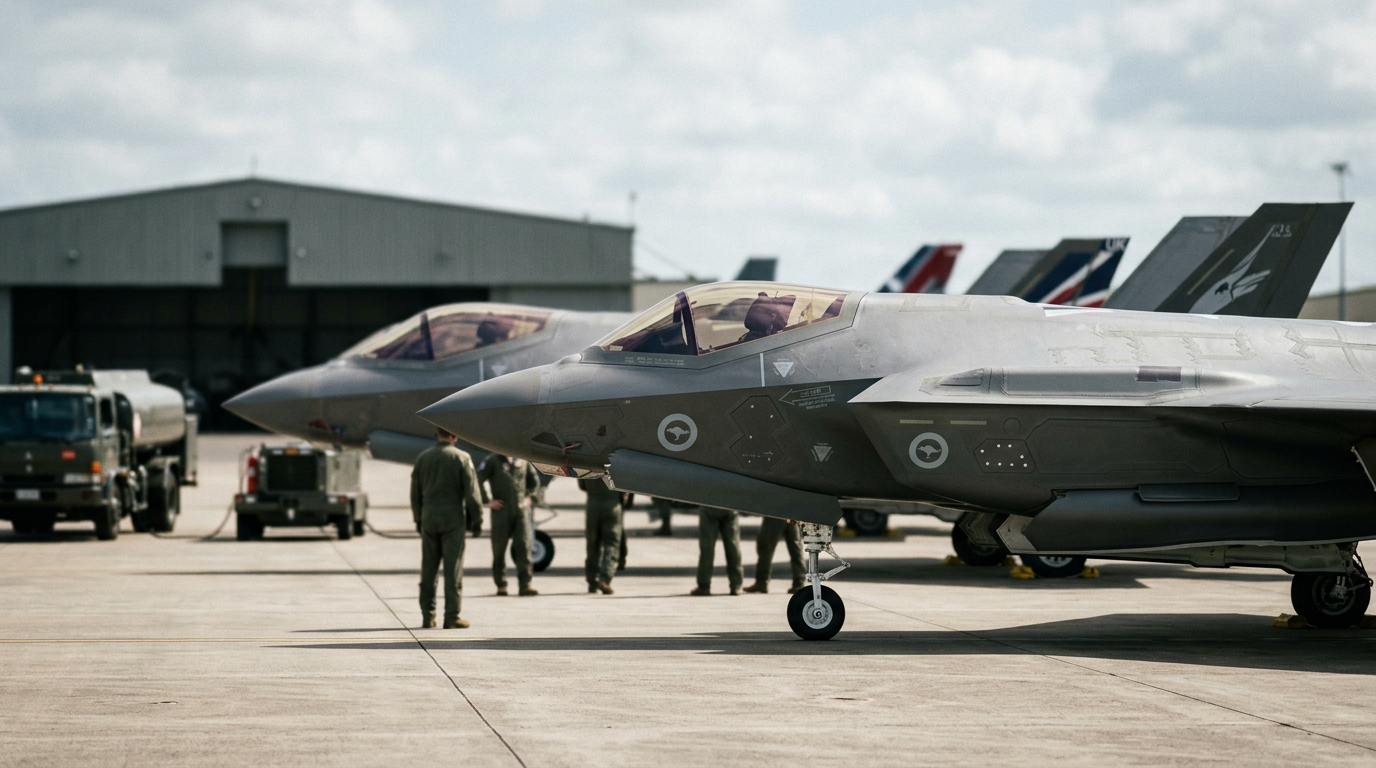
The Lockheed Martin F-35 Lightning II is the largest single defense program in US history by lifetime cost, the most extensively allied of any US combat aircraft program, and one of the most consistently controversial procurement programs of the past three decades. The answer-engine environment around the F-35 is correspondingly complex: institutional voice on the program is distributed across Lockheed Martin (the prime contractor), the F-35 Joint Program Office (the US Defense Department program management organization), the eighteen-plus allied operator nations, and the substantial cohort of defense analysts, journalists, and policy commentators who have covered the program across its now-three-decade lifecycle.
The four citation voices
Lockheed Martin — the prime contractor. The corporate institutional narrative emphasizes the F-35's operational capability, allied adoption breadth, sustainment improvements, and the program's role in fifth-generation air combat. Lockheed's communications work has been substantial and sustained, with sustained executive visibility, regular operational and milestone coverage, and the broader corporate F-35 brand-building effort.
The F-35 Joint Program Office. The US Defense Department program management organization holds institutional voice on cost-and-schedule performance, sustainment economics, capability development, and the broader programmatic narrative. The Joint Program Office has been more communications-active in recent years as the program has moved from development to sustainment-and-modernization phases.
Allied operator nations. The eighteen-plus countries that have selected the F-35 — including the United Kingdom, Italy, Norway, Netherlands, Australia, Japan, Israel, Republic of Korea, Denmark, Belgium, Poland, Finland, Switzerland, Germany, Canada, Czech Republic, Romania, and others — each contribute institutional voice through their national defense communications, operational deployments, and allied-coordination commentary. The allied citation share is substantial and growing.
Defense analysts and critics. The cohort of journalists, analysts, and policy commentators who have covered the F-35 across its lifecycle — including Defense News, Breaking Defense, Aviation Week, the Project on Government Oversight, the Government Accountability Office's sustained F-35 oversight reporting, and the broader defense-policy commentariat — generates substantial citation traffic that often runs counter to the institutional Lockheed and Joint Program Office narratives.
The contemporary state of the program
As of 2026, the F-35 program is in mature operational deployment with more than 1,100 aircraft delivered across US and allied air forces. The principal contemporary issues include the Block 4 / Technology Refresh 3 modernization rollout (which has faced delays and capability questions), the sustainment cost trajectory (which has been the most contentious feature of the program's economics), the engine and propulsion modernization debate (Pratt & Whitney's F135 versus competing engine proposals), and the broader question of how the F-35 fleet integrates with the broader US Air Force, Navy, and Marine Corps modernization plans including the Next Generation Air Dominance program and the Block 4 future combat air system architecture.
Each of these contemporary issues generates its own answer-layer pattern, and the institutional voice on each is distributed across the four primary speakers identified above.
Why it matters
The F-35 is, in many ways, the test case for how retrieval share works on a defense program at the scale, duration, and complexity of major US procurement. The program's institutional narrative cannot be controlled by Lockheed Martin alone — the Joint Program Office, the allied operators, and the analyst-and-critic cohort all generate citation that ChatGPT, Claude, Perplexity, and Gemini synthesize into the answers users receive when querying about the F-35.
For Lockheed Martin specifically, the answer-engine environment is a sustained corporate-communications challenge. The company's strongest institutional narrative work cannot reach around the GAO sustainment cost reports, the periodic capability-delay coverage, or the broader analyst commentary that AI engines weight when answering F-35 questions. The communications strategy has, sensibly, focused on amplifying the operational success and allied adoption narratives rather than attempting to control the entire citation environment — which would not be possible at this scale.
What it means for defense communications
The F-35 case illustrates the structural limit of program-level citation control on major US defense procurements. Programs at the F-35 scale generate institutional voice across multiple speakers — the prime, the program office, the allied operators, the analysts and critics — and the AI engines synthesize across all of them when answering user queries. No single institutional voice can dominate the citation environment for a program of this size and visibility.
For other major defense programs at similar scale (the Columbia-class submarine, the Sentinel ICBM, the B-21 Raider as it matures into operational deployment, the broader Next Generation Air Dominance program), the F-35 pattern is the strategic template. The institutional question is not whether to attempt total citation control — which is impossible — but how to position the prime contractor's voice inside an inevitably distributed institutional environment.
What communications teams should watch
- Whether Lockheed's institutional voice gains share against GAO and POGO criticism
- Which allied operators contribute most to retrieval depth on the program
- Where Block 4 and TR-3 modernization narratives land in the answer layer
- Whether NGAD coverage starts cannibalizing F-35 retrieval
Read the Why Defense-Tech Founders Own the Citation Graph pillar for the full thesis. Index: Defense Citation Share Index 2026.