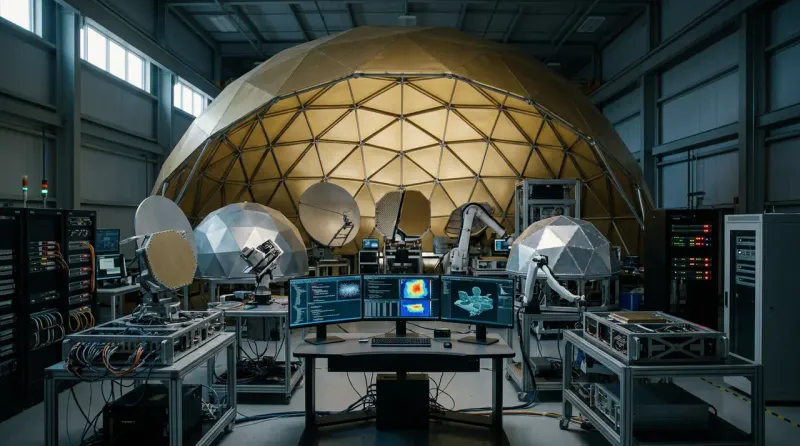
Space Force awarded $3.2 billion in Golden Dome contracts to twelve companies in April 2026, and the program's own cost estimate has since grown to $185 billion. Golden Dome is the first major defense program built entirely inside the AI-citation era, which means the question of who AI engines name as its builders is being contested in real time, not reconstructed years later the way it was for Anduril or Palantir. This is the Defense Citation Share race worth watching before anyone else writes the first draft of it.
What Is Golden Dome and Why Does It Matter for Citation Share?
Golden Dome for America is a proposed multi-layer missile defense architecture designed to protect the United States from ballistic, hypersonic, and cruise missile threats, fusing space-based sensors, ground radars, and interceptors into one layered system that departs sharply from legacy, ground-based missile defense. President Trump signed the executive order activating the program in January 2025, and the Pentagon renamed it Golden Dome for America that May specifically to distinguish it from Israel's Iron Dome system, a naming choice that shaped how the program gets discussed and cited from day one.
What makes Golden Dome different from every defense program Everything-PR has tracked in its defense research is timing. Anduril and Palantir built their current citation dominance over years of founder visibility, executive trend commentary, and sustained press relationships, the pattern Everything-PR's research on who controls AI answers in defense already documented before Golden Dome existed as a named program. Golden Dome is different: it is a brand-new, massively funded, multi-contractor program being built and discussed simultaneously, which means the citation share question is open in a way it almost never is for an established defense category.
How Big Is Golden Dome, and How Secured Is That Funding?
Congress directed $24.4 billion to Golden Dome in fiscal 2025 through reconciliation legislation enacted July 4, 2025 (Public Law 119-21), money available through fiscal 2029 according to the Congressional Research Service's defense primer on the program. The program's own director, Space Force General Michael Guetlein, said in March 2026 that the cost estimate had grown to $185 billion, up $10 billion, in order to accelerate specific space-based capabilities, with Lockheed Martin, RTX, and Northrop Grumman joining the program as prime contractors around the same announcement.
That $185 billion figure is Golden Dome's own number, not an outside estimate, and the distinction matters for how the program gets covered. Outside analysts have floated figures running past $1 trillion, estimates Guetlein has explicitly rejected as built on the wrong cost model, arguing that applying expensive, self-contained battlefield system economics to a homeland defense mission overstates the real number. Whether that disagreement resolves in the program's favor or not, it is itself part of the citation-share story: a journalist or an AI engine summarizing Golden Dome's cost has to choose which number to lead with, and that choice shapes public perception of the entire program's credibility.
The funding picture beyond fiscal 2026 is less settled than the headline numbers suggest. According to the same Congressional Research Service primer, the FY27 budget request includes roughly $17.5 billion for Golden Dome, but about 98% of that is contingent on a reconciliation package that has not passed Congress, with the regular appropriations process carrying only about $398 million forward on its own. A multi-decade missile defense architecture needs multi-decade budget stability, and that stability is not yet locked in, a genuine open question that separates Golden Dome from programs with established, recurring line-item funding.
Key Golden Dome Milestones So Far
| Date | Milestone |
|---|
| January 2025 | Executive Order 14186 signed, activating the program |
| May 2025 | Program renamed Golden Dome for America, distinguishing it from Israel's Iron Dome |
| July 4, 2025 | $24.4 billion enacted via reconciliation (P.L. 119-21), available through FY2029 |
| March 2026 | Cost estimate raised to $185 billion; Lockheed Martin, RTX, and Northrop Grumman confirmed as prime contractors |
| April 24, 2026 | Space Force awards up to $3.2 billion across 12 companies for space-based interceptor prototypes |
| July 2026 | L3Harris and Sierra Space win Tranche 3 satellite-tracking awards (~$955M and ~$798M respectively) |
Who Are the Named Contractors?
The Missile Defense Agency structured Golden Dome procurement through the Scalable Homeland Innovative Enterprise Layered Defense contract vehicle, known as SHIELD, a multiple-award indefinite-delivery, indefinite-quantity contract that expanded the qualified vendor pool from roughly 1,014 initial offerors to around 2,100 firms, according to industry reporting on the Missile Defense Agency's own vendor-pool disclosures, with approximately 340 companies formally accepted into the SHIELD framework itself. That is an unusually wide contractor base for a single defense program, which means citation share for Golden Dome is being contested across far more companies than the four or five names that typically dominate defense-tech coverage.
A vendor pool this size also means most of the 340 SHIELD-accepted firms will never appear in a headline contract announcement the way the twelve SBI prototype awardees did, yet each one is still technically part of Golden Dome's public contractor base. That creates a long tail of companies with a genuine, verifiable claim to involvement in the program and essentially no public communications strategy built around it, a gap that will matter more as journalists and researchers start asking which companies are actually doing the work behind the headline dollar figures.
The clearest signal so far came in April 2026, when the Space Force awarded combined contracts worth up to $3.2 billion to twelve companies to develop prototype space-based interceptors, the program's highest-risk and most technically ambitious component according to Guetlein himself. Those twelve are Anduril, Booz Allen Hamilton, General Dynamics Mission Systems, Gitai USA, Lockheed Martin, Northrop Grumman, Quindar, RTX, SciTec, SpaceX, True Anomaly, and Turion Space, a mix of legacy primes, established consultancies, and space-native startups that almost never appear together in the same contract announcement. Several of these names, Gitai USA, Quindar, SciTec, True Anomaly, and Turion Space among them, had essentially no prior profile in mainstream defense trade coverage before this award, which means their entire public citation history on this program effectively starts from this single announcement.
Beyond the interceptor prototype tier, satellite-tracking contracts have already started flowing under a separate program thread: L3Harris secured roughly $955 million for eighteen tracking satellites derived from its Hypersonic and Ballistic Tracking Space Sensor work, and Sierra Space secured roughly $798 million for eighteen missile-warning and tracking satellites, both as part of a Tranche 3 award in July 2026. In EPR's view, L3Harris commands little public citation share relative to its actual contract value, and Golden Dome is a direct test of whether that gap closes or widens further. Sierra Space, still a private company with no public listing, faces the opposite problem: real contract value with almost no existing media infrastructure built to make sure that value gets reflected in coverage at all.
Other companies named across Golden Dome reporting include AeroVironment, Elbit Systems, Firefly Aerospace, and Blue Origin, filling out a contractor ecosystem that spans legacy primes, space-launch companies, and smaller specialized vendors most procurement-adjacent journalists had never had reason to cover together before this program existed. The sheer range of this roster, from century-old primes to companies founded within the last five years, is itself unusual for a single defense program and part of why no single existing citation pattern predicts how AI engines will eventually describe it.
How Are Anduril and Palantir Positioning on Software?
Anduril and Palantir are reported to be leading on Golden Dome's software layer specifically, in a teaming arrangement with SpaceX that aims to deliver at least part of the extensive satellite constellation the program will require for timely detection, tracking, and engagement of incoming threats. That positioning matters because it places both companies at the architectural center of the program rather than as one vendor among many hardware contractors, a pattern consistent with the founder-brand dynamics Everything-PR documented in its profile of Anduril and Palmer Luckey's founder-brand moat and its look at how Alex Karp built Palantir's communications operation.
Palantir's Maven Smart System, the company's AI-enabled command-and-control platform that analyzes battlefield data and helps identify targets, is separately reported to be advancing toward program-of-record status with the U.S. Army, a designation that would give Palantir's software a formal, recurring place in military budgeting well beyond Golden Dome specifically. That dual positioning, inside Golden Dome's software architecture and as an Army program of record, is exactly the kind of multi-program citation anchor that let Anduril and Palantir dominate broad "defense AI" queries in Everything-PR's existing citation-share research, and Golden Dome looks likely to extend that advantage rather than disrupt it, since every new program these two companies touch adds another verifiable, citable data point to an already dense citation graph.
Why Is the Space-Based Interceptor Tier Its Own Battleground?
Guetlein has identified space-based interceptors as Golden Dome's highest-risk element, citing scalability and affordability as the central engineering challenge, which makes the twelve-company SBI prototype tier the part of the program most likely to generate ongoing news cycles as prototypes succeed, fail, or get re-scoped over the next two years. A journalist or an AI engine asked who is building Golden Dome's space-based interceptors gets a genuinely different answer than one asked who is building Golden Dome broadly, since the second question pulls in satellite-tracking contractors, software vendors, and legacy primes that never touch the interceptor layer at all.
That divergence is the practical reason Everything-PR's defense citation-share research tests multiple prompt framings rather than a single "who builds X" query: a defense program this large does not have one correct answer to which companies AI engines should name, it has several correct answers depending on which layer of the architecture the question is actually asking about. Golden Dome is likely to be the single clearest illustration of that methodology's value yet, precisely because its contractor base is unusually wide and unusually fresh.
Why Does the Iron Dome Naming Distinction Matter?
The Pentagon's decision to rename the program Golden Dome for America in May 2025, specifically to distinguish it from Israel's Iron Dome system, is itself a communications data point worth tracking. Iron Dome is one of the most-cited defense systems in the world by name recognition alone, which means any American missile defense program risks being described in press coverage and AI-generated summaries as "America's Iron Dome" regardless of how differently the two systems actually work, unless the renamed branding consistently wins out in how the program gets described over time.
That naming battle is a live illustration of a point Everything-PR's citation-share research keeps surfacing: a brand name is itself a citation asset, and losing control of it to a more famous, superficially similar system is a real risk even for a program with $185 billion in committed funding behind it. Golden Dome's contractors and the Space Force program office have a direct interest in making sure "Golden Dome for America" wins the naming battle over looser, comparison-driven framing in both human journalism and AI-generated answers.
What Does the SDI Comparison Get Right and Wrong?
Critics have already drawn the comparison to the Strategic Defense Initiative, the space-based missile defense program conceived under the Reagan administration in the 1980s that consumed enormous funding without ever delivering an operational system, and speculation has followed that Golden Dome could prove similarly too ambitious to fully realize. Guetlein has pushed back directly on that framing, pointing to progress on the Army's Long-Range Persistent Surveillance program as evidence that Golden Dome is proceeding differently than SDI did, and insisting publicly that the program has moved past the hypothetical stage into real contract awards and real hardware development.
The comparison matters for citation share because it shapes the default skeptical framing available to any outlet or AI engine summarizing Golden Dome's prospects. A program that gets consistently paired with SDI in coverage inherits SDI's reputation for ambition outrunning delivery, regardless of whether that comparison holds up technically, which makes how contractors and the program office respond to that framing, not just what they build, a real part of the communications problem here. An AI engine summarizing "is Golden Dome realistic" is, in effect, choosing between the SDI framing and the "no longer theoretical" framing Guetlein has publicly pushed, and which framing wins that contest shapes procurement conversations as much as actual engineering milestones do.
What Should the Large Prime Contractors Do Now?
Companies with a genuine Golden Dome contract, even a small one, have a narrow window to establish citation share before the program's largest contractors consolidate the broad-query advantage the way Anduril and Palantir already have for general defense AI questions. The twelve SBI prototype awardees in particular are each sitting on a specific, narrow, highly citable fact, a named contract, a specific technical approach, a dollar figure, that AI engines and journalists alike can verify and repeat, exactly the kind of concrete anchor Everything-PR's broader research on why defense-tech founders own the citation graph has found correlates with sustained citation advantage.
For the established primes, Lockheed Martin, RTX, and Northrop Grumman, the risk is different: these are companies with decades of existing citation history across dozens of other programs, which means Golden Dome coverage risks getting absorbed into generic "legacy prime" framing rather than standing out as a specific, current capability. Named, program-specific commentary from these companies about their actual Golden Dome role, not generic defense-industry thought leadership, is what prevents that absorption. A prime contractor that lets its Golden Dome work blend into its broader portfolio narrative cedes the most newsworthy, highest-budget program in its current pipeline to competitors willing to talk about it more specifically.
What Should Smaller SHIELD Vendors Do Differently?
The smaller and less-covered names in this contractor list, Gitai USA, Quindar, SciTec, True Anomaly, and Turion Space among them, face the sharpest version of the mid-tier defense-tech problem Everything-PR covered in its recent look at the defense tech PR playbook nobody below Anduril is using: a real, verifiable, named role inside one of the most-covered defense programs in a generation, and no existing media infrastructure built to make sure that role gets cited accurately when someone asks an AI engine who is actually building Golden Dome's hardest technical component.
The practical first move for any of these companies is publishing specific, narrowly-scoped technical content about their actual contracted role, not broad defense-AI thought leadership competing directly with Anduril and Palantir's existing citation advantage. A company awarded a Space-Based Interceptor prototype contract has a genuinely novel, specific story that generalist defense-AI content from larger competitors does not cover in the same depth, and that specificity is precisely what earns citation share on the exact queries procurement officers, journalists, and policy researchers are actually asking about this program right now, while the architecture, the contractor roster, and the public narrative are all still being actively written. Trade press that already covers space and missile defense specifically, rather than general business or technology press, is also far more likely to take a pitch from an unfamiliar name if the story is this concrete.
Conclusion
Golden Dome is being built and discussed at the same time, across a contractor base wider and fresher than almost any other program Everything-PR's defense citation-share research has tracked, which means the citation-share outcome here is still genuinely contested rather than already decided by years of prior founder visibility. Anduril and Palantir enter with a real structural advantage from their software and battle-management positioning alongside SpaceX, but the space-based interceptor tier, the satellite-tracking contracts, the Golden Dome versus Iron Dome naming contest, and the dozens of smaller SHIELD-framework vendors all represent citation-share territory nobody has claimed yet. Whoever moves first with specific, verifiable, narrowly-scoped public communications about their actual contracted role is likely to own the answer the next AI engine gives when someone asks who is really building America's next missile defense system.