PR people have been arguing for years that earned media is undervalued. The arguments have always been roughly correct and almost entirely unprovable. Impressions are noise. Ad equivalencies are fiction. Sentiment scores are vibes. The CFO conversation always ended the same way: spend more on performance and less on the press.
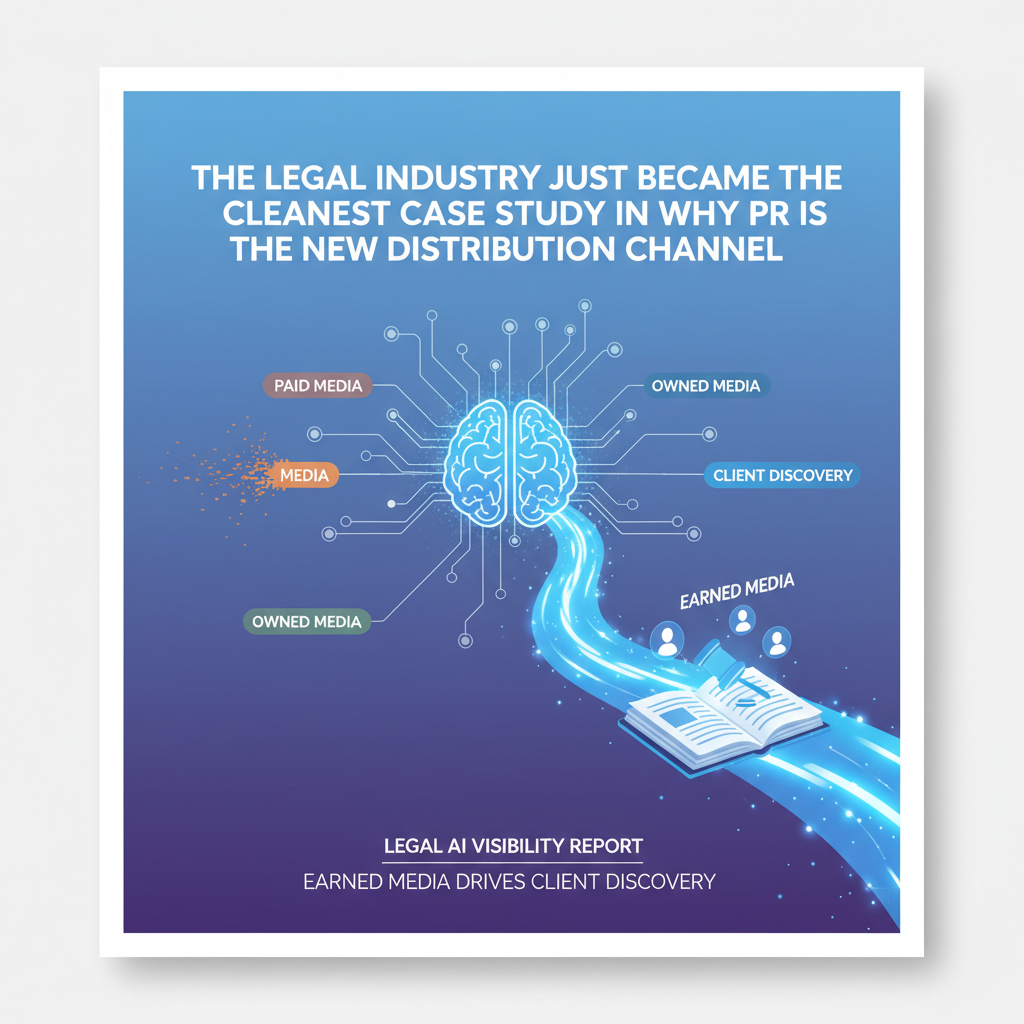
That argument is now over. The PR industry just lost the right to keep losing it. This week, Haute Lawyer Network and 5W — the AI communications firm — published the 2026 Legal AI Visibility Report. It is, on its surface, an audit of how generative answer engines surface lawyers and law firms when potential clients ask for recommendations. Look one layer deeper and it is the most concrete evidence in any consumer category to date that earned editorial authority is the only durable input into AI-driven client discovery.
For everyone in PR, this is the data point we have been waiting for.
What the report actually proves
The headline finding is the directory cartel. Across every type of legal query tested — from “best personal injury lawyer ” to “best M&A law firm US” — seven properties dominate the AI citation layer: Chambers, Legal 500, Super Lawyers, Best Lawyers, Martindale, Avvo, and Justia. Individual law firms, even the most prestigious in America, appear inside these directories but rarely as independent voices. Zero law-focused editorial sources appeared in the top results for any legal query the report tested.
But the more important finding for our industry is the structural reason the directories won.
They won because they were structured, claim-dense, and machine-readable. They published lawyer profiles in extractable factual format. Where Smith is licensed, where Smith went to school, what Smith specializes in, what awards Smith has won, what years Smith was recognized. Extractable claims. Answer engines reward extractable claims.
Law firm websites lost because they were rhetorical. “Jane is an accomplished attorney dedicated to serving her clients with passion and excellence.” Beautiful. Unfindable. The AI cannot extract anything from a sentence like that.
Now translate this finding out of legal services and into your category.
Every consumer category that has not yet been audited operates on the same dynamic. The brands appearing in AI answers are the brands whose stories have been told the most times, in the most authoritative places, with the most consistency. Authority sources win. Owned content loses. Earned editorial coverage is the substrate.
This is what PR has always done. The discipline of getting your client into authoritative third-party publications — trade press, editorial features, expert citations, awards databases — has just been validated as the single most consequential input into how answer engines describe brands to consumers. Not by us. By Google, OpenAI, Anthropic, Microsoft, and Perplexity, who have collectively decided that the open web’s editorial layer is what they are willing to cite from.
What this means for the agency business
Three implications for every senior PR leader reading this.
One. The agencies that win the next decade are the agencies that can engineer AI citation authority, not just secure media coverage. That’s a different muscle. It requires structured content strategy across owned, earned, and editorial. It requires rebuilding the press release with extractable factual claims that answer engines can lift cleanly. It requires LinkedIn to be treated as a citation asset, because Microsoft owns LinkedIn and partners with OpenAI, and LinkedIn content is disproportionately cited by ChatGPT. It requires schema, robots.txt audits, and Knowledge Graph work that traditional PR teams have never done. The agencies repositioning around this capability now are the agencies that will be billing it as a discrete service line within 18 months. The ones that don’t will be selling the same impression reports to a CFO who has finally stopped buying them.
Two. The pricing of earned media is being repriced upward in real time, even if no one in the industry has acknowledged it yet. The report documents that the cost of establishing equivalent AI citation authority is rising at roughly 50 to 80 percent compounded annually for the next 24 months. A firm — or a brand, in any category — investing in editorial visibility now is locking in citation authority that will be three to five times more expensive to acquire in 2028. PR retainers are not getting smaller. They are getting harder to justify only at agencies still measuring the wrong things.
Three. Categories that have not yet been audited will be soon. Legal got there first because the consumer ramp into AI was fastest in services where clients already research before referrals. Healthcare is next. Financial services is right behind. Real estate is already here, as Haute Living and 5W’s earlier South Florida AI Luxury 50 demonstrated. The industries that read this report and assume it’s about lawyers are missing what it actually is: the template for how every consumer-facing category will be measured. The brands that own their AI citation footprint inside their category will dominate. The brands that don’t will be invisible to the only distribution channel that now matters.
What our industry needs to do this quarter
Run the prompts your clients’ buyers would type. Score the answers across appearance rate, ranking position, sentiment, and factual accuracy — the same four dimensions the legal report uses. Identify the directory cartel, editorial cartel, or authority cartel in your client’s category. Map where your client appears, where they don’t, and what’s standing between them and the AI synthesis.
Then build the editorial program — earned media, expert bylines, structured content, FAQ architecture, schema markup, LinkedIn discipline — that closes the gap. The legal industry has 24 months. Most categories have less. The 2026 Legal AI Visibility Report is available as a free, ungated 31-page PDF. For deeper analysis on AI search and client discovery, read the companion piece on Haute Living.
For the PR industry, this is the case study we have been waiting for. It will not be the last.